

170
5 Direct Searches for New Physics
Events / 100 GeV
10
20
30
40
50
60
70
Data
Top quark
QCD multijet
Total uncertainty
bW
→
Tt, T
→
Z'
=0.7 TeV
T
=1.5 TeV, m
Z'
m
=0.9 TeV
T
=2.0 TeV, m
Z'
m
=1.2 TeV
T
=2.5 TeV, m
Z'
m
2 b-tag category
(13 TeV)
-1
2.6 fb
CMS
[GeV]
Z'
m
500 1000 1500 2000 2500 3000 3500
σ
Data-MC
2
−
0
2
Events / 100 GeV
20
40
60
80
100
120
140
160
Data
Top quark
QCD multijet
Total uncertainty
bW
→
Tt, T
→
Z'
=0.7 TeV
T
=1.5 TeV, m
Z'
m
=0.9 TeV
T
=2.0 TeV, m
Z'
m
=1.2 TeV
T
=2.5 TeV, m
Z'
m
2 b-tag category
(13 TeV)
-1
2.6 fb
CMS
[GeV]
T
m
500 1000 1500 2000 2500 3000 3500
σ
Data-MC
2
−
0
2
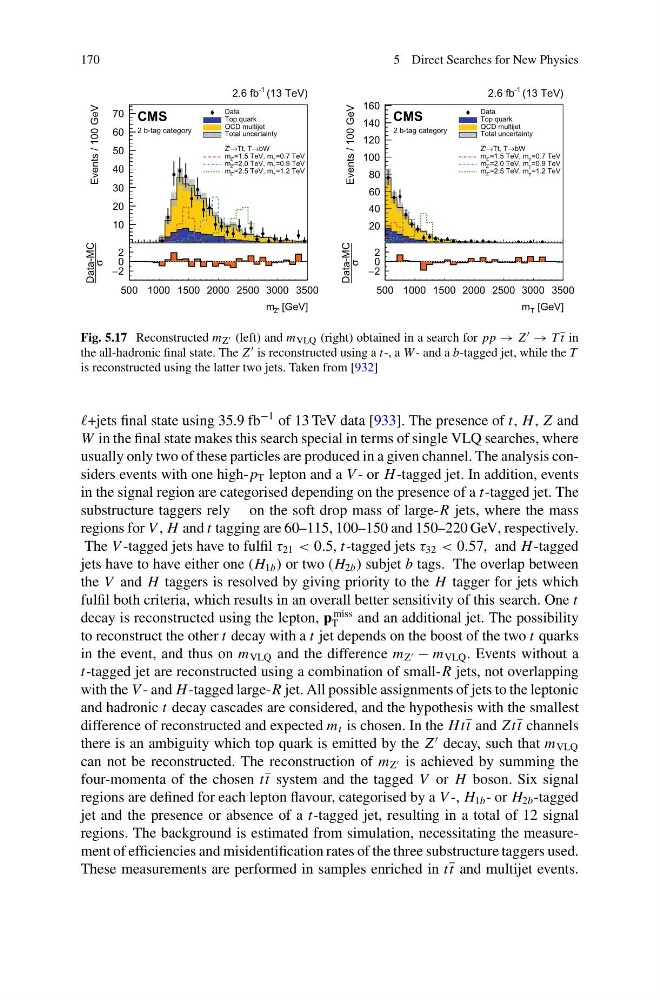
Fig. 5.17 Reconstructed m Z (left) and m VLQ (right) obtained in a search for pp → Z → T t in
the all-hadronic final state. The Z is reconstructed using a t-, a W - and a b-tagged jet, while the T
is reconstructed using the latter two jets. Taken from [932]
+jets final state using 35.9 fb
−1 of 13 TeV data [933]. The presence of t, H , Z and
W in the final state makes this search special in terms of single VLQ searches, where
usually only two of these particles are produced in a given channel. The analysis considers events with one high- p T lepton and a V - or H -tagged jet. In addition, events
in the signal region are categorised depending on the presence of a t-tagged jet. The
substructure taggers rely on the soft drop mass of large-R jets, where the mass
regions for V , H and t tagging are 60–115, 100–150 and 150–220 GeV, respectively.
The V -tagged jets have to fulfil τ 21 < 0.5, t-tagged jets τ 32 < 0.57, and H -tagged
jets have to have either one (H 1b ) or two (H 2b ) subjet b tags. The overlap between
the V and H taggers is resolved by giving priority to the H tagger for jets which
fulfil both criteria, which results in an overall better sensitivity of this search. One t
decay is reconstructed using the lepton, p
miss
T
and an additional jet. The possibility
to reconstruct the other t decay with a t jet depends on the boost of the two t quarks
in the event, and thus on m VLQ and the difference m Z − m VLQ . Events without a
t-tagged jet are reconstructed using a combination of small-R jets, not overlapping
with the V - and H -tagged large-R jet. All possible assignments of jets to the leptonic
and hadronic t decay cascades are considered, and the hypothesis with the smallest
difference of reconstructed and expected m t is chosen. In the Htt and Ztt channels
there is an ambiguity which top quark is emitted by the Z
decay, such that m VLQ
can not be reconstructed. The reconstruction of m Z is achieved by summing the
four-momenta of the chosen tt system and the tagged V or H boson. Six signal
regions are defined for each lepton flavour, categorised by a V -, H 1b - or H 2b -tagged
jet and the presence or absence of a t-tagged jet, resulting in a total of 12 signal
regions. The background is estimated from simulation, necessitating the measurement of efficiencies and misidentification rates of the three substructure taggers used.
These measurements are performed in samples enriched in tt and multijet events.
5 Direct Searches for New Physics
Events / 100 GeV
10
20
30
40
50
60
70
Data
Top quark
QCD multijet
Total uncertainty
bW
→
Tt, T
→
Z'
=0.7 TeV
T
=1.5 TeV, m
Z'
m
=0.9 TeV
T
=2.0 TeV, m
Z'
m
=1.2 TeV
T
=2.5 TeV, m
Z'
m
2 b-tag category
(13 TeV)
-1
2.6 fb
CMS
[GeV]
Z'
m
500 1000 1500 2000 2500 3000 3500
σ
Data-MC
2
−
0
2
Events / 100 GeV
20
40
60
80
100
120
140
160
Data
Top quark
QCD multijet
Total uncertainty
bW
→
Tt, T
→
Z'
=0.7 TeV
T
=1.5 TeV, m
Z'
m
=0.9 TeV
T
=2.0 TeV, m
Z'
m
=1.2 TeV
T
=2.5 TeV, m
Z'
m
2 b-tag category
(13 TeV)
-1
2.6 fb
CMS
[GeV]
T
m
500 1000 1500 2000 2500 3000 3500
σ
Data-MC
2
−
0
2
Fig. 5.17 Reconstructed m Z (left) and m VLQ (right) obtained in a search for pp → Z → T t in
the all-hadronic final state. The Z is reconstructed using a t-, a W - and a b-tagged jet, while the T
is reconstructed using the latter two jets. Taken from [932]
+jets final state using 35.9 fb
−1 of 13 TeV data [933]. The presence of t, H , Z and
W in the final state makes this search special in terms of single VLQ searches, where
usually only two of these particles are produced in a given channel. The analysis considers events with one high- p T lepton and a V - or H -tagged jet. In addition, events
in the signal region are categorised depending on the presence of a t-tagged jet. The
substructure taggers rely on the soft drop mass of large-R jets, where the mass
regions for V , H and t tagging are 60–115, 100–150 and 150–220 GeV, respectively.
The V -tagged jets have to fulfil τ 21 < 0.5, t-tagged jets τ 32 < 0.57, and H -tagged
jets have to have either one (H 1b ) or two (H 2b ) subjet b tags. The overlap between
the V and H taggers is resolved by giving priority to the H tagger for jets which
fulfil both criteria, which results in an overall better sensitivity of this search. One t
decay is reconstructed using the lepton, p
miss
T
and an additional jet. The possibility
to reconstruct the other t decay with a t jet depends on the boost of the two t quarks
in the event, and thus on m VLQ and the difference m Z − m VLQ . Events without a
t-tagged jet are reconstructed using a combination of small-R jets, not overlapping
with the V - and H -tagged large-R jet. All possible assignments of jets to the leptonic
and hadronic t decay cascades are considered, and the hypothesis with the smallest
difference of reconstructed and expected m t is chosen. In the Htt and Ztt channels
there is an ambiguity which top quark is emitted by the Z
decay, such that m VLQ
can not be reconstructed. The reconstruction of m Z is achieved by summing the
four-momenta of the chosen tt system and the tagged V or H boson. Six signal
regions are defined for each lepton flavour, categorised by a V -, H 1b - or H 2b -tagged
jet and the presence or absence of a t-tagged jet, resulting in a total of 12 signal
regions. The background is estimated from simulation, necessitating the measurement of efficiencies and misidentification rates of the three substructure taggers used.
These measurements are performed in samples enriched in tt and multijet events.