

4.2 Measurements Using Jet Substructure
111
100
200
300
400
500
Events / 10 GeV
Data
=0.72)
VH
μ
(
b
b
→
VH, H
=0.91)
VZ
μ
Diboson (
t
t
Wt
W+jets
Z+jets
Multijet
Uncertainty
2
×
b
b
→
VH, H
ATLAS
-1
= 13 TeV, 139 fb
s
1 large-R jets, SR
≥
1 lep.,
400 GeV
<
V
T
p
≤
250 GeV
60
80
100 120 140 160 180 200
[GeV]
J
m
0.5
1
1.5
Data/Pred.
Mass (GeV)
0 20 40 60 80 100 120 140 160 180 20
-1
Events / 8GeV / 30fb
0
5
10
15
20
25
30
35
q
q
V+jets
VV
V+Higgs
B
9
.
2
=
S/
in 112-128GeV
(c)
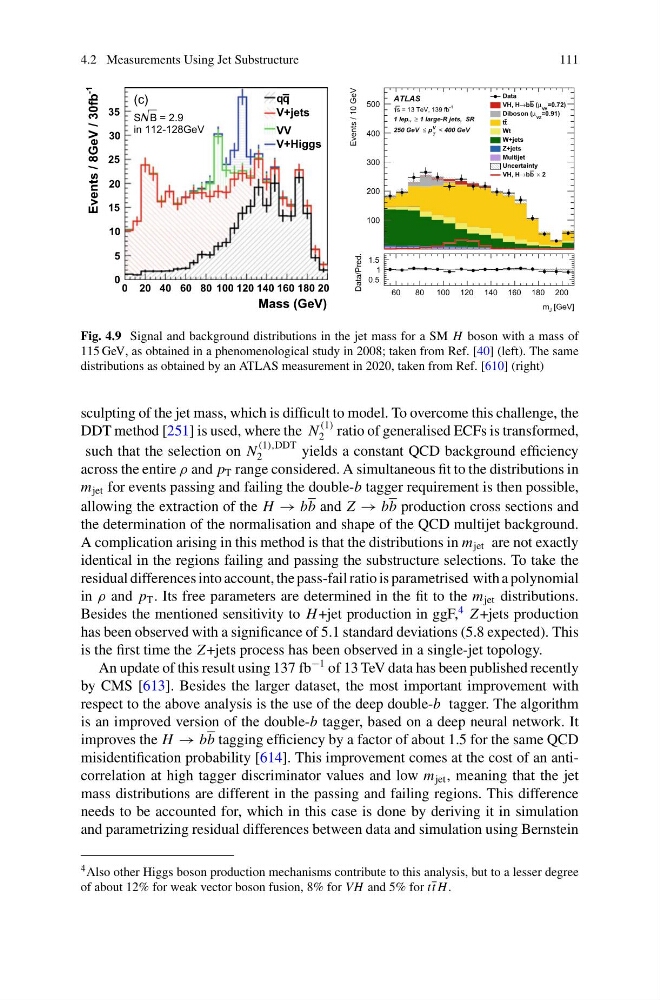
Fig. 4.9 Signal and background distributions in the jet mass for a SM H boson with a mass of
115 GeV, as obtained in a phenomenological study in 2008; taken from Ref. [40] (left). The same
distributions as obtained by an ATLAS measurement in 2020, taken from Ref. [610] (right)
sculpting of the jet mass, which is difficult to model. To overcome this challenge, the
DDT method [251] is used, where the N
(1)
2 ratio of generalised ECFs is transformed,
such that the selection on N
(1),DDT
2
yields a constant QCD background efficiency
across the entire ρ and p T range considered. A simultaneous fit to the distributions in
m jet for events passing and failing the double-b tagger requirement is then possible,
allowing the extraction of the H → bb and Z → bb production cross sections and
the determination of the normalisation and shape of the QCD multijet background.
A complication arising in this method is that the distributions in m jet are not exactly
identical in the regions failing and passing the substructure selections. To take the
residual differences into account, the pass-fail ratio is parametrised with a polynomial
in ρ and p T . Its free parameters are determined in the fit to the m jet distributions.
Besides the mentioned sensitivity to H +jet production in ggF,
4 Z +jets production
has been observed with a significance of 5.1 standard deviations (5.8 expected). This
is the first time the Z +jets process has been observed in a single-jet topology.
An update of this result using 137 fb
−1 of 13 TeV data has been published recently
by CMS [613]. Besides the larger dataset, the most important improvement with
respect to the above analysis is the use of the deep double-b tagger. The algorithm
is an improved version of the double-b tagger, based on a deep neural network. It
improves the H → bb tagging efficiency by a factor of about 1.5 for the same QCD
misidentification probability [614]. This improvement comes at the cost of an anticorrelation at high tagger discriminator values and low m jet , meaning that the jet
mass distributions are different in the passing and failing regions. This difference
needs to be accounted for, which in this case is done by deriving it in simulation
and parametrizing residual differences between data and simulation using Bernstein
4 Also other Higgs boson production mechanisms contribute to this analysis, but to a lesser degree
of about 12% for weak vector boson fusion, 8% for VH and 5% for tt H.
111
100
200
300
400
500
Events / 10 GeV
Data
=0.72)
VH
μ
(
b
b
→
VH, H
=0.91)
VZ
μ
Diboson (
t
t
Wt
W+jets
Z+jets
Multijet
Uncertainty
2
×
b
b
→
VH, H
ATLAS
-1
= 13 TeV, 139 fb
s
1 large-R jets, SR
≥
1 lep.,
400 GeV
<
V
T
p
≤
250 GeV
60
80
100 120 140 160 180 200
[GeV]
J
m
0.5
1
1.5
Data/Pred.
Mass (GeV)
0 20 40 60 80 100 120 140 160 180 20
-1
Events / 8GeV / 30fb
0
5
10
15
20
25
30
35
q
q
V+jets
VV
V+Higgs
B
9
.
2
=
S/
in 112-128GeV
(c)
Fig. 4.9 Signal and background distributions in the jet mass for a SM H boson with a mass of
115 GeV, as obtained in a phenomenological study in 2008; taken from Ref. [40] (left). The same
distributions as obtained by an ATLAS measurement in 2020, taken from Ref. [610] (right)
sculpting of the jet mass, which is difficult to model. To overcome this challenge, the
DDT method [251] is used, where the N
(1)
2 ratio of generalised ECFs is transformed,
such that the selection on N
(1),DDT
2
yields a constant QCD background efficiency
across the entire ρ and p T range considered. A simultaneous fit to the distributions in
m jet for events passing and failing the double-b tagger requirement is then possible,
allowing the extraction of the H → bb and Z → bb production cross sections and
the determination of the normalisation and shape of the QCD multijet background.
A complication arising in this method is that the distributions in m jet are not exactly
identical in the regions failing and passing the substructure selections. To take the
residual differences into account, the pass-fail ratio is parametrised with a polynomial
in ρ and p T . Its free parameters are determined in the fit to the m jet distributions.
Besides the mentioned sensitivity to H +jet production in ggF,
4 Z +jets production
has been observed with a significance of 5.1 standard deviations (5.8 expected). This
is the first time the Z +jets process has been observed in a single-jet topology.
An update of this result using 137 fb
−1 of 13 TeV data has been published recently
by CMS [613]. Besides the larger dataset, the most important improvement with
respect to the above analysis is the use of the deep double-b tagger. The algorithm
is an improved version of the double-b tagger, based on a deep neural network. It
improves the H → bb tagging efficiency by a factor of about 1.5 for the same QCD
misidentification probability [614]. This improvement comes at the cost of an anticorrelation at high tagger discriminator values and low m jet , meaning that the jet
mass distributions are different in the passing and failing regions. This difference
needs to be accounted for, which in this case is done by deriving it in simulation
and parametrizing residual differences between data and simulation using Bernstein
4 Also other Higgs boson production mechanisms contribute to this analysis, but to a lesser degree
of about 12% for weak vector boson fusion, 8% for VH and 5% for tt H.