

108
4 Standard Model Measurements
Jet Mass [GeV]
50
100
150
200
250
Jets / 2 GeV
0
5000
10000
15000
20000
25000
Data 2011
Signal + Background fit
Background fit component
Signal fit component
ATLAS
-1
= 7 TeV, 4.6 fb
s
| < 1.9
η
> 320 GeV |
T
p
L > 0.15
Jet Mass [GeV]
50 60 70 80 90 100 110 120 130 140
Data - Fit bkg
-200
0
200
400
600
800
1000
1200
1400
1600
1800
80 100 120 140
Events / 6 GeV
500
1000
1500
2000
2500
ATLAS
J
ν
l
→
WV
-1
= 8 TeV, 20.2 fb
s
Signal Region
Data
WV
V+Jets
Top quark
Multijet
Uncertainty
[GeV]
J
m
60
80
100
120
140
160
Bkg
Data-Bkg
-0.05
0
0.05
0.1
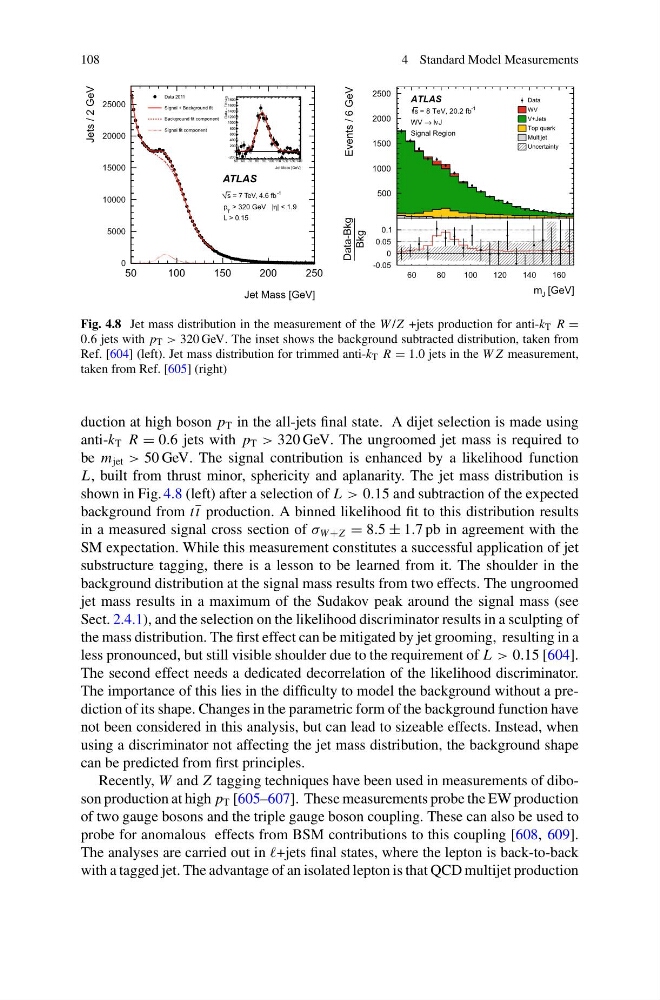
Fig. 4.8 Jet mass distribution in the measurement of the W /Z +jets production for anti-k T R =
0.6 jets with p T > 320 GeV. The inset shows the background subtracted distribution, taken from
Ref. [604] (left). Jet mass distribution for trimmed anti-k T R = 1.0 jets in the W Z measurement,
taken from Ref. [605] (right)
duction at high boson p T in the all-jets final state. A dijet selection is made using
anti-k T R = 0.6 jets with p T > 320 GeV. The ungroomed jet mass is required to
be m jet > 50 GeV. The signal contribution is enhanced by a likelihood function
L, built from thrust minor, sphericity and aplanarity. The jet mass distribution is
shown in Fig. 4.8 (left) after a selection of L > 0.15 and subtraction of the expected
background from tt production. A binned likelihood fit to this distribution results
in a measured signal cross section of σ W +Z = 8.5 ± 1.7 pb in agreement with the
SM expectation. While this measurement constitutes a successful application of jet
substructure tagging, there is a lesson to be learned from it. The shoulder in the
background distribution at the signal mass results from two effects. The ungroomed
jet mass results in a maximum of the Sudakov peak around the signal mass (see
Sect. 2.4.1), and the selection on the likelihood discriminator results in a sculpting of
the mass distribution. The first effect can be mitigated by jet grooming, resulting in a
less pronounced, but still visible shoulder due to the requirement of L > 0.15 [604].
The second effect needs a dedicated decorrelation of the likelihood discriminator.
The importance of this lies in the difficulty to model the background without a prediction of its shape. Changes in the parametric form of the background function have
not been considered in this analysis, but can lead to sizeable effects. Instead, when
using a discriminator not affecting the jet mass distribution, the background shape
can be predicted from first principles.
Recently, W and Z tagging techniques have been used in measurements of diboson production at high p T [605–607]. These measurements probe the EW production
of two gauge bosons and the triple gauge boson coupling. These can also be used to
probe for anomalous effects from BSM contributions to this coupling [608, 609].
The analyses are carried out in +jets final states, where the lepton is back-to-back
with a tagged jet. The advantage of an isolated lepton is that QCD multijet production
4 Standard Model Measurements
Jet Mass [GeV]
50
100
150
200
250
Jets / 2 GeV
0
5000
10000
15000
20000
25000
Data 2011
Signal + Background fit
Background fit component
Signal fit component
ATLAS
-1
= 7 TeV, 4.6 fb
s
| < 1.9
η
> 320 GeV |
T
p
L > 0.15
Jet Mass [GeV]
50 60 70 80 90 100 110 120 130 140
Data - Fit bkg
-200
0
200
400
600
800
1000
1200
1400
1600
1800
80 100 120 140
Events / 6 GeV
500
1000
1500
2000
2500
ATLAS
J
ν
l
→
WV
-1
= 8 TeV, 20.2 fb
s
Signal Region
Data
WV
V+Jets
Top quark
Multijet
Uncertainty
[GeV]
J
m
60
80
100
120
140
160
Bkg
Data-Bkg
-0.05
0
0.05
0.1
Fig. 4.8 Jet mass distribution in the measurement of the W /Z +jets production for anti-k T R =
0.6 jets with p T > 320 GeV. The inset shows the background subtracted distribution, taken from
Ref. [604] (left). Jet mass distribution for trimmed anti-k T R = 1.0 jets in the W Z measurement,
taken from Ref. [605] (right)
duction at high boson p T in the all-jets final state. A dijet selection is made using
anti-k T R = 0.6 jets with p T > 320 GeV. The ungroomed jet mass is required to
be m jet > 50 GeV. The signal contribution is enhanced by a likelihood function
L, built from thrust minor, sphericity and aplanarity. The jet mass distribution is
shown in Fig. 4.8 (left) after a selection of L > 0.15 and subtraction of the expected
background from tt production. A binned likelihood fit to this distribution results
in a measured signal cross section of σ W +Z = 8.5 ± 1.7 pb in agreement with the
SM expectation. While this measurement constitutes a successful application of jet
substructure tagging, there is a lesson to be learned from it. The shoulder in the
background distribution at the signal mass results from two effects. The ungroomed
jet mass results in a maximum of the Sudakov peak around the signal mass (see
Sect. 2.4.1), and the selection on the likelihood discriminator results in a sculpting of
the mass distribution. The first effect can be mitigated by jet grooming, resulting in a
less pronounced, but still visible shoulder due to the requirement of L > 0.15 [604].
The second effect needs a dedicated decorrelation of the likelihood discriminator.
The importance of this lies in the difficulty to model the background without a prediction of its shape. Changes in the parametric form of the background function have
not been considered in this analysis, but can lead to sizeable effects. Instead, when
using a discriminator not affecting the jet mass distribution, the background shape
can be predicted from first principles.
Recently, W and Z tagging techniques have been used in measurements of diboson production at high p T [605–607]. These measurements probe the EW production
of two gauge bosons and the triple gauge boson coupling. These can also be used to
probe for anomalous effects from BSM contributions to this coupling [608, 609].
The analyses are carried out in +jets final states, where the lepton is back-to-back
with a tagged jet. The advantage of an isolated lepton is that QCD multijet production