

4.1 Measurements of Jet Substructure Observables
107
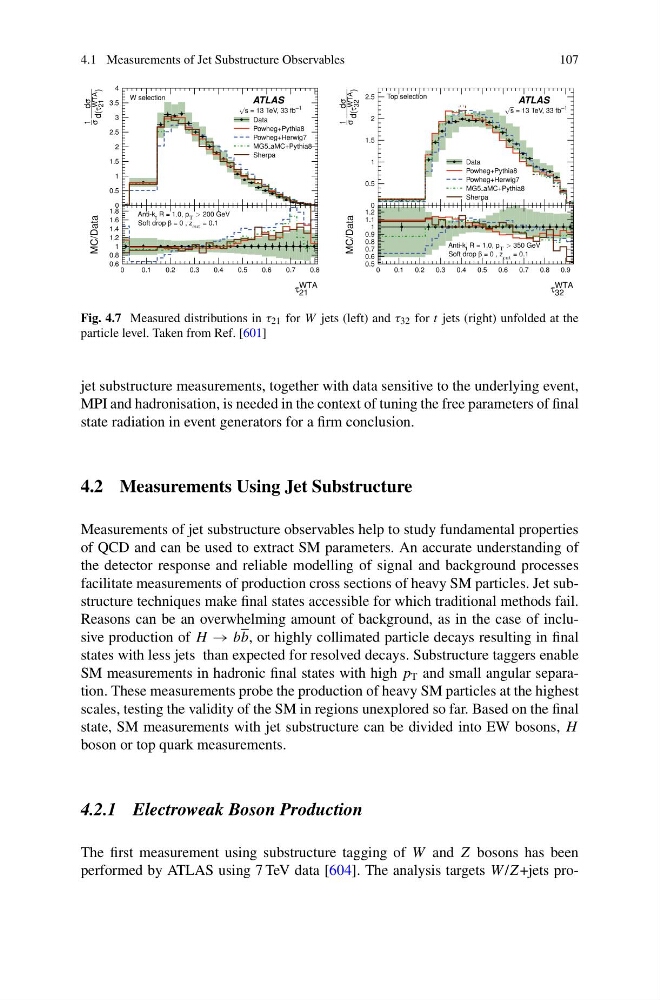
Fig. 4.7 Measured distributions in τ 21 for W jets (left) and τ 32 for t jets (right) unfolded at the
particle level. Taken from Ref. [601]
jet substructure measurements, together with data sensitive to the underlying event,
MPI and hadronisation, is needed in the context of tuning the free parameters of final
state radiation in event generators for a firm conclusion.
4.2 Measurements Using Jet Substructure
Measurements of jet substructure observables help to study fundamental properties
of QCD and can be used to extract SM parameters. An accurate understanding of
the detector response and reliable modelling of signal and background processes
facilitate measurements of production cross sections of heavy SM particles. Jet substructure techniques make final states accessible for which traditional methods fail.
Reasons can be an overwhelming amount of background, as in the case of inclusive production of H → bb, or highly collimated particle decays resulting in final
states with less jets than expected for resolved decays. Substructure taggers enable
SM measurements in hadronic final states with high p T and small angular separation. These measurements probe the production of heavy SM particles at the highest
scales, testing the validity of the SM in regions unexplored so far. Based on the final
state, SM measurements with jet substructure can be divided into EW bosons, H
boson or top quark measurements.
4.2.1 Electroweak Boson Production
The first measurement using substructure tagging of W and Z bosons has been
performed by ATLAS using 7 TeV data [604]. The analysis targets W /Z +jets pro-
107
Fig. 4.7 Measured distributions in τ 21 for W jets (left) and τ 32 for t jets (right) unfolded at the
particle level. Taken from Ref. [601]
jet substructure measurements, together with data sensitive to the underlying event,
MPI and hadronisation, is needed in the context of tuning the free parameters of final
state radiation in event generators for a firm conclusion.
4.2 Measurements Using Jet Substructure
Measurements of jet substructure observables help to study fundamental properties
of QCD and can be used to extract SM parameters. An accurate understanding of
the detector response and reliable modelling of signal and background processes
facilitate measurements of production cross sections of heavy SM particles. Jet substructure techniques make final states accessible for which traditional methods fail.
Reasons can be an overwhelming amount of background, as in the case of inclusive production of H → bb, or highly collimated particle decays resulting in final
states with less jets than expected for resolved decays. Substructure taggers enable
SM measurements in hadronic final states with high p T and small angular separation. These measurements probe the production of heavy SM particles at the highest
scales, testing the validity of the SM in regions unexplored so far. Based on the final
state, SM measurements with jet substructure can be divided into EW bosons, H
boson or top quark measurements.
4.2.1 Electroweak Boson Production
The first measurement using substructure tagging of W and Z bosons has been
performed by ATLAS using 7 TeV data [604]. The analysis targets W /Z +jets pro-