

96
4 Standard Model Measurements
4.1.2 Jet Mass of W and Z Jets
From the beginning of jet substructure measurements at the LHC, the two prong
decay of boosted W bosons has served as a means of calibrating the jet mass scale
and resolution [427–429, 435, 436]. Usually, W jets are selected in a sample enriched
with high- p T tt production, for example with a selection on the angular distance
between the large-R W jet and the closest b-tagged small-R jet, where is required
to be less than 2.0 [241]. The abundance of high- p T tt events, their identification
through high energy charged leptons and b jets, and the well known mass of the W
boson have resulted in precise calibrations of the jet mass scale and resolution. An
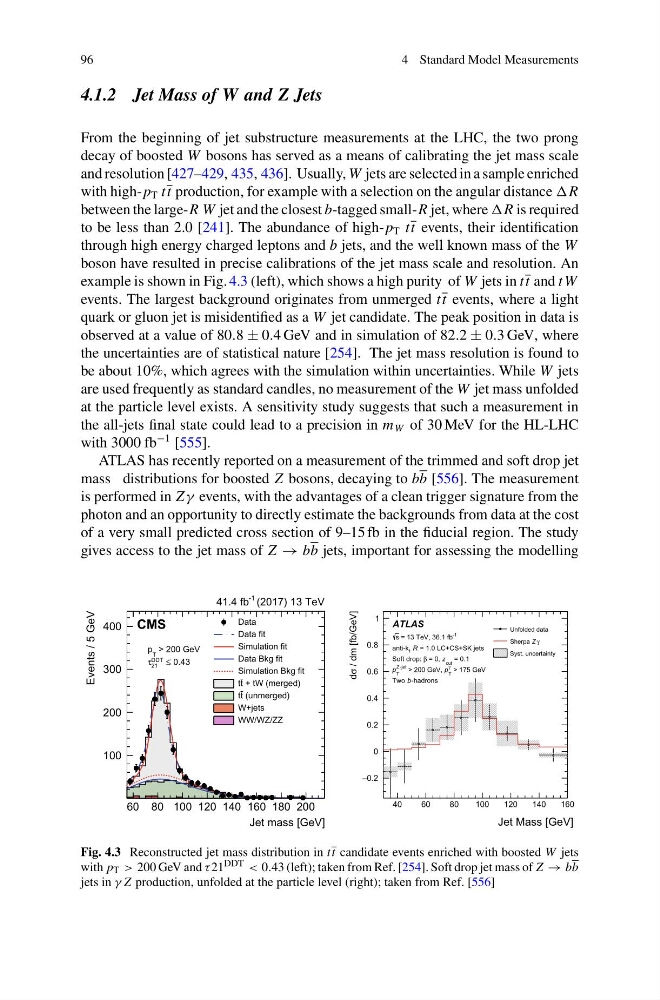
example is shown in Fig. 4.3 (left), which shows a high purity of W jets in tt and t W
events. The largest background originates from unmerged tt events, where a light
quark or gluon jet is misidentified as a W jet candidate. The peak position in data is
observed at a value of 80.8 ± 0.4 GeV and in simulation of 82.2 ± 0.3 GeV, where
the uncertainties are of statistical nature [254]. The jet mass resolution is found to
be about 10%, which agrees with the simulation within uncertainties. While W jets
are used frequently as standard candles, no measurement of the W jet mass unfolded
at the particle level exists. A sensitivity study suggests that such a measurement in
the all-jets final state could lead to a precision in m W of 30 MeV for the HL-LHC
with 3000 fb
−1 [555].
ATLAS has recently reported on a measurement of the trimmed and soft drop jet
mass distributions for boosted Z bosons, decaying to bb [556]. The measurement
is performed in Z γ events, with the advantages of a clean trigger signature from the
photon and an opportunity to directly estimate the backgrounds from data at the cost
of a very small predicted cross section of 9–15 fb in the fiducial region. The study
gives access to the jet mass of Z → bb jets, important for assessing the modelling
Jet mass [GeV]
60 80 100 120 140 160 180 200
Events / 5 GeV
100
200
300
400
> 200 GeV
T
p
0.43
≤
DDT
21
τ
Data
Data fit
Simulation fit
Data Bkg fit
Simulation Bkg fit
+ tW (merged)
t
t
(unmerged)
t
t
W+jets
WW/WZ/ZZ
(2017) 13 TeV
-1
41.4 fb
CMS
Jet Mass [GeV]
40
60
80
100
120
140
160
/ dm [fb/GeV]
σ
d
0.2
−
0
0.2
0.4
0.6
0.8
1
-1
= 13 TeV, 36.1 fb
s
= 1.0 LC+CS+SK jets
R
t
anti-k
= 0.1
cut
z
= 0,
β
Soft drop:
> 175 GeV
γ
T
p
> 200 GeV,
-jet
Z
T
p
-hadrons
b
Two
ATLAS
Unfolded data
γ
Z
Sherpa
Syst. uncertainty
Fig. 4.3 Reconstructed jet mass distribution in tt candidate events enriched with boosted W jets
with p T > 200 GeV and τ 21 DDT < 0.43 (left); taken from Ref. [254]. Soft drop jet mass of Z → bb
jets in γ Z production, unfolded at the particle level (right); taken from Ref. [556]
4 Standard Model Measurements
4.1.2 Jet Mass of W and Z Jets
From the beginning of jet substructure measurements at the LHC, the two prong
decay of boosted W bosons has served as a means of calibrating the jet mass scale
and resolution [427–429, 435, 436]. Usually, W jets are selected in a sample enriched
with high- p T tt production, for example with a selection on the angular distance
between the large-R W jet and the closest b-tagged small-R jet, where is required
to be less than 2.0 [241]. The abundance of high- p T tt events, their identification
through high energy charged leptons and b jets, and the well known mass of the W
boson have resulted in precise calibrations of the jet mass scale and resolution. An
example is shown in Fig. 4.3 (left), which shows a high purity of W jets in tt and t W
events. The largest background originates from unmerged tt events, where a light
quark or gluon jet is misidentified as a W jet candidate. The peak position in data is
observed at a value of 80.8 ± 0.4 GeV and in simulation of 82.2 ± 0.3 GeV, where
the uncertainties are of statistical nature [254]. The jet mass resolution is found to
be about 10%, which agrees with the simulation within uncertainties. While W jets
are used frequently as standard candles, no measurement of the W jet mass unfolded
at the particle level exists. A sensitivity study suggests that such a measurement in
the all-jets final state could lead to a precision in m W of 30 MeV for the HL-LHC
with 3000 fb
−1 [555].
ATLAS has recently reported on a measurement of the trimmed and soft drop jet
mass distributions for boosted Z bosons, decaying to bb [556]. The measurement
is performed in Z γ events, with the advantages of a clean trigger signature from the
photon and an opportunity to directly estimate the backgrounds from data at the cost
of a very small predicted cross section of 9–15 fb in the fiducial region. The study
gives access to the jet mass of Z → bb jets, important for assessing the modelling
Jet mass [GeV]
60 80 100 120 140 160 180 200
Events / 5 GeV
100
200
300
400
> 200 GeV
T
p
0.43
≤
DDT
21
τ
Data
Data fit
Simulation fit
Data Bkg fit
Simulation Bkg fit
+ tW (merged)
t
t
(unmerged)
t
t
W+jets
WW/WZ/ZZ
(2017) 13 TeV
-1
41.4 fb
CMS
Jet Mass [GeV]
40
60
80
100
120
140
160
/ dm [fb/GeV]
σ
d
0.2
−
0
0.2
0.4
0.6
0.8
1
-1
= 13 TeV, 36.1 fb
s
= 1.0 LC+CS+SK jets
R
t
anti-k
= 0.1
cut
z
= 0,
β
Soft drop:
> 175 GeV
γ
T
p
> 200 GeV,
-jet
Z
T
p
-hadrons
b
Two
ATLAS
Unfolded data
γ
Z
Sherpa
Syst. uncertainty
Fig. 4.3 Reconstructed jet mass distribution in tt candidate events enriched with boosted W jets
with p T > 200 GeV and τ 21 DDT < 0.43 (left); taken from Ref. [254]. Soft drop jet mass of Z → bb
jets in γ Z production, unfolded at the particle level (right); taken from Ref. [556]