

94
4 Standard Model Measurements
0
20 40 60 80 100 120 140 160 180 200
GeV
1
d m
σ
d
σ
1
0
0.005
0.01
0.015
0.02
0.025
0.03
0.035
ATLAS
-1
L = 2 pb
∫
2010 Data,
Systematic unc.
Total unc.
Pythia
Herwig++
= 1, |y| < 2
PV
N
R=1.0
t
anti-k
< 300 GeV,
T
200 < p
Jet mass [GeV]
0 20 40 60 80 100 120 140 160 180 200
MC/Data
0.2
0.4
0.6
0.8
1
1.2
1.4
1.6
1.8
0
50
100
150
200
250
300
GeV
1
d m
σ
d
σ
1
0
0.002
0.004
0.006
0.008
0.01
0.012
0.014
0.016
0.018
0.02
ATLAS
-1
L = 35 pb
∫
2010 Data,
Statistical unc.
Total unc.
Pythia
Herwig++
= 1, |y| < 2
PV
N
R=1.0
t
anti-k
< 500 GeV
T
400 < p
Jet mass [GeV]
0
50
100
150
200
250
300
MC/Data
0.2
0.4
0.6
0.8
1
1.2
1.4
1.6
1.8
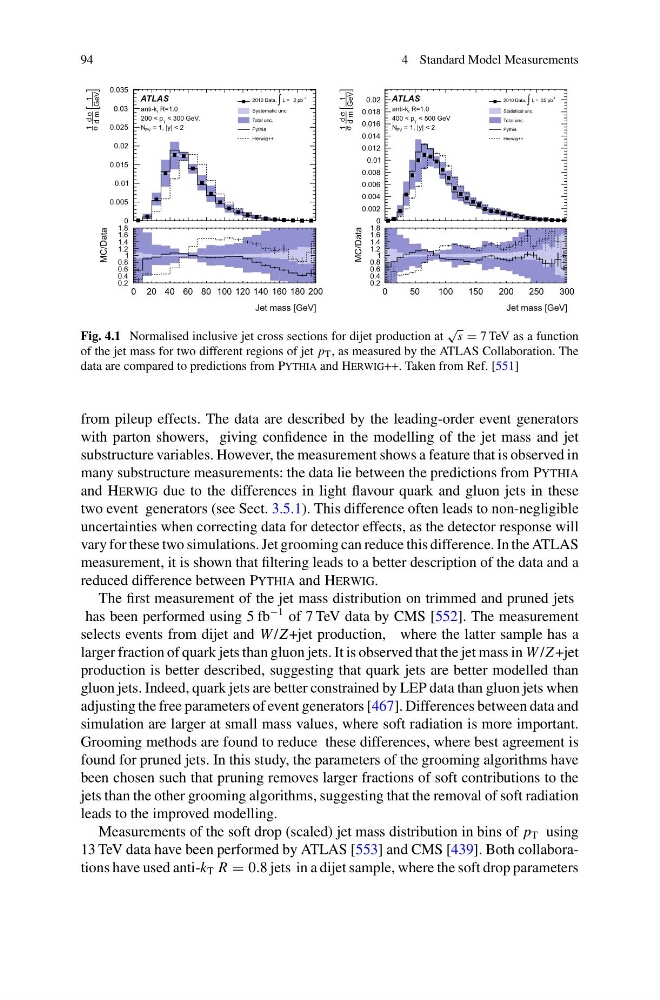
Fig. 4.1 Normalised inclusive jet cross sections for dijet production at
√
s = 7 TeV as a function
of the jet mass for two different regions of jet p T , as measured by the ATLAS Collaboration. The
data are compared to predictions from Pythia and Herwig++. Taken from Ref. [551]
from pileup effects. The data are described by the leading-order event generators
with parton showers, giving confidence in the modelling of the jet mass and jet
substructure variables. However, the measurement shows a feature that is observed in
many substructure measurements: the data lie between the predictions from Pythia
and Herwig due to the differences in light flavour quark and gluon jets in these
two event generators (see Sect. 3.5.1). This difference often leads to non-negligible
uncertainties when correcting data for detector effects, as the detector response will
vary for these two simulations. Jet grooming can reduce this difference. In the ATLAS
measurement, it is shown that filtering leads to a better description of the data and a
reduced difference between Pythia and Herwig.
The first measurement of the jet mass distribution on trimmed and pruned jets
has been performed using 5 fb
−1 of 7 TeV data by CMS [552]. The measurement
selects events from dijet and W /Z +jet production, where the latter sample has a
larger fraction of quark jets than gluon jets. It is observed that the jet mass in W /Z +jet
production is better described, suggesting that quark jets are better modelled than
gluon jets. Indeed, quark jets are better constrained by LEP data than gluon jets when
adjusting the free parameters of event generators [467]. Differences between data and
simulation are larger at small mass values, where soft radiation is more important.
Grooming methods are found to reduce these differences, where best agreement is
found for pruned jets. In this study, the parameters of the grooming algorithms have
been chosen such that pruning removes larger fractions of soft contributions to the
jets than the other grooming algorithms, suggesting that the removal of soft radiation
leads to the improved modelling.
Measurements of the soft drop (scaled) jet mass distribution in bins of p T using
13 TeV data have been performed by ATLAS [553] and CMS [439]. Both collaborations have used anti-k T R = 0.8 jets in a dijet sample, where the soft drop parameters
4 Standard Model Measurements
0
20 40 60 80 100 120 140 160 180 200
GeV
1
d m
σ
d
σ
1
0
0.005
0.01
0.015
0.02
0.025
0.03
0.035
ATLAS
-1
L = 2 pb
∫
2010 Data,
Systematic unc.
Total unc.
Pythia
Herwig++
= 1, |y| < 2
PV
N
R=1.0
t
anti-k
< 300 GeV,
T
200 < p
Jet mass [GeV]
0 20 40 60 80 100 120 140 160 180 200
MC/Data
0.2
0.4
0.6
0.8
1
1.2
1.4
1.6
1.8
0
50
100
150
200
250
300
GeV
1
d m
σ
d
σ
1
0
0.002
0.004
0.006
0.008
0.01
0.012
0.014
0.016
0.018
0.02
ATLAS
-1
L = 35 pb
∫
2010 Data,
Statistical unc.
Total unc.
Pythia
Herwig++
= 1, |y| < 2
PV
N
R=1.0
t
anti-k
< 500 GeV
T
400 < p
Jet mass [GeV]
0
50
100
150
200
250
300
MC/Data
0.2
0.4
0.6
0.8
1
1.2
1.4
1.6
1.8
Fig. 4.1 Normalised inclusive jet cross sections for dijet production at
√
s = 7 TeV as a function
of the jet mass for two different regions of jet p T , as measured by the ATLAS Collaboration. The
data are compared to predictions from Pythia and Herwig++. Taken from Ref. [551]
from pileup effects. The data are described by the leading-order event generators
with parton showers, giving confidence in the modelling of the jet mass and jet
substructure variables. However, the measurement shows a feature that is observed in
many substructure measurements: the data lie between the predictions from Pythia
and Herwig due to the differences in light flavour quark and gluon jets in these
two event generators (see Sect. 3.5.1). This difference often leads to non-negligible
uncertainties when correcting data for detector effects, as the detector response will
vary for these two simulations. Jet grooming can reduce this difference. In the ATLAS
measurement, it is shown that filtering leads to a better description of the data and a
reduced difference between Pythia and Herwig.
The first measurement of the jet mass distribution on trimmed and pruned jets
has been performed using 5 fb
−1 of 7 TeV data by CMS [552]. The measurement
selects events from dijet and W /Z +jet production, where the latter sample has a
larger fraction of quark jets than gluon jets. It is observed that the jet mass in W /Z +jet
production is better described, suggesting that quark jets are better modelled than
gluon jets. Indeed, quark jets are better constrained by LEP data than gluon jets when
adjusting the free parameters of event generators [467]. Differences between data and
simulation are larger at small mass values, where soft radiation is more important.
Grooming methods are found to reduce these differences, where best agreement is
found for pruned jets. In this study, the parameters of the grooming algorithms have
been chosen such that pruning removes larger fractions of soft contributions to the
jets than the other grooming algorithms, suggesting that the removal of soft radiation
leads to the improved modelling.
Measurements of the soft drop (scaled) jet mass distribution in bins of p T using
13 TeV data have been performed by ATLAS [553] and CMS [439]. Both collaborations have used anti-k T R = 0.8 jets in a dijet sample, where the soft drop parameters