

190
12 Application to Superstring Theory
Table 12.2 The spacetime
metric h(η (n) )
(n − 1 = 0, 1, · · · , 14 is the
layer number) which emerged
after the training
n − 1 h
0
3.0818 ± 0.0081
1
2.296 ± 0.016
2
1.464 ± 0.025
3
0.627 ± 0.035
4
−0.141 ± 0.045
5
−0.727 ± 0.049
6
−0.974 ± 0.043
7
−0.687 ± 0.032
n-1 h
8
0.374 ± 0.087
9
2.50 ± 0.19
10
6.03 ± 0.30
11 11.46 ± 0.35
12 19.47 ± 0.27
13 31.07 ± 0.17
14 46.70 ± 0.52
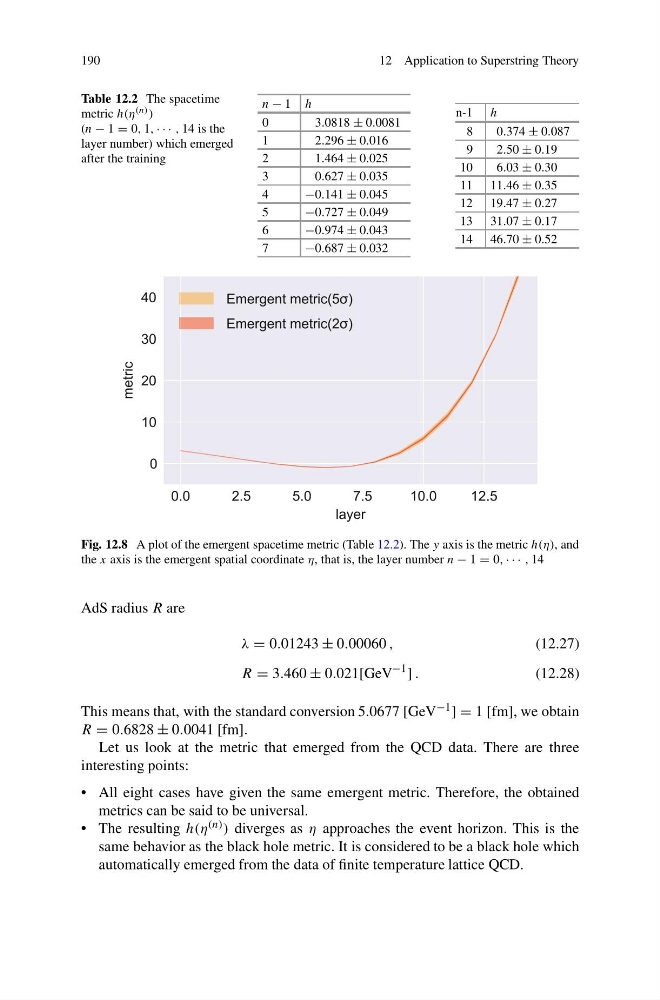
Fig. 12.8 A plot of the emergent spacetime metric (Table 12.2). The y axis is the metric h(η), and
the x axis is the emergent spatial coordinate η, that is, the layer number n − 1 = 0, · · · , 14
AdS radius R are
λ = 0.01243 ± 0.00060 ,
(12.27)
R = 3.460 ± 0.021[GeV
−1 ] .
(12.28)
This means that, with the standard conversion 5.0677 [GeV −1 ] = 1 [fm], we obtain
R = 0.6828 ± 0.0041 [fm].
Let us look at the metric that emerged from the QCD data. There are three
interesting points:
• All eight cases have given the same emergent metric. Therefore, the obtained
metrics can be said to be universal.
• The resulting h(η (n) ) diverges as η approaches the event horizon. This is the
same behavior as the black hole metric. It is considered to be a black hole which
automatically emerged from the data of finite temperature lattice QCD.
12 Application to Superstring Theory
Table 12.2 The spacetime
metric h(η (n) )
(n − 1 = 0, 1, · · · , 14 is the
layer number) which emerged
after the training
n − 1 h
0
3.0818 ± 0.0081
1
2.296 ± 0.016
2
1.464 ± 0.025
3
0.627 ± 0.035
4
−0.141 ± 0.045
5
−0.727 ± 0.049
6
−0.974 ± 0.043
7
−0.687 ± 0.032
n-1 h
8
0.374 ± 0.087
9
2.50 ± 0.19
10
6.03 ± 0.30
11 11.46 ± 0.35
12 19.47 ± 0.27
13 31.07 ± 0.17
14 46.70 ± 0.52
Fig. 12.8 A plot of the emergent spacetime metric (Table 12.2). The y axis is the metric h(η), and
the x axis is the emergent spatial coordinate η, that is, the layer number n − 1 = 0, · · · , 14
AdS radius R are
λ = 0.01243 ± 0.00060 ,
(12.27)
R = 3.460 ± 0.021[GeV
−1 ] .
(12.28)
This means that, with the standard conversion 5.0677 [GeV −1 ] = 1 [fm], we obtain
R = 0.6828 ± 0.0041 [fm].
Let us look at the metric that emerged from the QCD data. There are three
interesting points:
• All eight cases have given the same emergent metric. Therefore, the obtained
metrics can be said to be universal.
• The resulting h(η (n) ) diverges as η approaches the event horizon. This is the
same behavior as the black hole metric. It is considered to be a black hole which
automatically emerged from the data of finite temperature lattice QCD.