

12.4 Spacetime Emerging from QCD
189
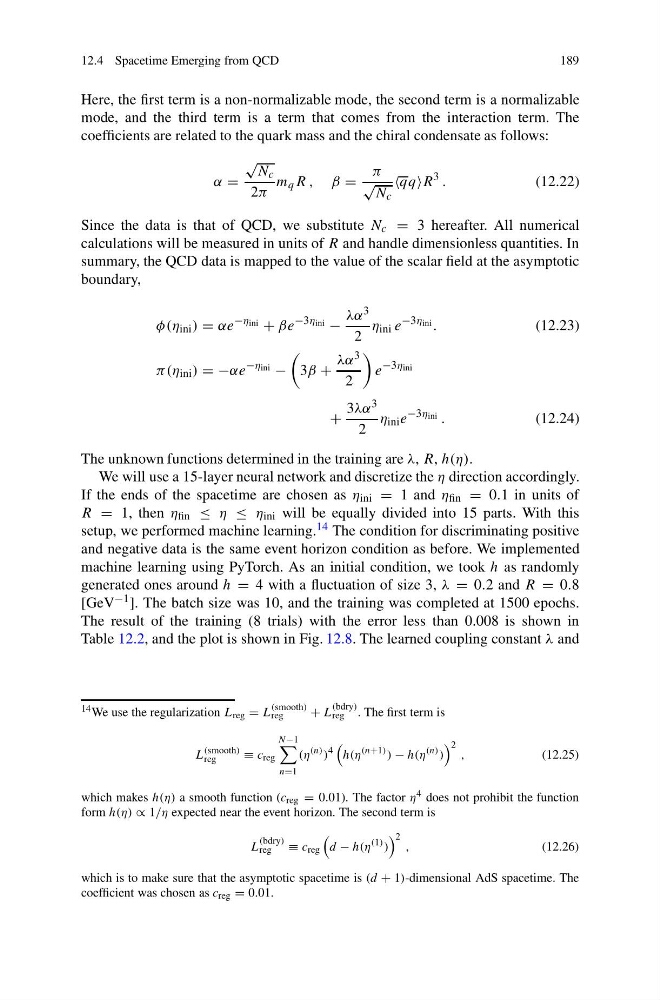
Here, the first term is a non-normalizable mode, the second term is a normalizable
mode, and the third term is a term that comes from the interaction term. The
coefficients are related to the quark mass and the chiral condensate as follows:
α =
√
N c
2π
m q R , β =
π
√
N c
qq
3 .
(12.22)
Since the data is that of QCD, we substitute N c = 3 hereafter. All numerical
calculations will be measured in units of R and handle dimensionless quantities. In
summary, the QCD data is mapped to the value of the scalar field at the asymptotic
boundary,
φ(η ini ) = αe
−η ini + βe
−3η ini −
λα 3
2
η ini e
−3η ini .
(12.23)
π(η ini ) = −αe
−η ini −
3β +
λα 3
2
e
−3η ini
+
3λα 3
2
η ini e
−3η ini .
(12.24)
The unknown functions determined in the training are λ, R, h(η).
We will use a 15-layer neural network and discretize the η direction accordingly.
If the ends of the spacetime are chosen as η ini = 1 and η fin = 0.1 in units of
R = 1, then η fin ≤ η ≤ η ini will be equally divided into 15 parts. With this
setup, we performed machine learning. 14 The condition for discriminating positive
and negative data is the same event horizon condition as before. We implemented
machine learning using PyTorch. As an initial condition, we took h as randomly
generated ones around h = 4 with a fluctuation of size 3, λ = 0.2 and R = 0.8
[GeV −1 ]. The batch size was 10, and the training was completed at 1500 epochs.
The result of the training (8 trials) with the error less than 0.008 is shown in
Table 12.2, and the plot is shown in Fig. 12.8. The learned coupling constant λ and
14 We use the regularization L reg = L
(smooth)
reg
+ L
(bdry)
reg . The first term is
L
(smooth)
reg
≡ c reg
N−1
n=1
(η
(n) )
4
h(η
(n+1) ) − h(η
(n) )
2
,
(12.25)
which makes h(η) a smooth function (c reg = 0.01). The factor η 4 does not prohibit the function
form h(η) ∝ 1/η expected near the event horizon. The second term is
L
(bdry)
reg
≡ c reg
d − h(η
(1) )
2
,
(12.26)
which is to make sure that the asymptotic spacetime is (d + 1)-dimensional AdS spacetime. The
coefficient was chosen as c reg = 0.01.
189
Here, the first term is a non-normalizable mode, the second term is a normalizable
mode, and the third term is a term that comes from the interaction term. The
coefficients are related to the quark mass and the chiral condensate as follows:
α =
√
N c
2π
m q R , β =
π
√
N c
3 .
(12.22)
Since the data is that of QCD, we substitute N c = 3 hereafter. All numerical
calculations will be measured in units of R and handle dimensionless quantities. In
summary, the QCD data is mapped to the value of the scalar field at the asymptotic
boundary,
φ(η ini ) = αe
−η ini + βe
−3η ini −
λα 3
2
η ini e
−3η ini .
(12.23)
π(η ini ) = −αe
−η ini −
3β +
λα 3
2
e
−3η ini
+
3λα 3
2
η ini e
−3η ini .
(12.24)
The unknown functions determined in the training are λ, R, h(η).
We will use a 15-layer neural network and discretize the η direction accordingly.
If the ends of the spacetime are chosen as η ini = 1 and η fin = 0.1 in units of
R = 1, then η fin ≤ η ≤ η ini will be equally divided into 15 parts. With this
setup, we performed machine learning. 14 The condition for discriminating positive
and negative data is the same event horizon condition as before. We implemented
machine learning using PyTorch. As an initial condition, we took h as randomly
generated ones around h = 4 with a fluctuation of size 3, λ = 0.2 and R = 0.8
[GeV −1 ]. The batch size was 10, and the training was completed at 1500 epochs.
The result of the training (8 trials) with the error less than 0.008 is shown in
Table 12.2, and the plot is shown in Fig. 12.8. The learned coupling constant λ and
14 We use the regularization L reg = L
(smooth)
reg
+ L
(bdry)
reg . The first term is
L
(smooth)
reg
≡ c reg
N−1
n=1
(η
(n) )
4
h(η
(n+1) ) − h(η
(n) )
2
,
(12.25)
which makes h(η) a smooth function (c reg = 0.01). The factor η 4 does not prohibit the function
form h(η) ∝ 1/η expected near the event horizon. The second term is
L
(bdry)
reg
≡ c reg
d − h(η
(1) )
2
,
(12.26)
which is to make sure that the asymptotic spacetime is (d + 1)-dimensional AdS spacetime. The
coefficient was chosen as c reg = 0.01.