

178
12 Application to Superstring Theory
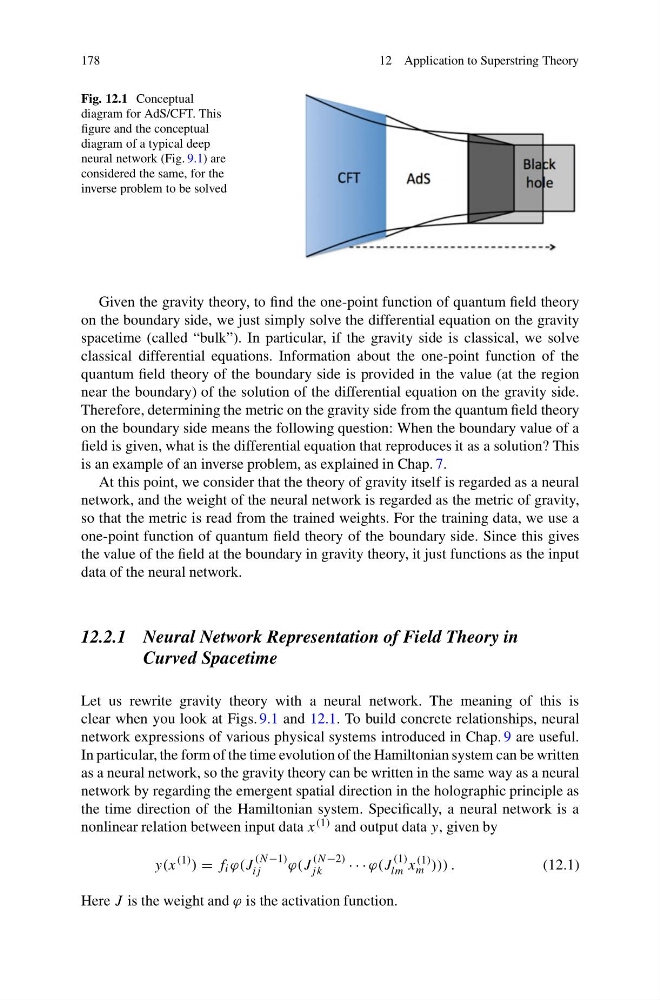
Fig. 12.1 Conceptual
diagram for AdS/CFT. This
figure and the conceptual
diagram of a typical deep
neural network (Fig. 9.1) are
considered the same, for the
inverse problem to be solved
Given the gravity theory, to find the one-point function of quantum field theory
on the boundary side, we just simply solve the differential equation on the gravity
spacetime (called “bulk”). In particular, if the gravity side is classical, we solve
classical differential equations. Information about the one-point function of the
quantum field theory of the boundary side is provided in the value (at the region
near the boundary) of the solution of the differential equation on the gravity side.
Therefore, determining the metric on the gravity side from the quantum field theory
on the boundary side means the following question: When the boundary value of a
field is given, what is the differential equation that reproduces it as a solution? This
is an example of an inverse problem, as explained in Chap. 7.
At this point, we consider that the theory of gravity itself is regarded as a neural
network, and the weight of the neural network is regarded as the metric of gravity,
so that the metric is read from the trained weights. For the training data, we use a
one-point function of quantum field theory of the boundary side. Since this gives
the value of the field at the boundary in gravity theory, it just functions as the input
data of the neural network.
12.2.1 Neural Network Representation of Field Theory in
Curved Spacetime
Let us rewrite gravity theory with a neural network. The meaning of this is
clear when you look at Figs. 9.1 and 12.1. To build concrete relationships, neural
network expressions of various physical systems introduced in Chap. 9 are useful.
In particular, the form of the time evolution of the Hamiltonian system can be written
as a neural network, so the gravity theory can be written in the same way as a neural
network by regarding the emergent spatial direction in the holographic principle as
the time direction of the Hamiltonian system. Specifically, a neural network is a
nonlinear relation between input data x (1) and output data y, given by
y(x
(1) ) = f i ϕ(J
(N−1)
ij
ϕ(J
(N−2)
jk
· · · ϕ(J
(1)
lm x
(1)
m ))) .
(12.1)
Here J is the weight and ϕ is the activation function.
12 Application to Superstring Theory
Fig. 12.1 Conceptual
diagram for AdS/CFT. This
figure and the conceptual
diagram of a typical deep
neural network (Fig. 9.1) are
considered the same, for the
inverse problem to be solved
Given the gravity theory, to find the one-point function of quantum field theory
on the boundary side, we just simply solve the differential equation on the gravity
spacetime (called “bulk”). In particular, if the gravity side is classical, we solve
classical differential equations. Information about the one-point function of the
quantum field theory of the boundary side is provided in the value (at the region
near the boundary) of the solution of the differential equation on the gravity side.
Therefore, determining the metric on the gravity side from the quantum field theory
on the boundary side means the following question: When the boundary value of a
field is given, what is the differential equation that reproduces it as a solution? This
is an example of an inverse problem, as explained in Chap. 7.
At this point, we consider that the theory of gravity itself is regarded as a neural
network, and the weight of the neural network is regarded as the metric of gravity,
so that the metric is read from the trained weights. For the training data, we use a
one-point function of quantum field theory of the boundary side. Since this gives
the value of the field at the boundary in gravity theory, it just functions as the input
data of the neural network.
12.2.1 Neural Network Representation of Field Theory in
Curved Spacetime
Let us rewrite gravity theory with a neural network. The meaning of this is
clear when you look at Figs. 9.1 and 12.1. To build concrete relationships, neural
network expressions of various physical systems introduced in Chap. 9 are useful.
In particular, the form of the time evolution of the Hamiltonian system can be written
as a neural network, so the gravity theory can be written in the same way as a neural
network by regarding the emergent spatial direction in the holographic principle as
the time direction of the Hamiltonian system. Specifically, a neural network is a
nonlinear relation between input data x (1) and output data y, given by
y(x
(1) ) = f i ϕ(J
(N−1)
ij
ϕ(J
(N−2)
jk
· · · ϕ(J
(1)
lm x
(1)
m ))) .
(12.1)
Here J is the weight and ϕ is the activation function.