

56
In GHG emissions, there is the possibility of large amounts of nitrous oxide
being generated during cultivation of feedstocks. This originates from nitrogen fertilizers and is produced by processes of nitrification and denitrification. The amounts
generated do not depend solely on the amounts of nitrogen fertilizer used but also
on soil characteristics and climate conditions, so there can be a very wide range of
values for emission factors. It should be noted that when land with a soil such as
peat that stores large amounts of organic carbon is developed and cultivated, the
carbon accumulated in the soil is released into the atmosphere as carbon dioxide.
The carbon dioxide is generated from a natural source, but it should be accounted as
anthropogenic production.
The production of biofuels is an industrial process, so it does not differ greatly
from the usual LCA. However, there are several points to consider. Because factories that carry out these production processes are often located in agricultural areas,
available energy sources in those locations are limited. Unlike industrial raw materials, energy crops include many unusable parts such as straw and husks, and how
these byproducts are used is an important question.
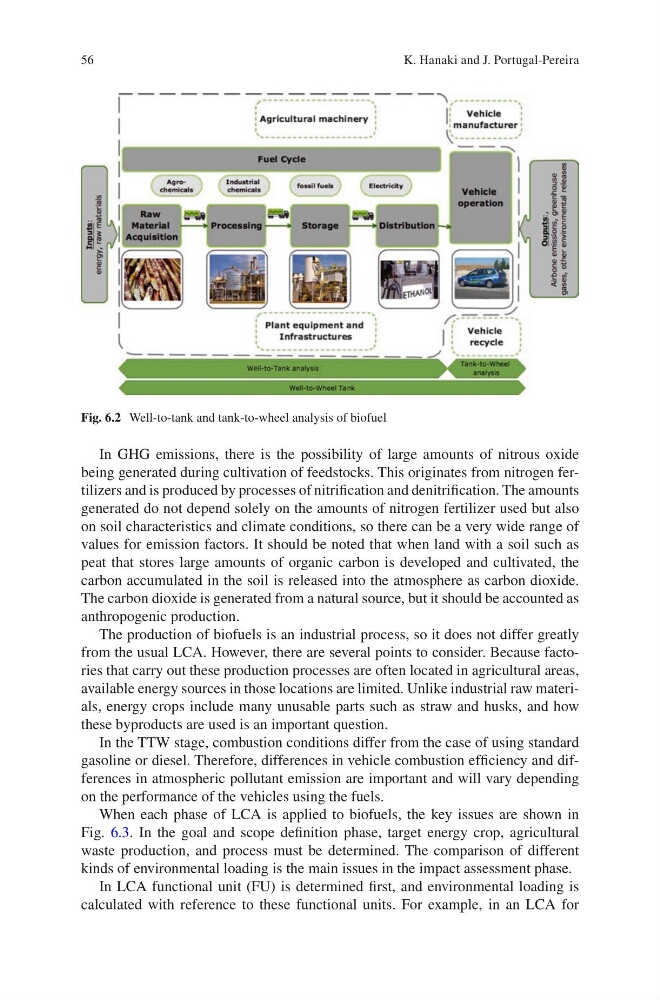
In the TTW stage, combustion conditions differ from the case of using standard
gasoline or diesel. Therefore, differences in vehicle combustion efficiency and differences in atmospheric pollutant emission are important and will vary depending
on the performance of the vehicles using the fuels.
When each phase of LCA is applied to biofuels, the key issues are shown in
Fig. 6.3. In the goal and scope definition phase, target energy crop, agricultural
waste production, and process must be determined. The comparison of different
kinds of environmental loading is the main issues in the impact assessment phase.
In LCA functional unit (FU) is determined first, and environmental loading is
calculated with reference to these functional units. For example, in an LCA for
Fig. 6.2 Well-to-tank and tank-to-wheel analysis of biofuel
K. Hanaki and J. Portugal-Pereira
In GHG emissions, there is the possibility of large amounts of nitrous oxide
being generated during cultivation of feedstocks. This originates from nitrogen fertilizers and is produced by processes of nitrification and denitrification. The amounts
generated do not depend solely on the amounts of nitrogen fertilizer used but also
on soil characteristics and climate conditions, so there can be a very wide range of
values for emission factors. It should be noted that when land with a soil such as
peat that stores large amounts of organic carbon is developed and cultivated, the
carbon accumulated in the soil is released into the atmosphere as carbon dioxide.
The carbon dioxide is generated from a natural source, but it should be accounted as
anthropogenic production.
The production of biofuels is an industrial process, so it does not differ greatly
from the usual LCA. However, there are several points to consider. Because factories that carry out these production processes are often located in agricultural areas,
available energy sources in those locations are limited. Unlike industrial raw materials, energy crops include many unusable parts such as straw and husks, and how
these byproducts are used is an important question.
In the TTW stage, combustion conditions differ from the case of using standard
gasoline or diesel. Therefore, differences in vehicle combustion efficiency and differences in atmospheric pollutant emission are important and will vary depending
on the performance of the vehicles using the fuels.
When each phase of LCA is applied to biofuels, the key issues are shown in
Fig. 6.3. In the goal and scope definition phase, target energy crop, agricultural
waste production, and process must be determined. The comparison of different
kinds of environmental loading is the main issues in the impact assessment phase.
In LCA functional unit (FU) is determined first, and environmental loading is
calculated with reference to these functional units. For example, in an LCA for
Fig. 6.2 Well-to-tank and tank-to-wheel analysis of biofuel
K. Hanaki and J. Portugal-Pereira