

253
15.2.1 Carbon Footprint
CF or LCCO 2 is one of the most popular indicators used in many LCA studies. CF
can be defined as the total GHG emission due to biomass cultivation, extraction,
transportation, the process of conversion to biofuel, and shipping of the biofuel.
Today, CF is applied to the product labeling scheme in many countries.
15.2.2 Water Footprint
Water is needed for several processes in biofuel production. WF can be defined as
the total annual volume of fresh water used to produce goods and services for consumption. WF consists of three components: the green WF, blue WF, and gray WF
(Worldwatch Institute 2007). The green WF refers to rainwater that evaporates during production, mainly during crop growth. The blue WF is the surface- and groundwater used for irrigation that evaporates during crop growth. The gray WF is the
amount of water needed to dilute pollutants discharged into the natural water system
to the extent that the quality of the ambient water remains above agreed-upon water
quality standards.
15.2.3 Ecological Footprint
EF is a tool to measure human demand by comparing with Earth’s ecological capacity to regenerate. It indicates the amount of biologically productive land and sea
area needed to regenerate the resources consumed by a human population and to
absorb its wastes (Rees 1992; Wackernagel 1994). Conceived in 1990 by Mathis
Wackernagel and William Rees at the University of British Columbia, EF has been
widely used by scientists, businesses, governments, agencies, individuals, and institutions to monitor ecological resource use and assess our pressure on Earth’s system. The following equation was used to calculate EF in this study. Wackernagel
and Rees (1995) selected 6.6 mt as their average value for the total CO 2 sequestered
by the world’s forests. Therefore, we also used the value of 6.6 Mg/ha for CO 2
sequestration. This value would be 3.2 Mg/ha (Greenhouse Gas Inventory Office of
Japan 2010) by assuming the offset CO 2 emissions from the forests in Japan:
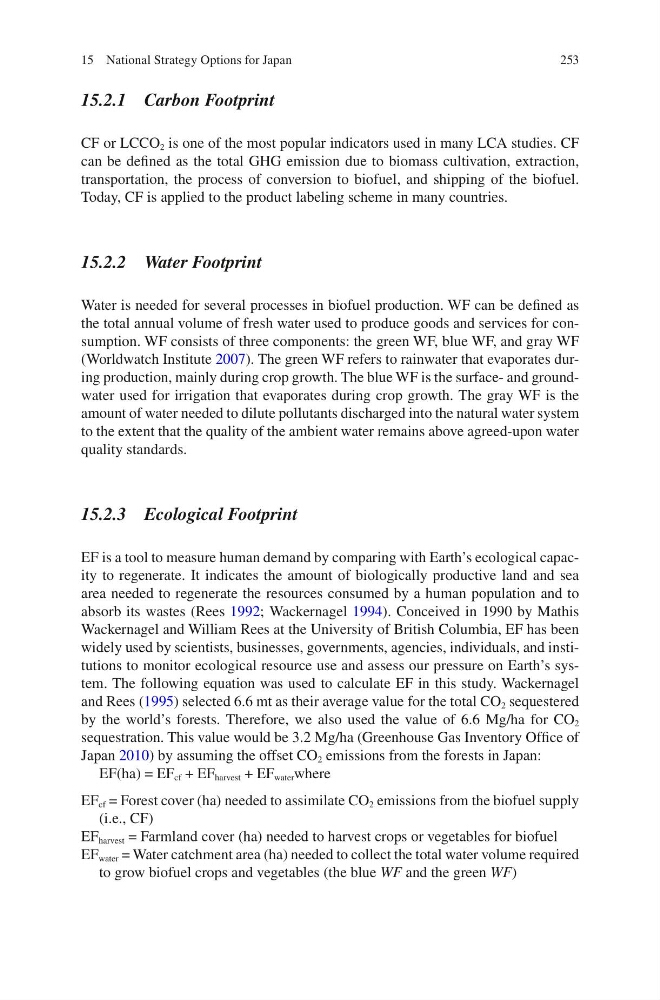
EF(ha) = EF cf + EF harvest + EF water where
EF cf = Forest cover (ha) needed to assimilate CO 2 emissions from the biofuel supply
(i.e., CF)
EF harvest = Farmland cover (ha) needed to harvest crops or vegetables for biofuel
EF water = Water catchment area (ha) needed to collect the total water volume required
to grow biofuel crops and vegetables (the blue WF and the green WF)
15 National Strategy Options for Japan
15.2.1 Carbon Footprint
CF or LCCO 2 is one of the most popular indicators used in many LCA studies. CF
can be defined as the total GHG emission due to biomass cultivation, extraction,
transportation, the process of conversion to biofuel, and shipping of the biofuel.
Today, CF is applied to the product labeling scheme in many countries.
15.2.2 Water Footprint
Water is needed for several processes in biofuel production. WF can be defined as
the total annual volume of fresh water used to produce goods and services for consumption. WF consists of three components: the green WF, blue WF, and gray WF
(Worldwatch Institute 2007). The green WF refers to rainwater that evaporates during production, mainly during crop growth. The blue WF is the surface- and groundwater used for irrigation that evaporates during crop growth. The gray WF is the
amount of water needed to dilute pollutants discharged into the natural water system
to the extent that the quality of the ambient water remains above agreed-upon water
quality standards.
15.2.3 Ecological Footprint
EF is a tool to measure human demand by comparing with Earth’s ecological capacity to regenerate. It indicates the amount of biologically productive land and sea
area needed to regenerate the resources consumed by a human population and to
absorb its wastes (Rees 1992; Wackernagel 1994). Conceived in 1990 by Mathis
Wackernagel and William Rees at the University of British Columbia, EF has been
widely used by scientists, businesses, governments, agencies, individuals, and institutions to monitor ecological resource use and assess our pressure on Earth’s system. The following equation was used to calculate EF in this study. Wackernagel
and Rees (1995) selected 6.6 mt as their average value for the total CO 2 sequestered
by the world’s forests. Therefore, we also used the value of 6.6 Mg/ha for CO 2
sequestration. This value would be 3.2 Mg/ha (Greenhouse Gas Inventory Office of
Japan 2010) by assuming the offset CO 2 emissions from the forests in Japan:
EF(ha) = EF cf + EF harvest + EF water where
EF cf = Forest cover (ha) needed to assimilate CO 2 emissions from the biofuel supply
(i.e., CF)
EF harvest = Farmland cover (ha) needed to harvest crops or vegetables for biofuel
EF water = Water catchment area (ha) needed to collect the total water volume required
to grow biofuel crops and vegetables (the blue WF and the green WF)
15 National Strategy Options for Japan