

248
changes in land use, imports, and environmental conditions as well as domestic supply capacity and national mandates. Based on the analysis, we end the discussion
with policy implications of moving toward sustainable biofuel.
15.2 Methods and Materials
Available future scenarios were reviewed for transportation usage of bioethanol and
biodiesel. The national targets for bioethanol (Table 15.2) were set on the basis of
Public Notice No. 242 issued by the Ministry of Economy, Trade, and Industry
(METI) in 2010. The biodiesel targets in Table 15.2 followed the targets set by the
MOE in 2006, but we modified them by shifting 5 years ahead from the original
targets (i.e., interpreting the 2030 MOE target as the 2035 target for this analysis)
because the actual diffusion of biodiesel has been delayed.
For analyzing each scenario, five options were prepared by considering the type
of biomass, producer country, associated land use changes, competition with respect
to food production, supply pattern, and transportation (Figs. 15.1 and 15.2).
We used three assessment indicators: carbon footprint (CF), WF, and EF. CFs
and WFs for biofuel derived from different crops were collected extensively and
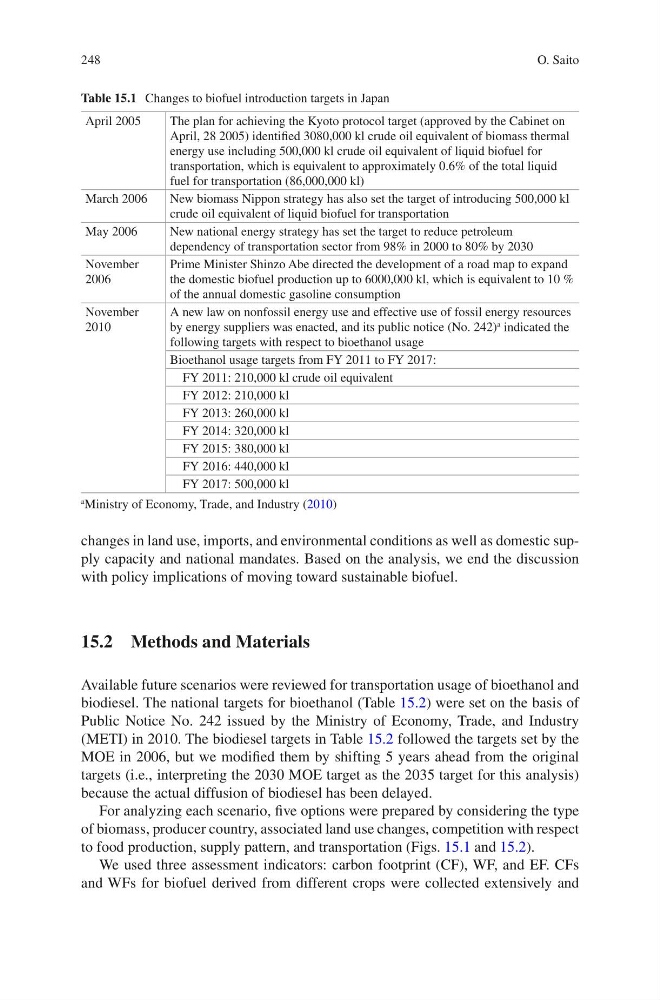
Table 15.1 Changes to biofuel introduction targets in Japan
April 2005
The plan for achieving the Kyoto protocol target (approved by the Cabinet on
April, 28 2005) identified 3080,000 kl crude oil equivalent of biomass thermal
energy use including 500,000 kl crude oil equivalent of liquid biofuel for
transportation, which is equivalent to approximately 0.6% of the total liquid
fuel for transportation (86,000,000 kl)
March 2006
New biomass Nippon strategy has also set the target of introducing 500,000 kl
crude oil equivalent of liquid biofuel for transportation
May 2006
New national energy strategy has set the target to reduce petroleum
dependency of transportation sector from 98% in 2000 to 80% by 2030
November
2006
Prime Minister Shinzo Abe directed the development of a road map to expand
the domestic biofuel production up to 6000,000 kl, which is equivalent to 10 %
of the annual domestic gasoline consumption
November
2010
A new law on nonfossil energy use and effective use of fossil energy resources
by energy suppliers was enacted, and its public notice (No. 242)
a indicated the
following targets with respect to bioethanol usage
Bioethanol usage targets from FY 2011 to FY 2017:
FY 2011: 210,000 kl crude oil equivalent
FY 2012: 210,000 kl
FY 2013: 260,000 kl
FY 2014: 320,000 kl
FY 2015: 380,000 kl
FY 2016: 440,000 kl
FY 2017: 500,000 kl
a
Ministry of Economy, Trade, and Industry (2010)
O. Saito
changes in land use, imports, and environmental conditions as well as domestic supply capacity and national mandates. Based on the analysis, we end the discussion
with policy implications of moving toward sustainable biofuel.
15.2 Methods and Materials
Available future scenarios were reviewed for transportation usage of bioethanol and
biodiesel. The national targets for bioethanol (Table 15.2) were set on the basis of
Public Notice No. 242 issued by the Ministry of Economy, Trade, and Industry
(METI) in 2010. The biodiesel targets in Table 15.2 followed the targets set by the
MOE in 2006, but we modified them by shifting 5 years ahead from the original
targets (i.e., interpreting the 2030 MOE target as the 2035 target for this analysis)
because the actual diffusion of biodiesel has been delayed.
For analyzing each scenario, five options were prepared by considering the type
of biomass, producer country, associated land use changes, competition with respect
to food production, supply pattern, and transportation (Figs. 15.1 and 15.2).
We used three assessment indicators: carbon footprint (CF), WF, and EF. CFs
and WFs for biofuel derived from different crops were collected extensively and
Table 15.1 Changes to biofuel introduction targets in Japan
April 2005
The plan for achieving the Kyoto protocol target (approved by the Cabinet on
April, 28 2005) identified 3080,000 kl crude oil equivalent of biomass thermal
energy use including 500,000 kl crude oil equivalent of liquid biofuel for
transportation, which is equivalent to approximately 0.6% of the total liquid
fuel for transportation (86,000,000 kl)
March 2006
New biomass Nippon strategy has also set the target of introducing 500,000 kl
crude oil equivalent of liquid biofuel for transportation
May 2006
New national energy strategy has set the target to reduce petroleum
dependency of transportation sector from 98% in 2000 to 80% by 2030
November
2006
Prime Minister Shinzo Abe directed the development of a road map to expand
the domestic biofuel production up to 6000,000 kl, which is equivalent to 10 %
of the annual domestic gasoline consumption
November
2010
A new law on nonfossil energy use and effective use of fossil energy resources
by energy suppliers was enacted, and its public notice (No. 242)
a indicated the
following targets with respect to bioethanol usage
Bioethanol usage targets from FY 2011 to FY 2017:
FY 2011: 210,000 kl crude oil equivalent
FY 2012: 210,000 kl
FY 2013: 260,000 kl
FY 2014: 320,000 kl
FY 2015: 380,000 kl
FY 2016: 440,000 kl
FY 2017: 500,000 kl
a
Ministry of Economy, Trade, and Industry (2010)
O. Saito