

233
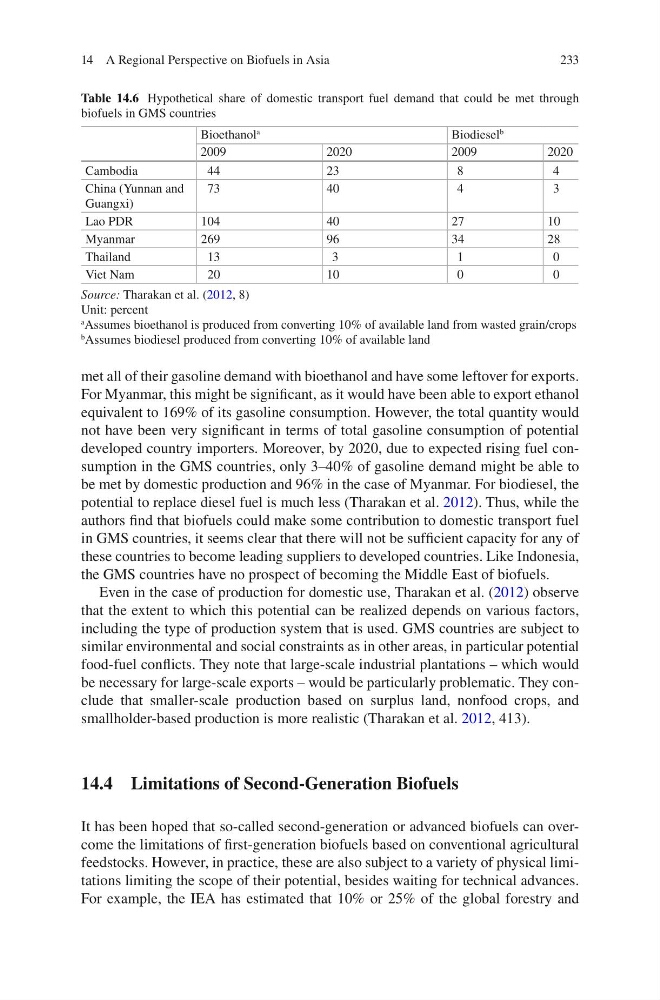
met all of their gasoline demand with bioethanol and have some leftover for exports.
For Myanmar, this might be significant, as it would have been able to export ethanol
equivalent to 169% of its gasoline consumption. However, the total quantity would
not have been very significant in terms of total gasoline consumption of potential
developed country importers. Moreover, by 2020, due to expected rising fuel consumption in the GMS countries, only 3–40% of gasoline demand might be able to
be met by domestic production and 96% in the case of Myanmar. For biodiesel, the
potential to replace diesel fuel is much less (Tharakan et al. 2012). Thus, while the
authors find that biofuels could make some contribution to domestic transport fuel
in GMS countries, it seems clear that there will not be sufficient capacity for any of
these countries to become leading suppliers to developed countries. Like Indonesia,
the GMS countries have no prospect of becoming the Middle East of biofuels.
Even in the case of production for domestic use, Tharakan et al. (2012) observe
that the extent to which this potential can be realized depends on various factors,
including the type of production system that is used. GMS countries are subject to
similar environmental and social constraints as in other areas, in particular potential
food-fuel conflicts. They note that large-scale industrial plantations – which would
be necessary for large-scale exports – would be particularly problematic. They conclude that smaller-scale production based on surplus land, nonfood crops, and
smallholder-based production is more realistic (Tharakan et al. 2012, 413).
14.4 Limitations of Second-Generation Biofuels
It has been hoped that so-called second-generation or advanced biofuels can overcome the limitations of first-generation biofuels based on conventional agricultural
feedstocks. However, in practice, these are also subject to a variety of physical limitations limiting the scope of their potential, besides waiting for technical advances.
For example, the IEA has estimated that 10% or 25% of the global forestry and
Table 14.6 Hypothetical share of domestic transport fuel demand that could be met through
biofuels in GMS countries
Bioethanol
a
Biodiesel
b
2009
2020
2009
2020
Cambodia
44
23
8
4
China (Yunnan and
Guangxi)
73
40
4
3
Lao PDR
104
40
27
10
Myanmar
269
96
34
28
Thailand
13
3
1
0
Viet Nam
20
10
0
0
Source: Tharakan et al. (2012, 8)
Unit: percent
a
Assumes bioethanol is produced from converting 10% of available land from wasted grain/crops
b
Assumes biodiesel produced from converting 10% of available land
14 A Regional Perspective on Biofuels in Asia
met all of their gasoline demand with bioethanol and have some leftover for exports.
For Myanmar, this might be significant, as it would have been able to export ethanol
equivalent to 169% of its gasoline consumption. However, the total quantity would
not have been very significant in terms of total gasoline consumption of potential
developed country importers. Moreover, by 2020, due to expected rising fuel consumption in the GMS countries, only 3–40% of gasoline demand might be able to
be met by domestic production and 96% in the case of Myanmar. For biodiesel, the
potential to replace diesel fuel is much less (Tharakan et al. 2012). Thus, while the
authors find that biofuels could make some contribution to domestic transport fuel
in GMS countries, it seems clear that there will not be sufficient capacity for any of
these countries to become leading suppliers to developed countries. Like Indonesia,
the GMS countries have no prospect of becoming the Middle East of biofuels.
Even in the case of production for domestic use, Tharakan et al. (2012) observe
that the extent to which this potential can be realized depends on various factors,
including the type of production system that is used. GMS countries are subject to
similar environmental and social constraints as in other areas, in particular potential
food-fuel conflicts. They note that large-scale industrial plantations – which would
be necessary for large-scale exports – would be particularly problematic. They conclude that smaller-scale production based on surplus land, nonfood crops, and
smallholder-based production is more realistic (Tharakan et al. 2012, 413).
14.4 Limitations of Second-Generation Biofuels
It has been hoped that so-called second-generation or advanced biofuels can overcome the limitations of first-generation biofuels based on conventional agricultural
feedstocks. However, in practice, these are also subject to a variety of physical limitations limiting the scope of their potential, besides waiting for technical advances.
For example, the IEA has estimated that 10% or 25% of the global forestry and
Table 14.6 Hypothetical share of domestic transport fuel demand that could be met through
biofuels in GMS countries
Bioethanol
a
Biodiesel
b
2009
2020
2009
2020
Cambodia
44
23
8
4
China (Yunnan and
Guangxi)
73
40
4
3
Lao PDR
104
40
27
10
Myanmar
269
96
34
28
Thailand
13
3
1
0
Viet Nam
20
10
0
0
Source: Tharakan et al. (2012, 8)
Unit: percent
a
Assumes bioethanol is produced from converting 10% of available land from wasted grain/crops
b
Assumes biodiesel produced from converting 10% of available land
14 A Regional Perspective on Biofuels in Asia