

105
crops, and this in turn could lead to a shortage in food production—a possible twostep food–fuel conflict (Sano et al. 2012).
8.4.3.2 Rural Development
To what extent biofuel production could contribute to rural development depends on
whether or not the rural economy can supply sufficient feedstock to biofuel producing factories. In this sense availability of inputs for production such as natural
resources and labor mentioned above are crucial. Water is one of the crucial inputs,
and potential shortages are an important concern.
In order to generate additional income for rural households, business coordination between a large number of farmers and a few state-owned enterprises and biofuel processing firms would be important. For overall improvement of welfare in
rural communities, however, liquid biofuels in general may have a smaller direct
contribution compared to potential alternatives, because they have fewer other
applications besides use in transport sector unlike other forms of biomass utilization
such as biogas and solid biomass. For instance, solar and biogas cookers could
lower the energy expense for households according a case study conducted in rural
region of Gansu province (Li et al. 2009).
8.4.3.3 Energy Security
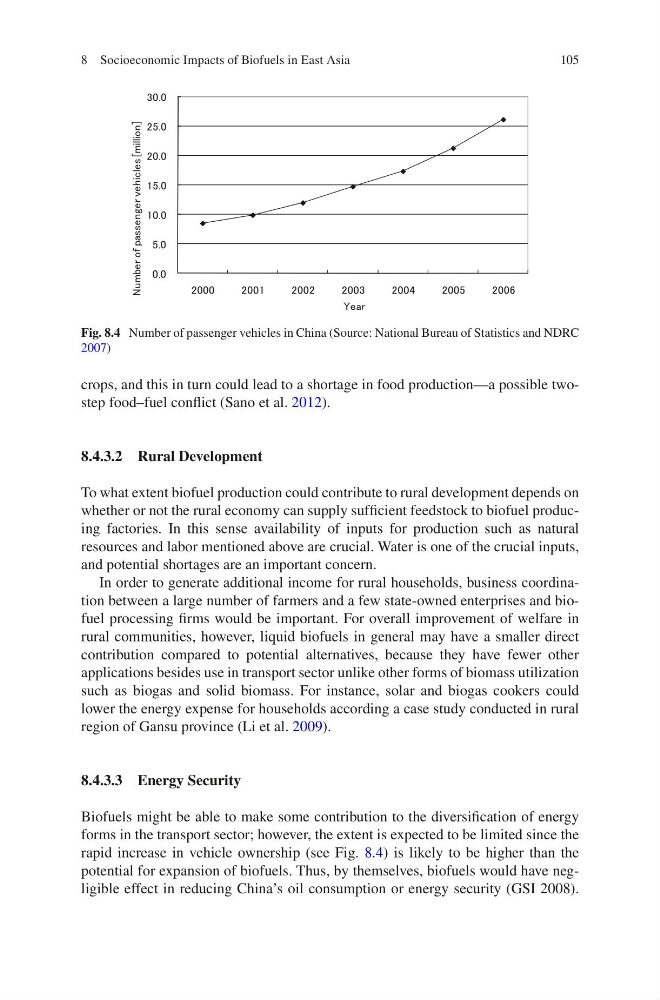
Biofuels might be able to make some contribution to the diversification of energy
forms in the transport sector; however, the extent is expected to be limited since the
rapid increase in vehicle ownership (see Fig. 8.4) is likely to be higher than the
potential for expansion of biofuels. Thus, by themselves, biofuels would have negligible effect in reducing China’s oil consumption or energy security (GSI 2008).
Fig. 8.4 Number of passenger vehicles in China (Source: National Bureau of Statistics and NDRC
2007)
8 Socioeconomic Impacts of Biofuels in East Asia
crops, and this in turn could lead to a shortage in food production—a possible twostep food–fuel conflict (Sano et al. 2012).
8.4.3.2 Rural Development
To what extent biofuel production could contribute to rural development depends on
whether or not the rural economy can supply sufficient feedstock to biofuel producing factories. In this sense availability of inputs for production such as natural
resources and labor mentioned above are crucial. Water is one of the crucial inputs,
and potential shortages are an important concern.
In order to generate additional income for rural households, business coordination between a large number of farmers and a few state-owned enterprises and biofuel processing firms would be important. For overall improvement of welfare in
rural communities, however, liquid biofuels in general may have a smaller direct
contribution compared to potential alternatives, because they have fewer other
applications besides use in transport sector unlike other forms of biomass utilization
such as biogas and solid biomass. For instance, solar and biogas cookers could
lower the energy expense for households according a case study conducted in rural
region of Gansu province (Li et al. 2009).
8.4.3.3 Energy Security
Biofuels might be able to make some contribution to the diversification of energy
forms in the transport sector; however, the extent is expected to be limited since the
rapid increase in vehicle ownership (see Fig. 8.4) is likely to be higher than the
potential for expansion of biofuels. Thus, by themselves, biofuels would have negligible effect in reducing China’s oil consumption or energy security (GSI 2008).
Fig. 8.4 Number of passenger vehicles in China (Source: National Bureau of Statistics and NDRC
2007)
8 Socioeconomic Impacts of Biofuels in East Asia