

104
seven plants were operated by China’s largest biodiesel producer Gushan
Environmental Energy Limited based in Hong Kong (Morimoto 2008; PetroChina
2008). Some biodiesel feedstocks, industrial waste oil and palm oil, have been
imported from Malaysia (PetroChina 2008).
Jatropha was regarded as one of the most promising feedstocks for biodiesel. In
2007, the State Forestry Administration (SFA) and PetroChina signed a contract to
cooperate on a 40,000 ha Jatropha project in Yunnan and Sichuan and with COFCO
(China National Cereals, Oils and Foodstuffs Corporation) in Guizhou. Foreign
investment also flowed in from the UK to Guangxi and Yunnan, from the USA to
Sichuan, and from Germany to Yunnan (Mang 2008).
8.4.2.3 Emerging Research on Second-Generation Biofuels
With abundant agriculture and forestry residues available in China, a considerable
amount of second-generation biofuels was expected. However, there were only two
second-generation biofuel pilot plants operating using corn stover as feedstock as of
2010 (IEA 2010). Water use and wastewater for/from the process could potentially
cause environmental problems (IEA 2010).
8.4.3 Socioeconomic Impacts
8.4.3.1 Employment
Agricultural labor availability in rural China has been rapidly decreasing, and more
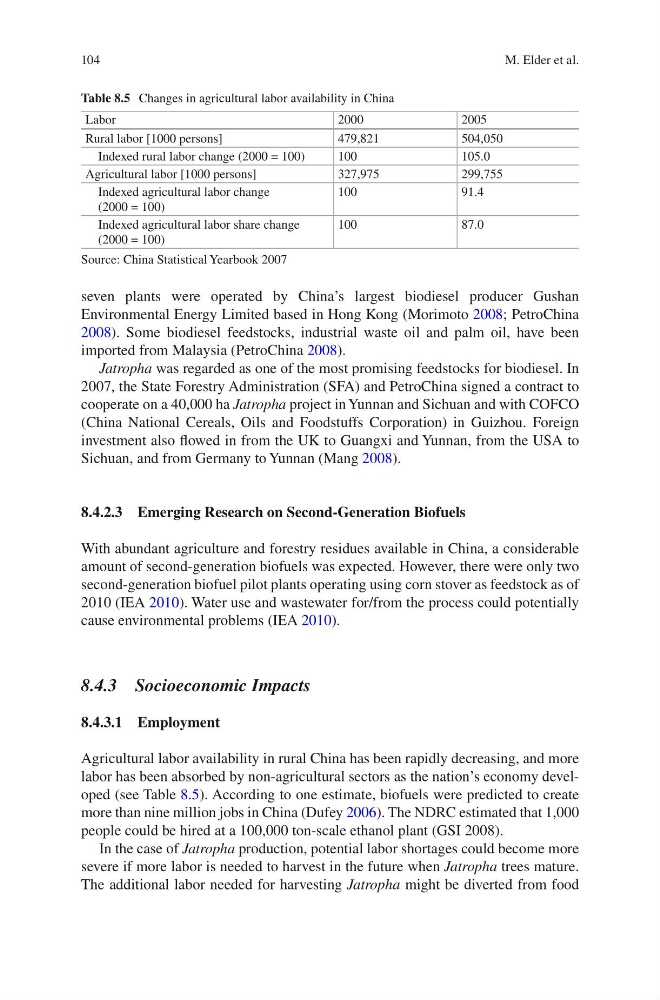
labor has been absorbed by non-agricultural sectors as the nation’s economy developed (see Table 8.5). According to one estimate, biofuels were predicted to create
more than nine million jobs in China (Dufey 2006). The NDRC estimated that 1,000
people could be hired at a 100,000 ton-scale ethanol plant (GSI 2008).
In the case of Jatropha production, potential labor shortages could become more
severe if more labor is needed to harvest in the future when Jatropha trees mature.
The additional labor needed for harvesting Jatropha might be diverted from food
Table 8.5 Changes in agricultural labor availability in China
Labor
2000
2005
Rural labor [1000 persons]
479,821
504,050
Indexed rural labor change (2000 = 100)
100
105.0
Agricultural labor [1000 persons]
327,975
299,755
Indexed agricultural labor change
(2000 = 100)
100
91.4
Indexed agricultural labor share change
(2000 = 100)
100
87.0
Source: China Statistical Yearbook 2007
M. Elder et al.
seven plants were operated by China’s largest biodiesel producer Gushan
Environmental Energy Limited based in Hong Kong (Morimoto 2008; PetroChina
2008). Some biodiesel feedstocks, industrial waste oil and palm oil, have been
imported from Malaysia (PetroChina 2008).
Jatropha was regarded as one of the most promising feedstocks for biodiesel. In
2007, the State Forestry Administration (SFA) and PetroChina signed a contract to
cooperate on a 40,000 ha Jatropha project in Yunnan and Sichuan and with COFCO
(China National Cereals, Oils and Foodstuffs Corporation) in Guizhou. Foreign
investment also flowed in from the UK to Guangxi and Yunnan, from the USA to
Sichuan, and from Germany to Yunnan (Mang 2008).
8.4.2.3 Emerging Research on Second-Generation Biofuels
With abundant agriculture and forestry residues available in China, a considerable
amount of second-generation biofuels was expected. However, there were only two
second-generation biofuel pilot plants operating using corn stover as feedstock as of
2010 (IEA 2010). Water use and wastewater for/from the process could potentially
cause environmental problems (IEA 2010).
8.4.3 Socioeconomic Impacts
8.4.3.1 Employment
Agricultural labor availability in rural China has been rapidly decreasing, and more
labor has been absorbed by non-agricultural sectors as the nation’s economy developed (see Table 8.5). According to one estimate, biofuels were predicted to create
more than nine million jobs in China (Dufey 2006). The NDRC estimated that 1,000
people could be hired at a 100,000 ton-scale ethanol plant (GSI 2008).
In the case of Jatropha production, potential labor shortages could become more
severe if more labor is needed to harvest in the future when Jatropha trees mature.
The additional labor needed for harvesting Jatropha might be diverted from food
Table 8.5 Changes in agricultural labor availability in China
Labor
2000
2005
Rural labor [1000 persons]
479,821
504,050
Indexed rural labor change (2000 = 100)
100
105.0
Agricultural labor [1000 persons]
327,975
299,755
Indexed agricultural labor change
(2000 = 100)
100
91.4
Indexed agricultural labor share change
(2000 = 100)
100
87.0
Source: China Statistical Yearbook 2007
M. Elder et al.