

25
Although there is a trend (enabled by the faster computational resources) to
increase the spatial resolution of the mesoscale models, regional weather prediction
and climate models still fail to capture appropriately the impact of local urban features on the mesoscale meteorology and climate without special sub-grid scale
treatment. This accelerated the implementation and application of urban canopy
sub-models (Chen et al. 2010 or Lee et al. 2010). For the regional climate model
RegCM4 we have chosen the Single Layer Urban Canopy Model (SLUCM)
developed by Kusaka et al. (2001) and Kusaka and Kimura (2004); this scheme is
proven to perform well in simulating the urban environment and it is less demanding in computational resources unlike its multi-layer counterparts (Lee et al. 2010).
SLUCM considers the urban surface in a realistic way: it assumes street canyons
with a certain width; in the street canyon, shadowing, reflection and trapping of
Euro-CORDEX-CMIPS-STS-EOBS8 t2avg 1990-2008
60°N
50°N
40°N
30°N
20°N
60°N
50°N
40°N
30°N
20°N
60°N
50°N
40°N
30°N
20°N
60°N
50°N
40°N
30°N
20°N
10°W
10°E
0°
20°E 30°E
10°W
10°E
0°
20°E 30°E
10°W
10°E
–4.5
–3.0
DJF
MAM
SON
JJA
–1.5
0.0
1.5
3.0
4.5
0°
20°E 30°E
10°W
10°E
0°
20°E 30°E
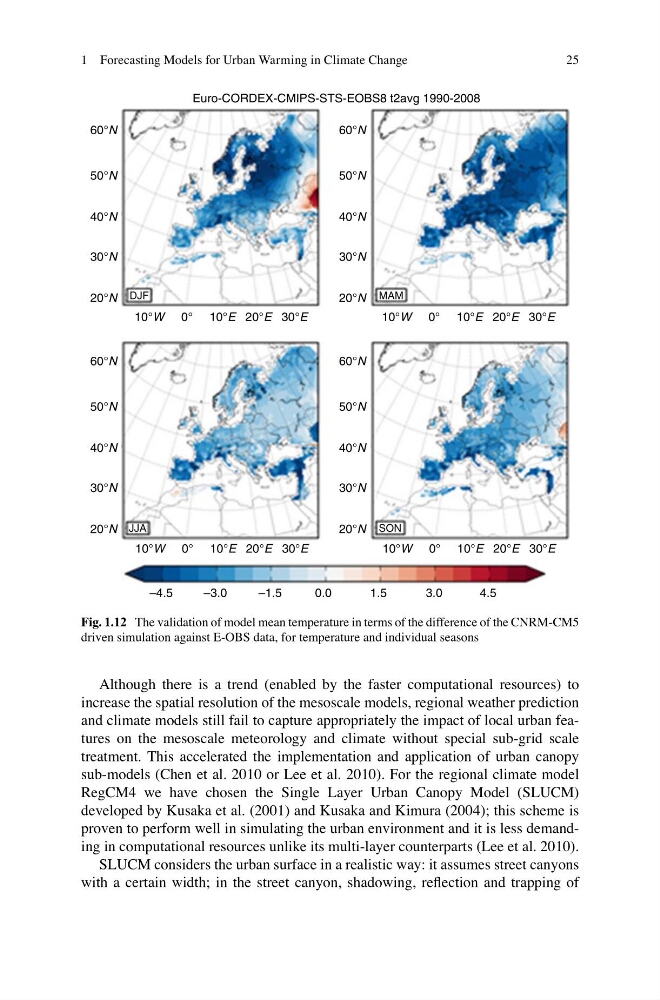
Fig. 1.12 The validation of model mean temperature in terms of the difference of the CNRM-CM5
driven simulation against E-OBS data, for temperature and individual seasons
1 Forecasting Models for Urban Warming in Climate Change
Although there is a trend (enabled by the faster computational resources) to
increase the spatial resolution of the mesoscale models, regional weather prediction
and climate models still fail to capture appropriately the impact of local urban features on the mesoscale meteorology and climate without special sub-grid scale
treatment. This accelerated the implementation and application of urban canopy
sub-models (Chen et al. 2010 or Lee et al. 2010). For the regional climate model
RegCM4 we have chosen the Single Layer Urban Canopy Model (SLUCM)
developed by Kusaka et al. (2001) and Kusaka and Kimura (2004); this scheme is
proven to perform well in simulating the urban environment and it is less demanding in computational resources unlike its multi-layer counterparts (Lee et al. 2010).
SLUCM considers the urban surface in a realistic way: it assumes street canyons
with a certain width; in the street canyon, shadowing, reflection and trapping of
Euro-CORDEX-CMIPS-STS-EOBS8 t2avg 1990-2008
60°N
50°N
40°N
30°N
20°N
60°N
50°N
40°N
30°N
20°N
60°N
50°N
40°N
30°N
20°N
60°N
50°N
40°N
30°N
20°N
10°W
10°E
0°
20°E 30°E
10°W
10°E
0°
20°E 30°E
10°W
10°E
–4.5
–3.0
DJF
MAM
SON
JJA
–1.5
0.0
1.5
3.0
4.5
0°
20°E 30°E
10°W
10°E
0°
20°E 30°E
Fig. 1.12 The validation of model mean temperature in terms of the difference of the CNRM-CM5
driven simulation against E-OBS data, for temperature and individual seasons
1 Forecasting Models for Urban Warming in Climate Change