

381
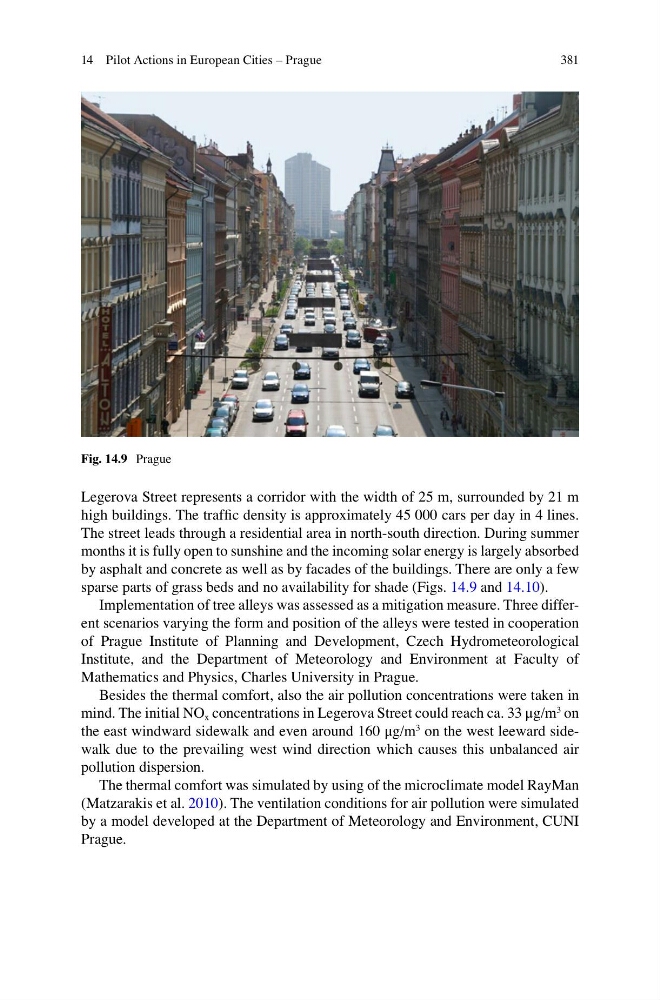
Fig. 14.9 Prague
Legerova Street represents a corridor with the width of 25 m, surrounded by 21 m
high buildings. The traffic density is approximately 45 000 cars per day in 4 lines.
The street leads through a residential area in north-south direction. During summer
months it is fully open to sunshine and the incoming solar energy is largely absorbed
by asphalt and concrete as well as by facades of the buildings. There are only a few
sparse parts of grass beds and no availability for shade (Figs. 14.9 and 14.10).
Implementation of tree alleys was assessed as a mitigation measure. Three different scenarios varying the form and position of the alleys were tested in cooperation
of Prague Institute of Planning and Development, Czech Hydrometeorological
Institute, and the Department of Meteorology and Environment at Faculty of
Mathematics and Physics, Charles University in Prague.
Besides the thermal comfort, also the air pollution concentrations were taken in
mind. The initial NO x concentrations in Legerova Street could reach ca. 33 μg/m
3 on
the east windward sidewalk and even around 160 μg/m
3 on the west leeward sidewalk due to the prevailing west wind direction which causes this unbalanced air
pollution dispersion.
The thermal comfort was simulated by using of the microclimate model RayMan
(Matzarakis et al. 2010). The ventilation conditions for air pollution were simulated
by a model developed at the Department of Meteorology and Environment, CUNI
Prague.
14 Pilot Actions in European Cities – Prague
Fig. 14.9 Prague
Legerova Street represents a corridor with the width of 25 m, surrounded by 21 m
high buildings. The traffic density is approximately 45 000 cars per day in 4 lines.
The street leads through a residential area in north-south direction. During summer
months it is fully open to sunshine and the incoming solar energy is largely absorbed
by asphalt and concrete as well as by facades of the buildings. There are only a few
sparse parts of grass beds and no availability for shade (Figs. 14.9 and 14.10).
Implementation of tree alleys was assessed as a mitigation measure. Three different scenarios varying the form and position of the alleys were tested in cooperation
of Prague Institute of Planning and Development, Czech Hydrometeorological
Institute, and the Department of Meteorology and Environment at Faculty of
Mathematics and Physics, Charles University in Prague.
Besides the thermal comfort, also the air pollution concentrations were taken in
mind. The initial NO x concentrations in Legerova Street could reach ca. 33 μg/m
3 on
the east windward sidewalk and even around 160 μg/m
3 on the west leeward sidewalk due to the prevailing west wind direction which causes this unbalanced air
pollution dispersion.
The thermal comfort was simulated by using of the microclimate model RayMan
(Matzarakis et al. 2010). The ventilation conditions for air pollution were simulated
by a model developed at the Department of Meteorology and Environment, CUNI
Prague.
14 Pilot Actions in European Cities – Prague