

354
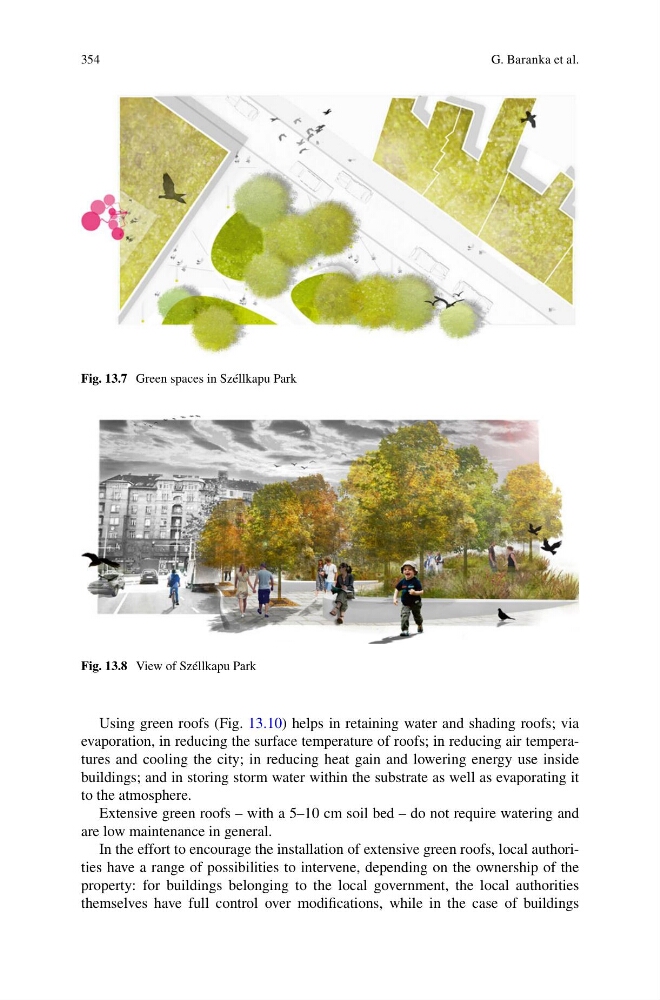
Fig. 13.8 View of Széllkapu Park
Fig. 13.7 Green spaces in Széllkapu Park
Using green roofs (Fig. 13.10 ) helps in retaining water and shading roofs; via
evaporation, in reducing the surface temperature of roofs; in reducing air temperatures and cooling the city; in reducing heat gain and lowering energy use inside
buildings; and in storing storm water within the substrate as well as evaporating it
to the atmosphere.
Extensive green roofs – with a 5–10 cm soil bed – do not require watering and
are low maintenance in general.
In the effort to encourage the installation of extensive green roofs, local authorities have a range of possibilities to intervene, depending on the ownership of the
property: for buildings belonging to the local government, the local authorities
themselves have full control over modifi cations, while in the case of buildings
G. Baranka et al.
Fig. 13.8 View of Széllkapu Park
Fig. 13.7 Green spaces in Széllkapu Park
Using green roofs (Fig. 13.10 ) helps in retaining water and shading roofs; via
evaporation, in reducing the surface temperature of roofs; in reducing air temperatures and cooling the city; in reducing heat gain and lowering energy use inside
buildings; and in storing storm water within the substrate as well as evaporating it
to the atmosphere.
Extensive green roofs – with a 5–10 cm soil bed – do not require watering and
are low maintenance in general.
In the effort to encourage the installation of extensive green roofs, local authorities have a range of possibilities to intervene, depending on the ownership of the
property: for buildings belonging to the local government, the local authorities
themselves have full control over modifi cations, while in the case of buildings
G. Baranka et al.