

353
the installation of new green spaces: a public park in the area bordered by Margitkörút – Kis Rókus utca – Fény utca, adjacent to Millenáris, which is to be called
“Széllkapu Park” – a pun on the neighbouring public transport hub called Széll
Kálmán tér and the Hungarian words szél (‘wind’) and kapu (‘gate’); at the corner
of Fillér utca and Garas utca (see Fig. 13.7 ); and in the inside courtyards of buildings Fillér utca 9–11 and Lövőház utca 24, 22, 20 and 16b.
These planned green spaces are characterised by multi-zone vegetation; the species and types recommended for planting in the Széllkapu area are similar to those
planted in Millenáris (Fig. 13.8 ). Within green spaces, permeable pavement may be
applied in areas paved for foot and service traffi c: gravel, concrete tiles and light
natural stone, such as limestone.
Permeable pavement is applied to decrease storm water runoff and desiccated
soil in the city, thereby increasing evaporation even on paved surfaces.
Recommended locations: replacing older pavement on sidewalks (except for
Lövőház utca, Káplár utca and Keleti Károly utca), and in parking lanes. As for the
choice of materials, an important consideration is the use of light colours for a
higher albedo, instead of dark, waterproof asphalt. For sidewalks, mostly used for
foot traffi c, the use of concrete tiles is recommended, while for areas of heavy use
(surfaces in new green spaces) natural stone – limestone – is suggested.
For the installation, permeable pointing and foundation work must be applied.
Green Walls – Vertical Gardens
The use of green walls or vertical gardens contributes to the shading of walls,
thereby lowering the surface temperature of wall facades, reducing heat gain and
lowering energy use inside buildings, as well as cooling through evapotranspiration.
Green walls or vertical gardens are best used in locations where the width of the
street does not allow for the placement of any other vegetation. Recommended
locations: Kis Rókus utca 35, 18 (Fig. 13.9 ); Fény utca 21 (on the facade of the
Melegpörgető building). Species and types of plants recommended: Parthenocissus
ssp., Vitis ssp., Hedera ssp., Reynourtia ssp.
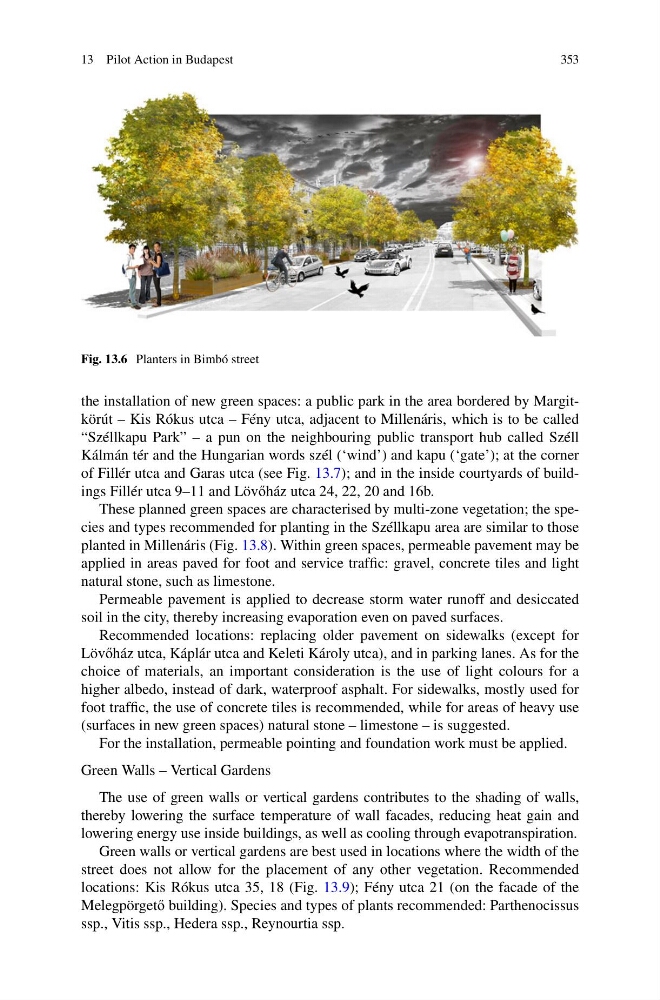
Fig. 13.6 Planters in Bimbó street
13 Pilot Action in Budapest
the installation of new green spaces: a public park in the area bordered by Margitkörút – Kis Rókus utca – Fény utca, adjacent to Millenáris, which is to be called
“Széllkapu Park” – a pun on the neighbouring public transport hub called Széll
Kálmán tér and the Hungarian words szél (‘wind’) and kapu (‘gate’); at the corner
of Fillér utca and Garas utca (see Fig. 13.7 ); and in the inside courtyards of buildings Fillér utca 9–11 and Lövőház utca 24, 22, 20 and 16b.
These planned green spaces are characterised by multi-zone vegetation; the species and types recommended for planting in the Széllkapu area are similar to those
planted in Millenáris (Fig. 13.8 ). Within green spaces, permeable pavement may be
applied in areas paved for foot and service traffi c: gravel, concrete tiles and light
natural stone, such as limestone.
Permeable pavement is applied to decrease storm water runoff and desiccated
soil in the city, thereby increasing evaporation even on paved surfaces.
Recommended locations: replacing older pavement on sidewalks (except for
Lövőház utca, Káplár utca and Keleti Károly utca), and in parking lanes. As for the
choice of materials, an important consideration is the use of light colours for a
higher albedo, instead of dark, waterproof asphalt. For sidewalks, mostly used for
foot traffi c, the use of concrete tiles is recommended, while for areas of heavy use
(surfaces in new green spaces) natural stone – limestone – is suggested.
For the installation, permeable pointing and foundation work must be applied.
Green Walls – Vertical Gardens
The use of green walls or vertical gardens contributes to the shading of walls,
thereby lowering the surface temperature of wall facades, reducing heat gain and
lowering energy use inside buildings, as well as cooling through evapotranspiration.
Green walls or vertical gardens are best used in locations where the width of the
street does not allow for the placement of any other vegetation. Recommended
locations: Kis Rókus utca 35, 18 (Fig. 13.9 ); Fény utca 21 (on the facade of the
Melegpörgető building). Species and types of plants recommended: Parthenocissus
ssp., Vitis ssp., Hedera ssp., Reynourtia ssp.
Fig. 13.6 Planters in Bimbó street
13 Pilot Action in Budapest