

331
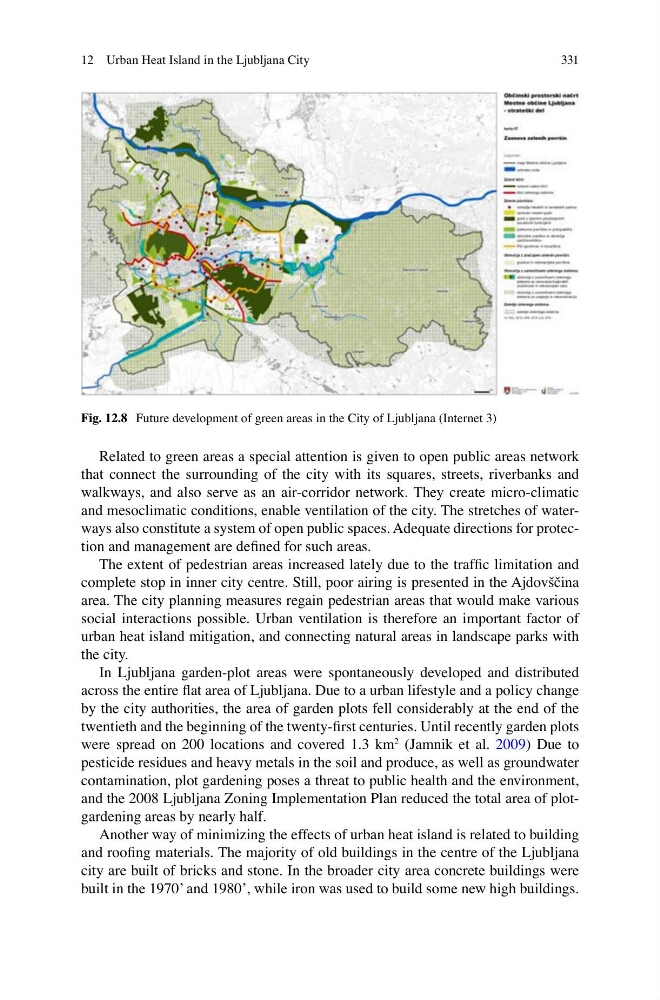
Related to green areas a special attention is given to open public areas network
that connect the surrounding of the city with its squares, streets, riverbanks and
walkways, and also serve as an air-corridor network. They create micro-climatic
and mesoclimatic conditions, enable ventilation of the city. The stretches of waterways also constitute a system of open public spaces. Adequate directions for protection and management are defi ned for such areas.
The extent of pedestrian areas increased lately due to the traffi c limitation and
complete stop in inner city centre. Still, poor airing is presented in the Ajdovščina
area. The city planning measures regain pedestrian areas that would make various
social interactions possible. Urban ventilation is therefore an important factor of
urban heat island mitigation, and connecting natural areas in landscape parks with
the city.
In Ljubljana garden-plot areas were spontaneously developed and distributed
across the entire fl at area of Ljubljana. Due to a urban lifestyle and a policy change
by the city authorities, the area of garden plots fell considerably at the end of the
twentieth and the beginning of the twenty-fi rst centuries. Until recently garden plots
were spread on 200 locations and covered 1.3 km
2 (Jamnik et al. 2009 ) Due to
pesticide residues and heavy metals in the soil and produce, as well as groundwater
contamination, plot gardening poses a threat to public health and the environment,
and the 2008 Ljubljana Zoning Implementation Plan reduced the total area of plotgardening areas by nearly half.
Another way of minimizing the effects of urban heat island is related to building
and roofi ng materials. The majority of old buildings in the centre of the Ljubljana
city are built of bricks and stone. In the broader city area concrete buildings were
built in the 1970’ and 1980’, while iron was used to build some new high buildings.
Fig. 12.8 Future development of green areas in the City of Ljubljana (Internet 3)
12 Urban Heat Island in the Ljubljana City
Related to green areas a special attention is given to open public areas network
that connect the surrounding of the city with its squares, streets, riverbanks and
walkways, and also serve as an air-corridor network. They create micro-climatic
and mesoclimatic conditions, enable ventilation of the city. The stretches of waterways also constitute a system of open public spaces. Adequate directions for protection and management are defi ned for such areas.
The extent of pedestrian areas increased lately due to the traffi c limitation and
complete stop in inner city centre. Still, poor airing is presented in the Ajdovščina
area. The city planning measures regain pedestrian areas that would make various
social interactions possible. Urban ventilation is therefore an important factor of
urban heat island mitigation, and connecting natural areas in landscape parks with
the city.
In Ljubljana garden-plot areas were spontaneously developed and distributed
across the entire fl at area of Ljubljana. Due to a urban lifestyle and a policy change
by the city authorities, the area of garden plots fell considerably at the end of the
twentieth and the beginning of the twenty-fi rst centuries. Until recently garden plots
were spread on 200 locations and covered 1.3 km
2 (Jamnik et al. 2009 ) Due to
pesticide residues and heavy metals in the soil and produce, as well as groundwater
contamination, plot gardening poses a threat to public health and the environment,
and the 2008 Ljubljana Zoning Implementation Plan reduced the total area of plotgardening areas by nearly half.
Another way of minimizing the effects of urban heat island is related to building
and roofi ng materials. The majority of old buildings in the centre of the Ljubljana
city are built of bricks and stone. In the broader city area concrete buildings were
built in the 1970’ and 1980’, while iron was used to build some new high buildings.
Fig. 12.8 Future development of green areas in the City of Ljubljana (Internet 3)
12 Urban Heat Island in the Ljubljana City