

309
with coniferous shrubs grow between the buildings. Only a few young deciduous
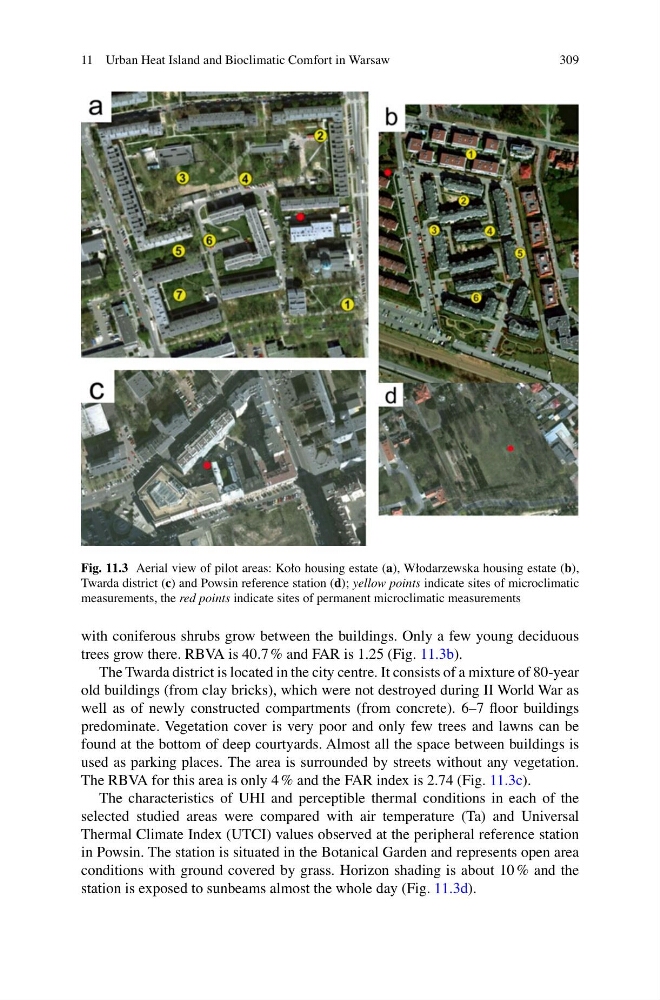
trees grow there. RBVA is 40.7 % and FAR is 1.25 (Fig. 11.3b ).
The Twarda district is located in the city centre. It consists of a mixture of 80-year
old buildings (from clay bricks), which were not destroyed during II World War as
well as of newly constructed compartments (from concrete). 6–7 fl oor buildings
predominate. Vegetation cover is very poor and only few trees and lawns can be
found at the bottom of deep courtyards. Almost all the space between buildings is
used as parking places. The area is surrounded by streets without any vegetation.
The RBVA for this area is only 4 % and the FAR index is 2.74 (Fig. 11.3c ).
The characteristics of UHI and perceptible thermal conditions in each of the
selected studied areas were compared with air temperature (Ta) and Universal
Thermal Climate Index (UTCI) values observed at the peripheral reference station
in Powsin. The station is situated in the Botanical Garden and represents open area
conditions with ground covered by grass. Horizon shading is about 10 % and the
station is exposed to sunbeams almost the whole day (Fig. 11.3d ).
Fig. 11.3 Aerial view of pilot areas: Koło housing estate ( a ), Włodarzewska housing estate ( b ),
Twarda district ( c ) and Powsin reference station ( d ); yellow points indicate sites of microclimatic
measurements, the red points indicate sites of permanent microclimatic measurements
11 Urban Heat Island and Bioclimatic Comfort in Warsaw
with coniferous shrubs grow between the buildings. Only a few young deciduous
trees grow there. RBVA is 40.7 % and FAR is 1.25 (Fig. 11.3b ).
The Twarda district is located in the city centre. It consists of a mixture of 80-year
old buildings (from clay bricks), which were not destroyed during II World War as
well as of newly constructed compartments (from concrete). 6–7 fl oor buildings
predominate. Vegetation cover is very poor and only few trees and lawns can be
found at the bottom of deep courtyards. Almost all the space between buildings is
used as parking places. The area is surrounded by streets without any vegetation.
The RBVA for this area is only 4 % and the FAR index is 2.74 (Fig. 11.3c ).
The characteristics of UHI and perceptible thermal conditions in each of the
selected studied areas were compared with air temperature (Ta) and Universal
Thermal Climate Index (UTCI) values observed at the peripheral reference station
in Powsin. The station is situated in the Botanical Garden and represents open area
conditions with ground covered by grass. Horizon shading is about 10 % and the
station is exposed to sunbeams almost the whole day (Fig. 11.3d ).
Fig. 11.3 Aerial view of pilot areas: Koło housing estate ( a ), Włodarzewska housing estate ( b ),
Twarda district ( c ) and Powsin reference station ( d ); yellow points indicate sites of microclimatic
measurements, the red points indicate sites of permanent microclimatic measurements
11 Urban Heat Island and Bioclimatic Comfort in Warsaw