

271
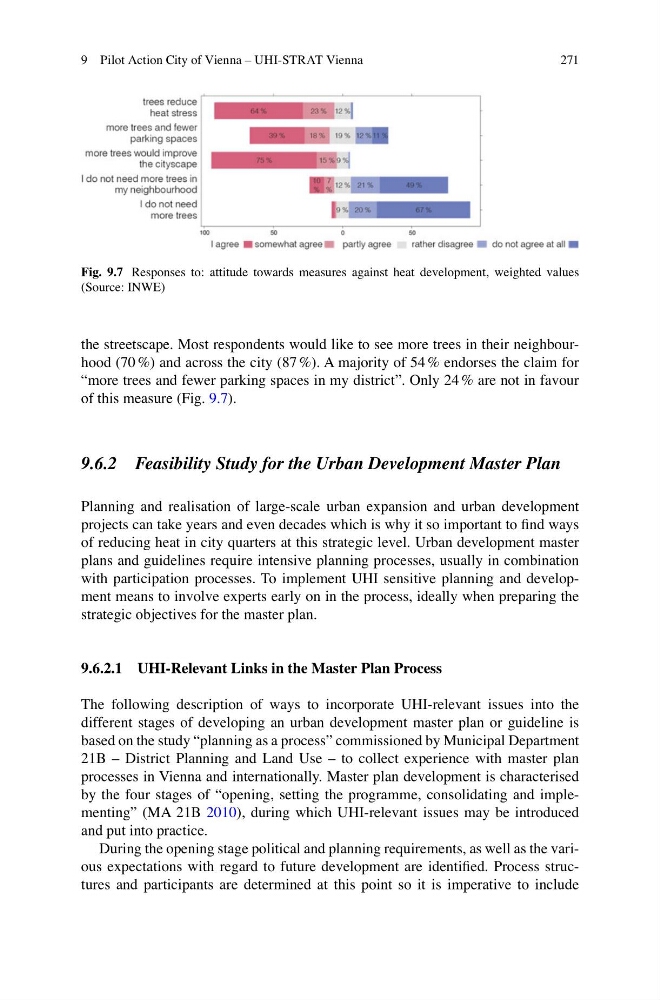
the streetscape. Most respondents would like to see more trees in their neighbourhood (70 %) and across the city (87 %). A majority of 54 % endorses the claim for
“more trees and fewer parking spaces in my district”. Only 24 % are not in favour
of this measure (Fig. 9.7 ).
9.6.2 Feasibility Study for the Urban Development Master Plan
Planning and realisation of large-scale urban expansion and urban development
projects can take years and even decades which is why it so important to fi nd ways
of reducing heat in city quarters at this strategic level. Urban development master
plans and guidelines require intensive planning processes, usually in combination
with participation processes. To implement UHI sensitive planning and development means to involve experts early on in the process, ideally when preparing the
strategic objectives for the master plan.
9.6.2.1 UHI-Relevant Links in the Master Plan Process
The following description of ways to incorporate UHI-relevant issues into the
different stages of developing an urban development master plan or guideline is
based on the study “planning as a process” commissioned by Municipal Department
21B – District Planning and Land Use – to collect experience with master plan
processes in Vienna and internationally. Master plan development is characterised
by the four stages of “opening, setting the programme, consolidating and implementing” (MA 21B 2010 ), during which UHI-relevant issues may be introduced
and put into practice.
During the opening stage political and planning requirements, as well as the various expectations with regard to future development are identifi ed. Process structures and participants are determined at this point so it is imperative to include
Fig. 9.7 Responses to: attitude towards measures against heat development, weighted values
(Source: INWE)
9 Pilot Action City of Vienna – UHI-STRAT Vienna
the streetscape. Most respondents would like to see more trees in their neighbourhood (70 %) and across the city (87 %). A majority of 54 % endorses the claim for
“more trees and fewer parking spaces in my district”. Only 24 % are not in favour
of this measure (Fig. 9.7 ).
9.6.2 Feasibility Study for the Urban Development Master Plan
Planning and realisation of large-scale urban expansion and urban development
projects can take years and even decades which is why it so important to fi nd ways
of reducing heat in city quarters at this strategic level. Urban development master
plans and guidelines require intensive planning processes, usually in combination
with participation processes. To implement UHI sensitive planning and development means to involve experts early on in the process, ideally when preparing the
strategic objectives for the master plan.
9.6.2.1 UHI-Relevant Links in the Master Plan Process
The following description of ways to incorporate UHI-relevant issues into the
different stages of developing an urban development master plan or guideline is
based on the study “planning as a process” commissioned by Municipal Department
21B – District Planning and Land Use – to collect experience with master plan
processes in Vienna and internationally. Master plan development is characterised
by the four stages of “opening, setting the programme, consolidating and implementing” (MA 21B 2010 ), during which UHI-relevant issues may be introduced
and put into practice.
During the opening stage political and planning requirements, as well as the various expectations with regard to future development are identifi ed. Process structures and participants are determined at this point so it is imperative to include
Fig. 9.7 Responses to: attitude towards measures against heat development, weighted values
(Source: INWE)
9 Pilot Action City of Vienna – UHI-STRAT Vienna