

270
survey refl ects people’s attitude towards heat in the city, their behaviour during heat
waves, as well as their assessment of the measures employed to reduce the UHI
effect.
9.6.1 People’s Attitude Towards Heat in the City
385 answers were collected during this postal survey among people in Vienna to
assess their perception and attitudes towards heat in the city.
The survey was done in August 2013. Questionnaires were sent to 3792 households in Vienna, which approximately 10 % of the addressees replied to. 27 blocks
of fl ats were picked out randomly from different areas in Vienna, some more densely
built-up than others, and the responses were weighted to arrive at as representative
as possible a sample. Almost everyone in Vienna has witnessed at least one heat
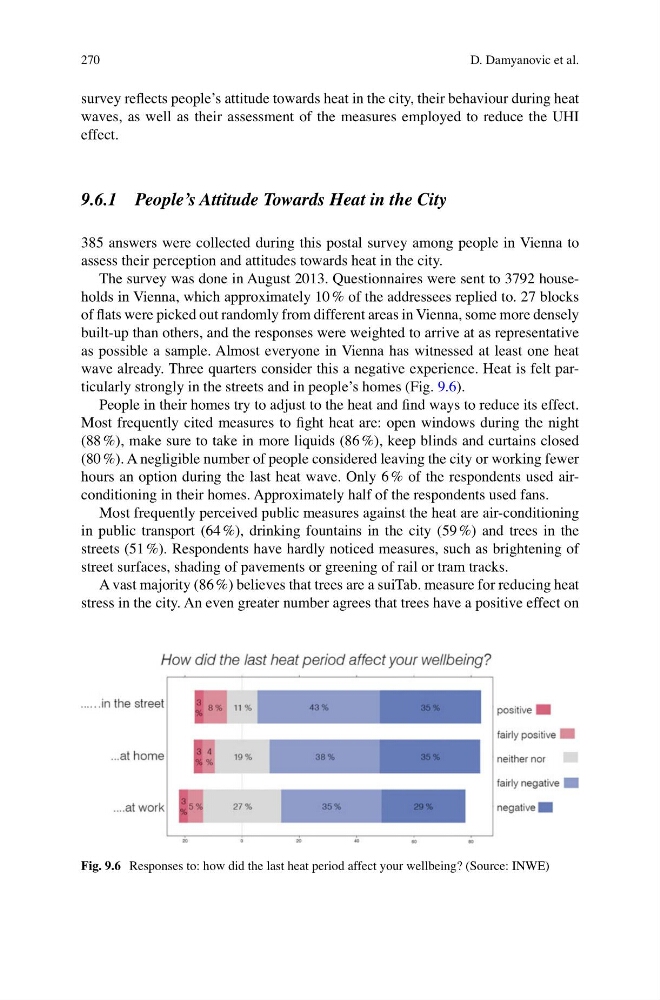
wave already. Three quarters consider this a negative experience. Heat is felt particularly strongly in the streets and in people’s homes (Fig. 9.6 ).
People in their homes try to adjust to the heat and fi nd ways to reduce its effect.
Most frequently cited measures to fi ght heat are: open windows during the night
(88 %), make sure to take in more liquids (86 %), keep blinds and curtains closed
(80 %). A negligible number of people considered leaving the city or working fewer
hours an option during the last heat wave. Only 6 % of the respondents used airconditioning in their homes. Approximately half of the respondents used fans.
Most frequently perceived public measures against the heat are air-conditioning
in public transport (64 %), drinking fountains in the city (59 %) and trees in the
streets (51 %). Respondents have hardly noticed measures, such as brightening of
street surfaces, shading of pavements or greening of rail or tram tracks.
A vast majority (86 %) believes that trees are a suiTab. measure for reducing heat
stress in the city. An even greater number agrees that trees have a positive effect on
Fig. 9.6 Responses to: how did the last heat period affect your wellbeing? (Source: INWE)
D. Damyanovic et al.
survey refl ects people’s attitude towards heat in the city, their behaviour during heat
waves, as well as their assessment of the measures employed to reduce the UHI
effect.
9.6.1 People’s Attitude Towards Heat in the City
385 answers were collected during this postal survey among people in Vienna to
assess their perception and attitudes towards heat in the city.
The survey was done in August 2013. Questionnaires were sent to 3792 households in Vienna, which approximately 10 % of the addressees replied to. 27 blocks
of fl ats were picked out randomly from different areas in Vienna, some more densely
built-up than others, and the responses were weighted to arrive at as representative
as possible a sample. Almost everyone in Vienna has witnessed at least one heat
wave already. Three quarters consider this a negative experience. Heat is felt particularly strongly in the streets and in people’s homes (Fig. 9.6 ).
People in their homes try to adjust to the heat and fi nd ways to reduce its effect.
Most frequently cited measures to fi ght heat are: open windows during the night
(88 %), make sure to take in more liquids (86 %), keep blinds and curtains closed
(80 %). A negligible number of people considered leaving the city or working fewer
hours an option during the last heat wave. Only 6 % of the respondents used airconditioning in their homes. Approximately half of the respondents used fans.
Most frequently perceived public measures against the heat are air-conditioning
in public transport (64 %), drinking fountains in the city (59 %) and trees in the
streets (51 %). Respondents have hardly noticed measures, such as brightening of
street surfaces, shading of pavements or greening of rail or tram tracks.
A vast majority (86 %) believes that trees are a suiTab. measure for reducing heat
stress in the city. An even greater number agrees that trees have a positive effect on
Fig. 9.6 Responses to: how did the last heat period affect your wellbeing? (Source: INWE)
D. Damyanovic et al.