

218
– The “Green ground” mitigation strategy allows an appreciable UHI maximum
intensity decrease only in point 2 (around 1 °C): in all other points the positive
effect of the action is quite negligible;
– During the day (afternoon) the most effective mitigation actions are “Green
ground” and “Green ground + cool pavements”: they allow till 3 °C decrease in
UHI intensity;
– During all the other seasons, but especially in winter, the most effective UHI
mitigation strategies (“Cool pavements” and “Green ground + cool pavements”)
cause a negative effect during the central hours of the day: UHI intensity becomes
negative, that is air temperature in urban zone id colder (about 0.5 °C) than in
rural zone.
Acknowledgement This chapter was based on the work undertaken as part of the UHI Project
implemented through the CENTRAL EUROPE Programme 2007–2013 co-fi nanced by the ERDF
(grant number 3CE292P3). The authors are grateful to Mr. Pierpaolo Campostrini and Mr. Matteo
Morgantin (CORILA) for the support. Thanks to ARPAV and to Mr. Matteo Sottana for the use of
meteorological data. Thanks to Prof. A. Matzarakis (Meteorological Institute – University of
Freiburg) for the use of RayMan simulation model and to Prof. M. Bruse (Inst. of Geography –
University of Mainz) for the use of ENVI-met simulation model.
Open Access This chapter is distributed under the terms of the Creative Commons Attribution 4.0
International License ( http://creativecommons.org/licenses/by/4.0/ ), which permits use, duplication, adaptation, distribution and reproduction in any medium or format, as long as you give appropriate credit to the original author(s) and the source, a link is provided to the Creative Commons
license and any changes made are indicated.
The images or other third party material in this chapter are included in the work's Creative
Commons license, unless indicated otherwise in the credit line; if such material is not included in
the work's Creative Commons license and the respective action is not permitted by statutory regulation, users will need to obtain permission from the license holder to duplicate, adapt or reproduce
the material.
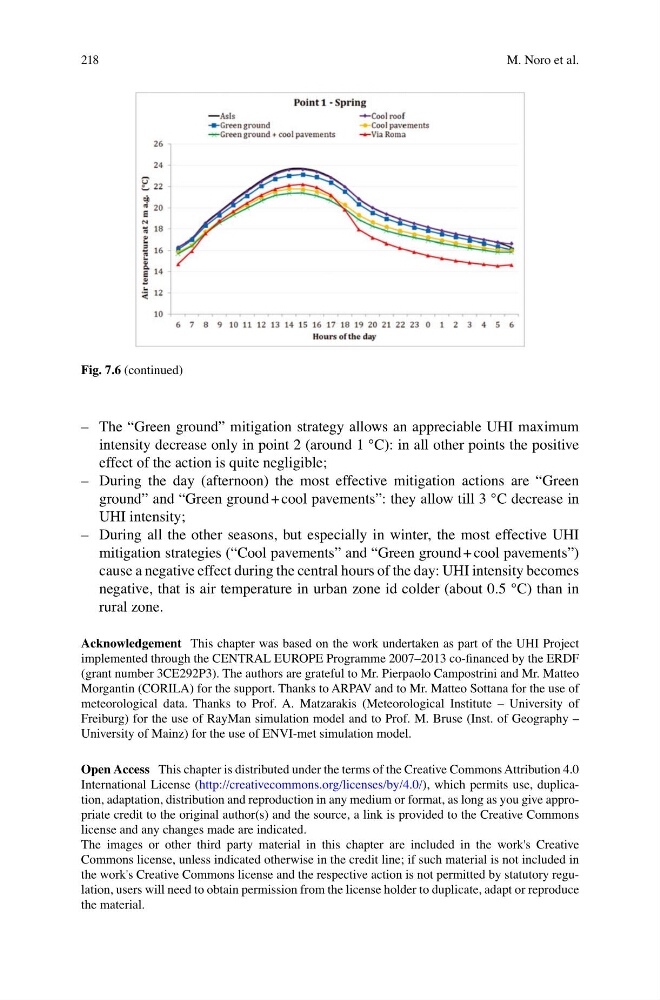
Fig. 7.6 (continued)
M. Noro et al.
– The “Green ground” mitigation strategy allows an appreciable UHI maximum
intensity decrease only in point 2 (around 1 °C): in all other points the positive
effect of the action is quite negligible;
– During the day (afternoon) the most effective mitigation actions are “Green
ground” and “Green ground + cool pavements”: they allow till 3 °C decrease in
UHI intensity;
– During all the other seasons, but especially in winter, the most effective UHI
mitigation strategies (“Cool pavements” and “Green ground + cool pavements”)
cause a negative effect during the central hours of the day: UHI intensity becomes
negative, that is air temperature in urban zone id colder (about 0.5 °C) than in
rural zone.
Acknowledgement This chapter was based on the work undertaken as part of the UHI Project
implemented through the CENTRAL EUROPE Programme 2007–2013 co-fi nanced by the ERDF
(grant number 3CE292P3). The authors are grateful to Mr. Pierpaolo Campostrini and Mr. Matteo
Morgantin (CORILA) for the support. Thanks to ARPAV and to Mr. Matteo Sottana for the use of
meteorological data. Thanks to Prof. A. Matzarakis (Meteorological Institute – University of
Freiburg) for the use of RayMan simulation model and to Prof. M. Bruse (Inst. of Geography –
University of Mainz) for the use of ENVI-met simulation model.
Open Access This chapter is distributed under the terms of the Creative Commons Attribution 4.0
International License ( http://creativecommons.org/licenses/by/4.0/ ), which permits use, duplication, adaptation, distribution and reproduction in any medium or format, as long as you give appropriate credit to the original author(s) and the source, a link is provided to the Creative Commons
license and any changes made are indicated.
The images or other third party material in this chapter are included in the work's Creative
Commons license, unless indicated otherwise in the credit line; if such material is not included in
the work's Creative Commons license and the respective action is not permitted by statutory regulation, users will need to obtain permission from the license holder to duplicate, adapt or reproduce
the material.
Fig. 7.6 (continued)
M. Noro et al.