

209
T mr and the higher values of wind velocity in via Pindemonte with respect to via
Rinaldi resulted in lower values of the thermal comfort indexes.
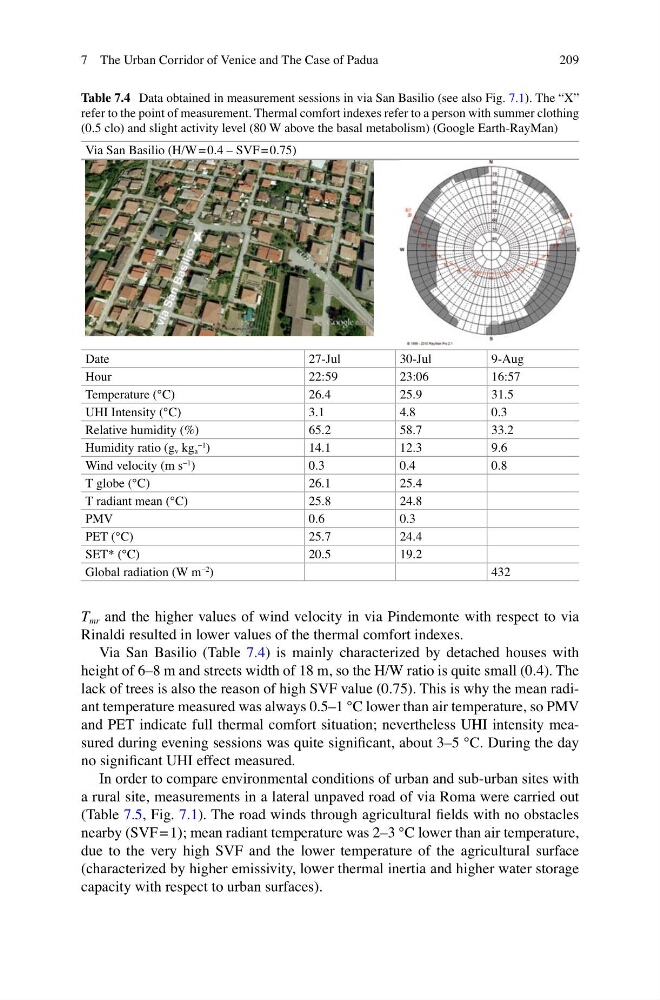
Via San Basilio (Table 7.4 ) is mainly characterized by detached houses with
height of 6–8 m and streets width of 18 m, so the H/W ratio is quite small (0.4). The
lack of trees is also the reason of high SVF value (0.75). This is why the mean radiant temperature measured was always 0.5–1 °C lower than air temperature, so PMV
and PET indicate full thermal comfort situation; nevertheless UHI intensity measured during evening sessions was quite signifi cant, about 3–5 °C. During the day
no signifi cant UHI effect measured.
In order to compare environmental conditions of urban and sub-urban sites with
a rural site, measurements in a lateral unpaved road of via Roma were carried out
(Table 7.5 , Fig. 7.1 ). The road winds through agricultural fi elds with no obstacles
nearby (SVF = 1); mean radiant temperature was 2–3 °C lower than air temperature,
due to the very high SVF and the lower temperature of the agricultural surface
(characterized by higher emissivity, lower thermal inertia and higher water storage
capacity with respect to urban surfaces).
Table 7.4 Data obtained in measurement sessions in via San Basilio (see also Fig. 7.1 ). The “X”
refer to the point of measurement. Thermal comfort indexes refer to a person with summer clothing
(0.5 clo) and slight activity level (80 W above the basal metabolism) (Google Earth-RayMan)
Via San Basilio (H/W = 0.4 – SVF = 0.75)
Date
27-Jul
30-Jul
9-Aug
Hour
22:59
23:06
16:57
Temperature (°C)
26.4
25.9
31.5
UHI Intensity (°C)
3.1
4.8
0.3
Relative humidity (%)
65.2
58.7
33.2
Humidity ratio (g v kg a
−1
)
14.1
12.3
9.6
Wind velocity (m s
−1
)
0.3
0.4
0.8
T globe (°C)
26.1
25.4
T radiant mean (°C)
25.8
24.8
PMV
0.6
0.3
PET (°C)
25.7
24.4
SET* (°C)
20.5
19.2
Global radiation (W m
−2
)
432
7 The Urban Corridor of Venice and The Case of Padua
T mr and the higher values of wind velocity in via Pindemonte with respect to via
Rinaldi resulted in lower values of the thermal comfort indexes.
Via San Basilio (Table 7.4 ) is mainly characterized by detached houses with
height of 6–8 m and streets width of 18 m, so the H/W ratio is quite small (0.4). The
lack of trees is also the reason of high SVF value (0.75). This is why the mean radiant temperature measured was always 0.5–1 °C lower than air temperature, so PMV
and PET indicate full thermal comfort situation; nevertheless UHI intensity measured during evening sessions was quite signifi cant, about 3–5 °C. During the day
no signifi cant UHI effect measured.
In order to compare environmental conditions of urban and sub-urban sites with
a rural site, measurements in a lateral unpaved road of via Roma were carried out
(Table 7.5 , Fig. 7.1 ). The road winds through agricultural fi elds with no obstacles
nearby (SVF = 1); mean radiant temperature was 2–3 °C lower than air temperature,
due to the very high SVF and the lower temperature of the agricultural surface
(characterized by higher emissivity, lower thermal inertia and higher water storage
capacity with respect to urban surfaces).
Table 7.4 Data obtained in measurement sessions in via San Basilio (see also Fig. 7.1 ). The “X”
refer to the point of measurement. Thermal comfort indexes refer to a person with summer clothing
(0.5 clo) and slight activity level (80 W above the basal metabolism) (Google Earth-RayMan)
Via San Basilio (H/W = 0.4 – SVF = 0.75)
Date
27-Jul
30-Jul
9-Aug
Hour
22:59
23:06
16:57
Temperature (°C)
26.4
25.9
31.5
UHI Intensity (°C)
3.1
4.8
0.3
Relative humidity (%)
65.2
58.7
33.2
Humidity ratio (g v kg a
−1
)
14.1
12.3
9.6
Wind velocity (m s
−1
)
0.3
0.4
0.8
T globe (°C)
26.1
25.4
T radiant mean (°C)
25.8
24.8
PMV
0.6
0.3
PET (°C)
25.7
24.4
SET* (°C)
20.5
19.2
Global radiation (W m
−2
)
432
7 The Urban Corridor of Venice and The Case of Padua