

182
HORIZONTAL SURFACES
14 "extensive" green
15 "cold"
It is possible to write the year of construction on the wall, in order to keep track of the
thermal resistance of the roof.
16 "cold" tiles
17 photovoltaic
(roof tile or else)
18 tile roof
19 light colour flat roof
20 dark colour flat roof
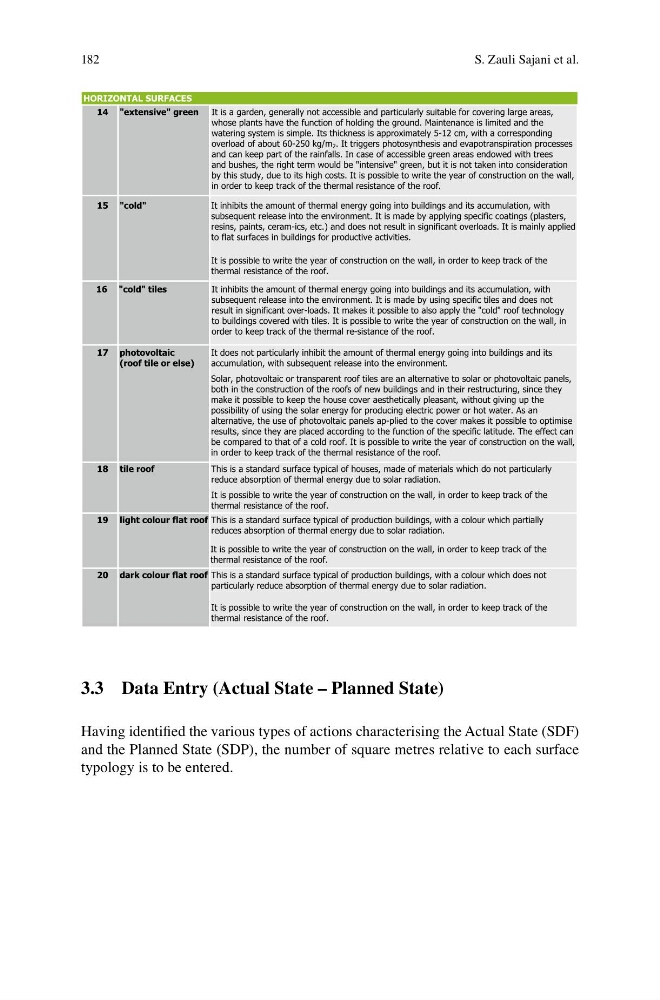
It is a garden, generally not accessible and particularly suitable for covering large areas,
whose plants have the function of holding the ground. Maintenance is limited and the
watering system is simple. Its thickness is approximately 5-12 cm, with a corresponding
overload of about 60-250 kg/m2. It triggers photosynthesis and evapotranspiration processes
and can keep part of the rainfalls. In case of accessible green areas endowed with trees
and bushes, the right term would be "intensive" green, but it is not taken into consideration
by this study, due to its high costs. It is possible to write the year of construction on the wall,
in order to keep track of the thermal resistance of the roof.
It inhibits the amount of thermal energy going into buildings and its accumulation, with
subsequent release into the environment. It is made by applying specific coatings (plasters,
resins, paints, ceram-ics, etc.) and does not result in significant overloads. It is mainly applied
to flat surfaces in buildings for productive activities.
It inhibits the amount of thermal energy going into buildings and its accumulation, with
subsequent release into the environment. It is made by using specific tiles and does not
result in significant over-loads. It makes it possible to also apply the "cold" roof technology
to buildings covered with tiles. It is possible to write the year of construction on the wall, in
order to keep track of the thermal re-sistance of the roof.
Solar, photovoltaic or transparent roof tiles are an alternative to solar or photovoltaic panels,
both in the construction of the roofs of new buildings and in their restructuring, since they
make it possible to keep the house cover aesthetically pleasant, without giving up the
possibility of using the solar energy for producing electric power or hot water. As an
alternative, the use of photovoltaic panels ap-plied to the cover makes it possible to optimise
results, since they are placed according to the function of the specific latitude. The effect can
be compared to that of a cold roof. It is possible to write the year of construction on the wall,
in order to keep track of the thermal resistance of the roof.
It does not particularly inhibit the amount of thermal energy going into buildings and its
accumulation, with subsequent release into the environment.
This is a standard surface typical of houses, made of materials which do not particularly
reduce absorption of thermal energy due to solar radiation.
It is possible to write the year of construction on the wall, in order to keep track of the
thermal resistance of the roof.
This is a standard surface typical of production buildings, with a colour which partially
reduces absorption of thermal energy due to solar radiation.
It is possible to write the year of construction on the wall, in order to keep track of the
thermal resistance of the roof.
This is a standard surface typical of production buildings, with a colour which does not
particularly reduce absorption of thermal energy due to solar radiation.
It is possible to write the year of construction on the wall, in order to keep track of the
thermal resistance of the roof.
3.3 Data Entry (Actual State – Planned State)
Having identified the various types of actions characterising the Actual State (SDF)
and the Planned State (SDP), the number of square metres relative to each surface
typology is to be entered.
S. Zauli Sajani et al.
HORIZONTAL SURFACES
14 "extensive" green
15 "cold"
It is possible to write the year of construction on the wall, in order to keep track of the
thermal resistance of the roof.
16 "cold" tiles
17 photovoltaic
(roof tile or else)
18 tile roof
19 light colour flat roof
20 dark colour flat roof
It is a garden, generally not accessible and particularly suitable for covering large areas,
whose plants have the function of holding the ground. Maintenance is limited and the
watering system is simple. Its thickness is approximately 5-12 cm, with a corresponding
overload of about 60-250 kg/m2. It triggers photosynthesis and evapotranspiration processes
and can keep part of the rainfalls. In case of accessible green areas endowed with trees
and bushes, the right term would be "intensive" green, but it is not taken into consideration
by this study, due to its high costs. It is possible to write the year of construction on the wall,
in order to keep track of the thermal resistance of the roof.
It inhibits the amount of thermal energy going into buildings and its accumulation, with
subsequent release into the environment. It is made by applying specific coatings (plasters,
resins, paints, ceram-ics, etc.) and does not result in significant overloads. It is mainly applied
to flat surfaces in buildings for productive activities.
It inhibits the amount of thermal energy going into buildings and its accumulation, with
subsequent release into the environment. It is made by using specific tiles and does not
result in significant over-loads. It makes it possible to also apply the "cold" roof technology
to buildings covered with tiles. It is possible to write the year of construction on the wall, in
order to keep track of the thermal re-sistance of the roof.
Solar, photovoltaic or transparent roof tiles are an alternative to solar or photovoltaic panels,
both in the construction of the roofs of new buildings and in their restructuring, since they
make it possible to keep the house cover aesthetically pleasant, without giving up the
possibility of using the solar energy for producing electric power or hot water. As an
alternative, the use of photovoltaic panels ap-plied to the cover makes it possible to optimise
results, since they are placed according to the function of the specific latitude. The effect can
be compared to that of a cold roof. It is possible to write the year of construction on the wall,
in order to keep track of the thermal resistance of the roof.
It does not particularly inhibit the amount of thermal energy going into buildings and its
accumulation, with subsequent release into the environment.
This is a standard surface typical of houses, made of materials which do not particularly
reduce absorption of thermal energy due to solar radiation.
It is possible to write the year of construction on the wall, in order to keep track of the
thermal resistance of the roof.
This is a standard surface typical of production buildings, with a colour which partially
reduces absorption of thermal energy due to solar radiation.
It is possible to write the year of construction on the wall, in order to keep track of the
thermal resistance of the roof.
This is a standard surface typical of production buildings, with a colour which does not
particularly reduce absorption of thermal energy due to solar radiation.
It is possible to write the year of construction on the wall, in order to keep track of the
thermal resistance of the roof.
3.3 Data Entry (Actual State – Planned State)
Having identified the various types of actions characterising the Actual State (SDF)
and the Planned State (SDP), the number of square metres relative to each surface
typology is to be entered.
S. Zauli Sajani et al.