

181
YARDS
1
gardens/meadows
2
Trees/bushes
3
self-blocking
4
meadow suitable for
vehicles
5
with "cold" asphalt
6
with normal asphalt
7
with gravel
VERTICAL SURFACES
8
green with a frame on
the wall
It is possible to write the year of construction on the wall, in order to keep track of the
thermal resistance of the wall.
9
green integrated in the wall
It is possible to write the year of construction on the wall, in order to keep track of the
thermal resistance of the wall.
10
ventilated with a frame on
the wall
11
plastered painted with a
light colour
12
plastered painted with a
dark colour
13
visible bricks
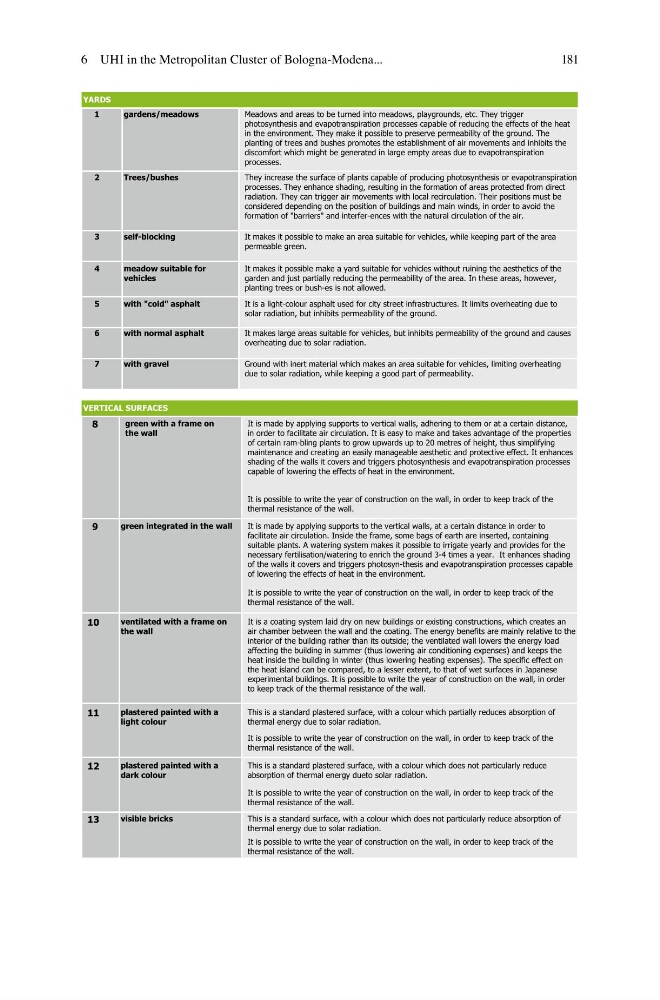
It is made by applying supports to vertical walls, adhering to them or at a certain distance,
in order to facilitate air circulation. It is easy to make and takes advantage of the properties
of certain ram-bling plants to grow upwards up to 20 metres of height, thus simplifying
maintenance and creating an easily manageable aesthetic and protective effect. It enhances
shading of the walls it covers and triggers photosynthesis and evapotranspiration processes
capable of lowering the effects of heat in the environment.
Meadows and areas to be turned into meadows, playgrounds, etc. They trigger
photosynthesis and evapotranspiration processes capable of reducing the effects of the heat
in the environment. They make it possible to preserve permeability of the ground. The
planting of trees and bushes promotes the establishment of air movements and inhibits the
discomfort which might be generated in large empty areas due to evapotranspiration
processes.
They increase the surface of plants capable of producing photosynthesis or evapotranspiration
processes. They enhance shading, resulting in the formation of areas protected from direct
radiation. They can trigger air movements with local recirculation. Their positions must be
considered depending on the position of buildings and main winds, in order to avoid the
formation of "barriers" and interfer-ences with the natural circulation of the air.
Ground with inert material which makes an area suitable for vehicles, limiting overheating
due to solar radiation, while keeping a good part of permeability.
It makes large areas suitable for vehicles, but inhibits permeability of the ground and causes
overheating due to solar radiation.
It is a light-colour asphalt used for city street infrastructures. It limits overheating due to
solar radiation, but inhibits permeability of the ground.
It makes it possible make a yard suitable for vehicles without ruining the aesthetics of the
garden and just partially reducing the permeability of the area. In these areas, however,
planting trees or bush-es is not allowed.
It makes it possible to make an area suitable for vehicles, while keeping part of the area
permeable green.
It is made by applying supports to the vertical walls, at a certain distance in order to
facilitate air circulation. Inside the frame, some bags of earth are inserted, containing
suitable plants. A watering system makes it possible to irrigate yearly and provides for the
necessary fertilisation/watering to enrich the ground 3-4 times a year. It enhances shading
of the walls it covers and triggers photosyn-thesis and evapotranspiration processes capable
of lowering the effects of heat in the environment.
It is a coating system laid dry on new buildings or existing constructions, which creates an
air chamber between the wall and the coating. The energy benefits are mainly relative to the
interior of the building rather than its outside; the ventilated wall lowers the energy load
affecting the building in summer (thus lowering air conditioning expenses) and keeps the
heat inside the building in winter (thus lowering heating expenses). The specific effect on
the heat island can be compared, to a lesser extent, to that of wet surfaces in Japanese
experimental buildings. It is possible to write the year of construction on the wall, in order
to keep track of the thermal resistance of the wall.
This is a standard plastered surface, with a colour which partially reduces absorption of
thermal energy due to solar radiation.
It is possible to write the year of construction on the wall, in order to keep track of the
thermal resistance of the wall.
This is a standard plastered surface, with a colour which does not particularly reduce
absorption of thermal energy dueto solar radiation.
It is possible to write the year of construction on the wall, in order to keep track of the
thermal resistance of the wall.
This is a standard surface, with a colour which does not particularly reduce absorption of
thermal energy due to solar radiation.
It is possible to write the year of construction on the wall, in order to keep track of the
thermal resistance of the wall.
6 UHI in the Metropolitan Cluster of Bologna-Modena...
YARDS
1
gardens/meadows
2
Trees/bushes
3
self-blocking
4
meadow suitable for
vehicles
5
with "cold" asphalt
6
with normal asphalt
7
with gravel
VERTICAL SURFACES
8
green with a frame on
the wall
It is possible to write the year of construction on the wall, in order to keep track of the
thermal resistance of the wall.
9
green integrated in the wall
It is possible to write the year of construction on the wall, in order to keep track of the
thermal resistance of the wall.
10
ventilated with a frame on
the wall
11
plastered painted with a
light colour
12
plastered painted with a
dark colour
13
visible bricks
It is made by applying supports to vertical walls, adhering to them or at a certain distance,
in order to facilitate air circulation. It is easy to make and takes advantage of the properties
of certain ram-bling plants to grow upwards up to 20 metres of height, thus simplifying
maintenance and creating an easily manageable aesthetic and protective effect. It enhances
shading of the walls it covers and triggers photosynthesis and evapotranspiration processes
capable of lowering the effects of heat in the environment.
Meadows and areas to be turned into meadows, playgrounds, etc. They trigger
photosynthesis and evapotranspiration processes capable of reducing the effects of the heat
in the environment. They make it possible to preserve permeability of the ground. The
planting of trees and bushes promotes the establishment of air movements and inhibits the
discomfort which might be generated in large empty areas due to evapotranspiration
processes.
They increase the surface of plants capable of producing photosynthesis or evapotranspiration
processes. They enhance shading, resulting in the formation of areas protected from direct
radiation. They can trigger air movements with local recirculation. Their positions must be
considered depending on the position of buildings and main winds, in order to avoid the
formation of "barriers" and interfer-ences with the natural circulation of the air.
Ground with inert material which makes an area suitable for vehicles, limiting overheating
due to solar radiation, while keeping a good part of permeability.
It makes large areas suitable for vehicles, but inhibits permeability of the ground and causes
overheating due to solar radiation.
It is a light-colour asphalt used for city street infrastructures. It limits overheating due to
solar radiation, but inhibits permeability of the ground.
It makes it possible make a yard suitable for vehicles without ruining the aesthetics of the
garden and just partially reducing the permeability of the area. In these areas, however,
planting trees or bush-es is not allowed.
It makes it possible to make an area suitable for vehicles, while keeping part of the area
permeable green.
It is made by applying supports to the vertical walls, at a certain distance in order to
facilitate air circulation. Inside the frame, some bags of earth are inserted, containing
suitable plants. A watering system makes it possible to irrigate yearly and provides for the
necessary fertilisation/watering to enrich the ground 3-4 times a year. It enhances shading
of the walls it covers and triggers photosyn-thesis and evapotranspiration processes capable
of lowering the effects of heat in the environment.
It is a coating system laid dry on new buildings or existing constructions, which creates an
air chamber between the wall and the coating. The energy benefits are mainly relative to the
interior of the building rather than its outside; the ventilated wall lowers the energy load
affecting the building in summer (thus lowering air conditioning expenses) and keeps the
heat inside the building in winter (thus lowering heating expenses). The specific effect on
the heat island can be compared, to a lesser extent, to that of wet surfaces in Japanese
experimental buildings. It is possible to write the year of construction on the wall, in order
to keep track of the thermal resistance of the wall.
This is a standard plastered surface, with a colour which partially reduces absorption of
thermal energy due to solar radiation.
It is possible to write the year of construction on the wall, in order to keep track of the
thermal resistance of the wall.
This is a standard plastered surface, with a colour which does not particularly reduce
absorption of thermal energy dueto solar radiation.
It is possible to write the year of construction on the wall, in order to keep track of the
thermal resistance of the wall.
This is a standard surface, with a colour which does not particularly reduce absorption of
thermal energy due to solar radiation.
It is possible to write the year of construction on the wall, in order to keep track of the
thermal resistance of the wall.
6 UHI in the Metropolitan Cluster of Bologna-Modena...