

134
The regional climate is sub-continental with strong difference between summer
and winter: summers are hot and muggy and winters are cold, rainy, foggy, moderately snowy and long. On average, the temperature reaches minimum values at
dawn and maximum during mid-afternoon. Since 2001 an absolute maximum of
38,7°C and a minimum of −10°C has been detected.
The urban area of Modena is usually hotter and drier than the rural one. The biggest temperature differences are at night, and go from 2 °to 8°C, especially in the
summer.
Furthermore, while variations in humidity tend to be wider at night, they can also
be quite considerable in the daytime, during the winter months.
During the last 20 years the climate has undergone a strong change, if compared
to the period 1961–1990: the average temperature has increased (+1,1 °C) and so
has the maximum temperature (especially in summer, + 2 °C) and changes have
been registered with regards to seasonal cycles and the intensity of rainfall.
Issues such as the quality of the air, energy and water cycles, renewable energy
and land consumption reduction have been set as priorities by the regional
governments.
Appendix A contains rules and regulation set up by Emilia-Romagna local governments and Appendix B contains a summary of incentives, financing and regulatory actions implemented at local levels to facilitate a sustainable land use and to
support environmental restoration, energy conservation and reduction of phenomena related to climate change.
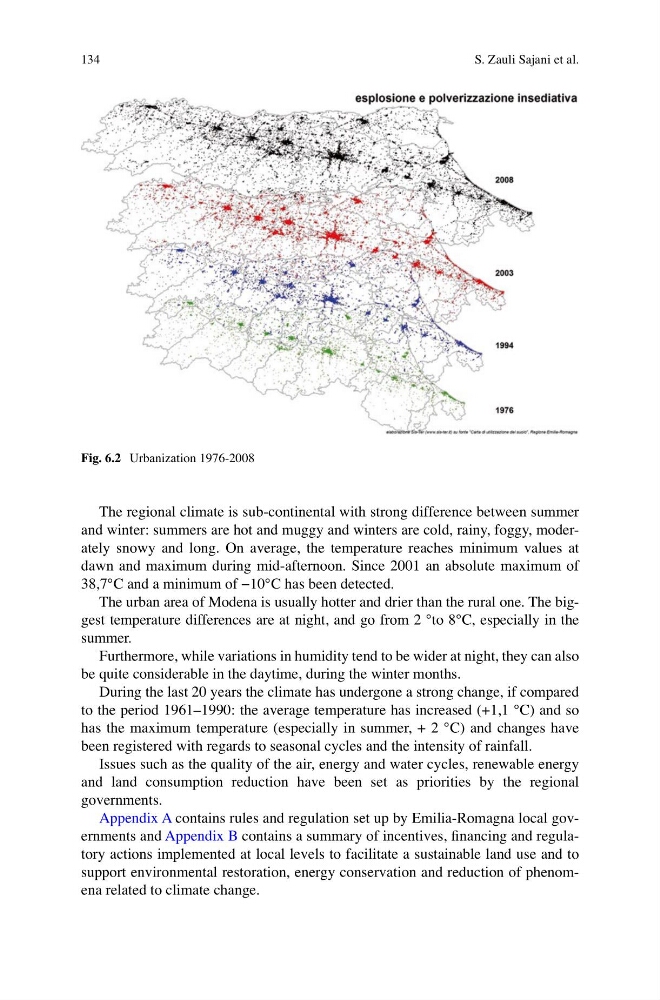
Fig. 6.2 Urbanization 1976-2008
S. Zauli Sajani et al.
The regional climate is sub-continental with strong difference between summer
and winter: summers are hot and muggy and winters are cold, rainy, foggy, moderately snowy and long. On average, the temperature reaches minimum values at
dawn and maximum during mid-afternoon. Since 2001 an absolute maximum of
38,7°C and a minimum of −10°C has been detected.
The urban area of Modena is usually hotter and drier than the rural one. The biggest temperature differences are at night, and go from 2 °to 8°C, especially in the
summer.
Furthermore, while variations in humidity tend to be wider at night, they can also
be quite considerable in the daytime, during the winter months.
During the last 20 years the climate has undergone a strong change, if compared
to the period 1961–1990: the average temperature has increased (+1,1 °C) and so
has the maximum temperature (especially in summer, + 2 °C) and changes have
been registered with regards to seasonal cycles and the intensity of rainfall.
Issues such as the quality of the air, energy and water cycles, renewable energy
and land consumption reduction have been set as priorities by the regional
governments.
Appendix A contains rules and regulation set up by Emilia-Romagna local governments and Appendix B contains a summary of incentives, financing and regulatory actions implemented at local levels to facilitate a sustainable land use and to
support environmental restoration, energy conservation and reduction of phenomena related to climate change.
Fig. 6.2 Urbanization 1976-2008
S. Zauli Sajani et al.