

96
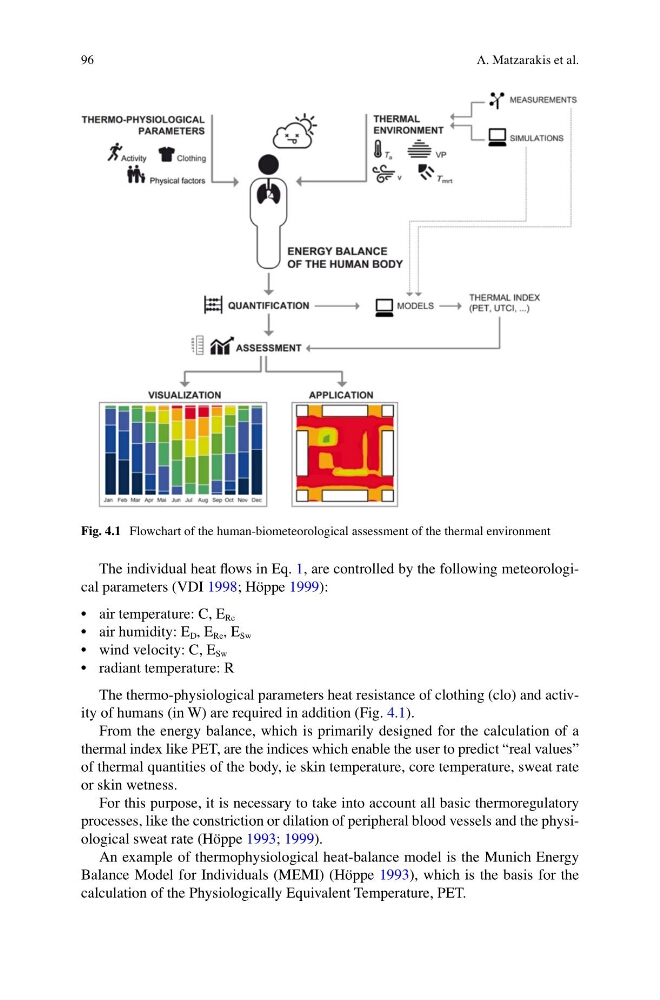
The individual heat flows in Eq. 1, are controlled by the following meteorological parameters (VDI 1998; Höppe 1999):
• air temperature: C, E Re
• air humidity: E D , E Re , E Sw
• wind velocity: C, E Sw
• radiant temperature: R
The thermo-physiological parameters heat resistance of clothing (clo) and activity of humans (in W) are required in addition (Fig. 4.1).
From the energy balance, which is primarily designed for the calculation of a
thermal index like PET, are the indices which enable the user to predict “real values”
of thermal quantities of the body, ie skin temperature, core temperature, sweat rate
or skin wetness.
For this purpose, it is necessary to take into account all basic thermoregulatory
processes, like the constriction or dilation of peripheral blood vessels and the physiological sweat rate (Höppe 1993; 1999).
An example of thermophysiological heat-balance model is the Munich Energy
Balance Model for Individuals (MEMI) (Höppe 1993), which is the basis for the
calculation of the Physiologically Equivalent Temperature, PET.
Fig. 4.1 Flowchart of the human-biometeorological assessment of the thermal environment
A. Matzarakis et al.
The individual heat flows in Eq. 1, are controlled by the following meteorological parameters (VDI 1998; Höppe 1999):
• air temperature: C, E Re
• air humidity: E D , E Re , E Sw
• wind velocity: C, E Sw
• radiant temperature: R
The thermo-physiological parameters heat resistance of clothing (clo) and activity of humans (in W) are required in addition (Fig. 4.1).
From the energy balance, which is primarily designed for the calculation of a
thermal index like PET, are the indices which enable the user to predict “real values”
of thermal quantities of the body, ie skin temperature, core temperature, sweat rate
or skin wetness.
For this purpose, it is necessary to take into account all basic thermoregulatory
processes, like the constriction or dilation of peripheral blood vessels and the physiological sweat rate (Höppe 1993; 1999).
An example of thermophysiological heat-balance model is the Munich Energy
Balance Model for Individuals (MEMI) (Höppe 1993), which is the basis for the
calculation of the Physiologically Equivalent Temperature, PET.
Fig. 4.1 Flowchart of the human-biometeorological assessment of the thermal environment
A. Matzarakis et al.