

95
4.2 Methods and Data
The application of thermal indices based on the human energy balance gives detailed
information on the effect of complex thermal environments on humans (Höppe
1999). It is related to the close relationship between the human thermoregulatory
mechanism and the human circulatory system. The human body does not have any
selective sensors for the perception of individual climatic parameters.
Thermoreceptors can register the temperature of the skin and blood flow passing
the hypothalamus and response thermoregulatorily (Höppe 1984, 1993, 1999).
These temperatures, however, are influenced by the integrated effect of all climatic
parameters, which are in some kind of interrelation, ie affect each other (VDI 1998;
Höppe 1999).
Commonly used thermal indices, based on the human energy balance, are
Predicted Mean VotePMV (Fanger 1972), Physiologically Equivalent Temperature
PET (Mayer and Höppe 1987; Höppe 1999; Matzarakis et al. 1999), Standard
Effective Temperature SET* (Gagge et al. 1986) or Outdoor Standard Effective
Temperature Out_SET* (Spagnolo and Dear 2003), Perceived Temperature pT
(Staiger et al. 2012) and Universal Thermal Climate Index UTCI (Jendritzky et al.
2012). These thermal indices require the same meteorological input parameters: air
temperature, air humidity, wind speed, short and long wave radiation fluxes. These
input parameters have a temporal and spatial variability, which have a huge influence on thermal indices. Wind speed and mean radiant temperature have the highest
variability and are modified by surroundings and obstacles in complex urban areas.
Thus, it is particularly important to calculate correctly these parameters and to
perform the measurements with high quality and exactness (ie including artificial
ventilation and radiation shield for air temperature measurements).
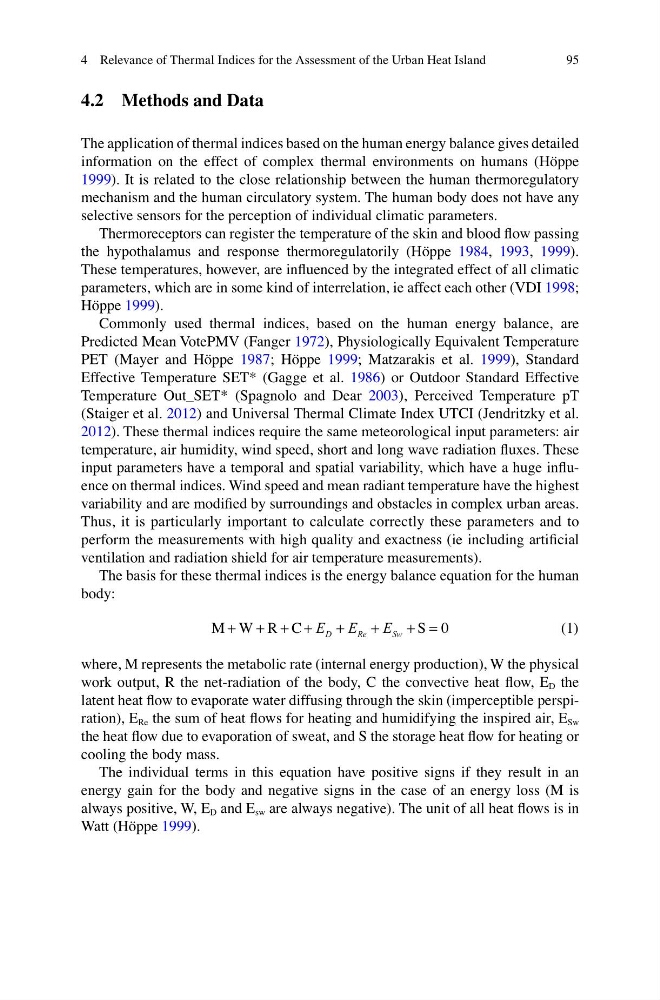
The basis for these thermal indices is the energy balance equation for the human
body:
M W R C
S
+ + + +
+
+
+ =
E
E
E
D
R e
S w
0
(1)
where, M represents the metabolic rate (internal energy production), W the physical
work output, R the net-radiation of the body, C the convective heat flow, E D the
latent heat flow to evaporate water diffusing through the skin (imperceptible perspiration), E Re the sum of heat flows for heating and humidifying the inspired air, E Sw
the heat flow due to evaporation of sweat, and S the storage heat flow for heating or
cooling the body mass.
The individual terms in this equation have positive signs if they result in an
energy gain for the body and negative signs in the case of an energy loss (M is
always positive, W, E D and E sw are always negative). The unit of all heat flows is in
Watt (Höppe 1999).
4 Relevance of Thermal Indices for the Assessment of the Urban Heat Island
4.2 Methods and Data
The application of thermal indices based on the human energy balance gives detailed
information on the effect of complex thermal environments on humans (Höppe
1999). It is related to the close relationship between the human thermoregulatory
mechanism and the human circulatory system. The human body does not have any
selective sensors for the perception of individual climatic parameters.
Thermoreceptors can register the temperature of the skin and blood flow passing
the hypothalamus and response thermoregulatorily (Höppe 1984, 1993, 1999).
These temperatures, however, are influenced by the integrated effect of all climatic
parameters, which are in some kind of interrelation, ie affect each other (VDI 1998;
Höppe 1999).
Commonly used thermal indices, based on the human energy balance, are
Predicted Mean VotePMV (Fanger 1972), Physiologically Equivalent Temperature
PET (Mayer and Höppe 1987; Höppe 1999; Matzarakis et al. 1999), Standard
Effective Temperature SET* (Gagge et al. 1986) or Outdoor Standard Effective
Temperature Out_SET* (Spagnolo and Dear 2003), Perceived Temperature pT
(Staiger et al. 2012) and Universal Thermal Climate Index UTCI (Jendritzky et al.
2012). These thermal indices require the same meteorological input parameters: air
temperature, air humidity, wind speed, short and long wave radiation fluxes. These
input parameters have a temporal and spatial variability, which have a huge influence on thermal indices. Wind speed and mean radiant temperature have the highest
variability and are modified by surroundings and obstacles in complex urban areas.
Thus, it is particularly important to calculate correctly these parameters and to
perform the measurements with high quality and exactness (ie including artificial
ventilation and radiation shield for air temperature measurements).
The basis for these thermal indices is the energy balance equation for the human
body:
M W R C
S
+ + + +
+
+
+ =
E
E
E
D
R e
S w
0
(1)
where, M represents the metabolic rate (internal energy production), W the physical
work output, R the net-radiation of the body, C the convective heat flow, E D the
latent heat flow to evaporate water diffusing through the skin (imperceptible perspiration), E Re the sum of heat flows for heating and humidifying the inspired air, E Sw
the heat flow due to evaporation of sweat, and S the storage heat flow for heating or
cooling the body mass.
The individual terms in this equation have positive signs if they result in an
energy gain for the body and negative signs in the case of an energy loss (M is
always positive, W, E D and E sw are always negative). The unit of all heat flows is in
Watt (Höppe 1999).
4 Relevance of Thermal Indices for the Assessment of the Urban Heat Island