

89
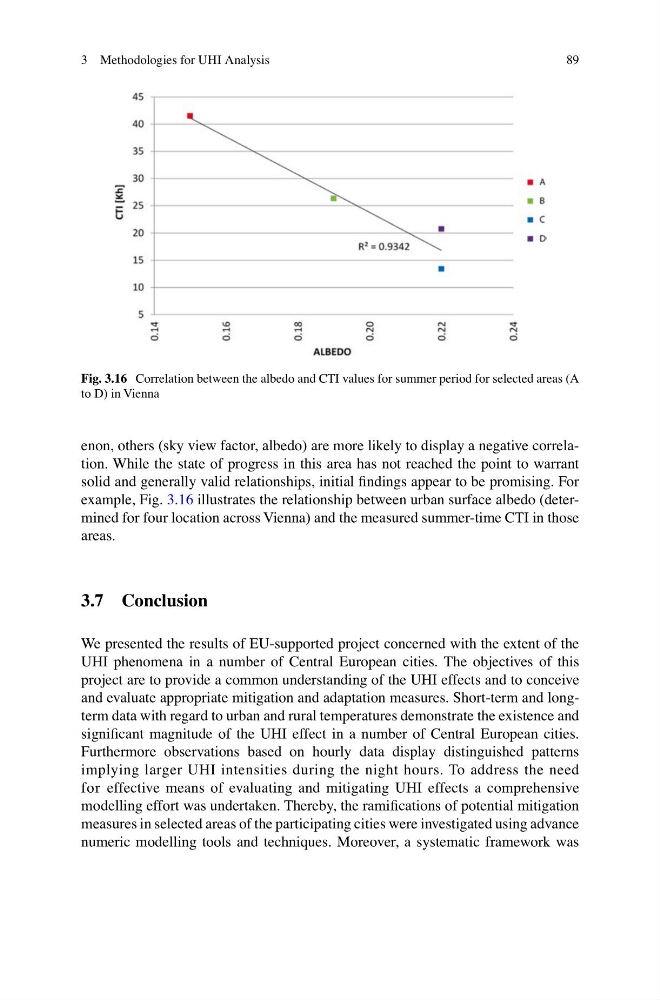
enon, others (sky view factor, albedo) are more likely to display a negative correlation. While the state of progress in this area has not reached the point to warrant
solid and generally valid relationships, initial findings appear to be promising. For
example, Fig. 3.16 illustrates the relationship between urban surface albedo (determined for four location across Vienna) and the measured summer-time CTI in those
areas.
3.7 Conclusion
We presented the results of EU-supported project concerned with the extent of the
UHI phenomena in a number of Central European cities. The objectives of this
project are to provide a common understanding of the UHI effects and to conceive
and evaluate appropriate mitigation and adaptation measures. Short-term and longterm data with regard to urban and rural temperatures demonstrate the existence and
significant magnitude of the UHI effect in a number of Central European cities.
Furthermore observations based on hourly data display distinguished patterns
implying larger UHI intensities during the night hours. To address the need
for effective means of evaluating and mitigating UHI effects a comprehensive
modelling effort was undertaken. Thereby, the ramifications of potential mitigation
measures in selected areas of the participating cities were investigated using advance
numeric modelling tools and techniques. Moreover, a systematic framework was
Fig. 3.16 Correlation between the albedo and CTI values for summer period for selected areas (A
to D) in Vienna
3 Methodologies for UHI Analysis
enon, others (sky view factor, albedo) are more likely to display a negative correlation. While the state of progress in this area has not reached the point to warrant
solid and generally valid relationships, initial findings appear to be promising. For
example, Fig. 3.16 illustrates the relationship between urban surface albedo (determined for four location across Vienna) and the measured summer-time CTI in those
areas.
3.7 Conclusion
We presented the results of EU-supported project concerned with the extent of the
UHI phenomena in a number of Central European cities. The objectives of this
project are to provide a common understanding of the UHI effects and to conceive
and evaluate appropriate mitigation and adaptation measures. Short-term and longterm data with regard to urban and rural temperatures demonstrate the existence and
significant magnitude of the UHI effect in a number of Central European cities.
Furthermore observations based on hourly data display distinguished patterns
implying larger UHI intensities during the night hours. To address the need
for effective means of evaluating and mitigating UHI effects a comprehensive
modelling effort was undertaken. Thereby, the ramifications of potential mitigation
measures in selected areas of the participating cities were investigated using advance
numeric modelling tools and techniques. Moreover, a systematic framework was
Fig. 3.16 Correlation between the albedo and CTI values for summer period for selected areas (A
to D) in Vienna
3 Methodologies for UHI Analysis