

3.5 Supplementary Problems
83
Fig. 3.31 Simply supported
Euler–Bernoulli beam under
pure bending
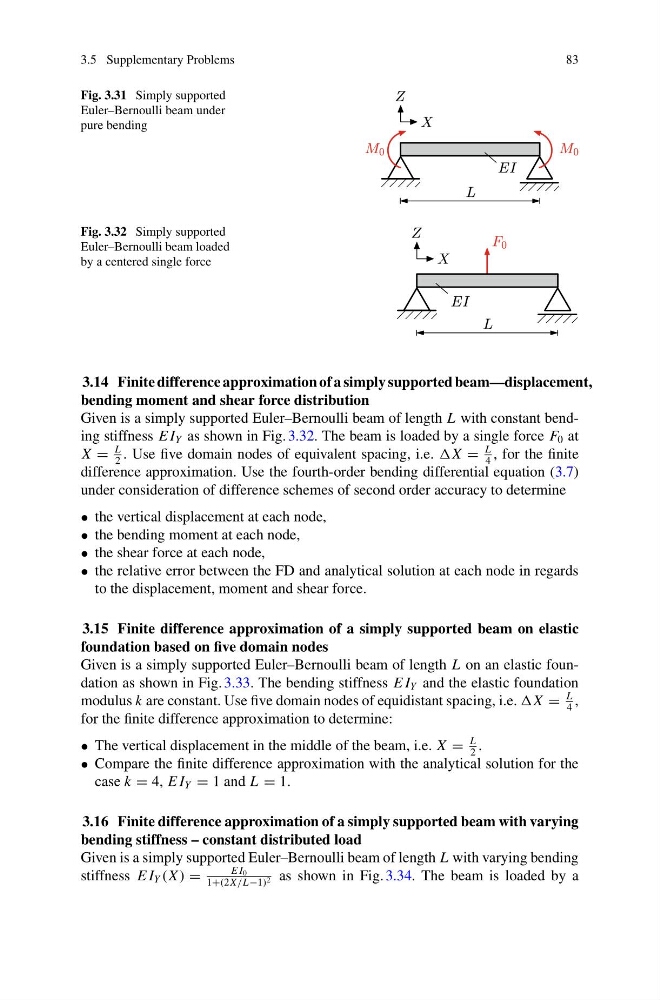
Fig. 3.32 Simply supported
Euler–Bernoulli beam loaded
by a centered single force
3.14 Finite difference approximation of a simply supported beam—displacement,
bending moment and shear force distribution
Given is a simply supported Euler–Bernoulli beam of length L with constant bending stiffness E I Y as shown in Fig. 3.32. The beam is loaded by a single force F 0 at
X =
L
2
. Use five domain nodes of equivalent spacing, i.e. =
L
4
, for the finite
difference approximation. Use the fourth-order bending differential equation (3.7)
under consideration of difference schemes of second order accuracy to determine
• the vertical displacement at each node,
• the bending moment at each node,
• the shear force at each node,
• the relative error between the FD and analytical solution at each node in regards
to the displacement, moment and shear force.
3.15 Finite difference approximation of a simply supported beam on elastic
foundation based on five domain nodes
Given is a simply supported Euler–Bernoulli beam of length L on an elastic foundation as shown in Fig. 3.33. The bending stiffness E I Y and the elastic foundation
modulus k are constant. Use five domain nodes of equidistant spacing, i.e. =
L
4
,
for the finite difference approximation to determine:
• The vertical displacement in the middle of the beam, i.e. X =
L
2
.
• Compare the finite difference approximation with the analytical solution for the
case k = 4, E I Y = 1 and L = 1.
3.16 Finite difference approximation of a simply supported beam with varying
bending stiffness – constant distributed load
Given is a simply supported Euler–Bernoulli beam of length L with varying bending
stiffness E I Y (X ) =
E I 0
1+(2X/L−1) 2 as shown in Fig.3.34. The beam is loaded by a
83
Fig. 3.31 Simply supported
Euler–Bernoulli beam under
pure bending
Fig. 3.32 Simply supported
Euler–Bernoulli beam loaded
by a centered single force
3.14 Finite difference approximation of a simply supported beam—displacement,
bending moment and shear force distribution
Given is a simply supported Euler–Bernoulli beam of length L with constant bending stiffness E I Y as shown in Fig. 3.32. The beam is loaded by a single force F 0 at
X =
L
2
. Use five domain nodes of equivalent spacing, i.e. =
L
4
, for the finite
difference approximation. Use the fourth-order bending differential equation (3.7)
under consideration of difference schemes of second order accuracy to determine
• the vertical displacement at each node,
• the bending moment at each node,
• the shear force at each node,
• the relative error between the FD and analytical solution at each node in regards
to the displacement, moment and shear force.
3.15 Finite difference approximation of a simply supported beam on elastic
foundation based on five domain nodes
Given is a simply supported Euler–Bernoulli beam of length L on an elastic foundation as shown in Fig. 3.33. The bending stiffness E I Y and the elastic foundation
modulus k are constant. Use five domain nodes of equidistant spacing, i.e. =
L
4
,
for the finite difference approximation to determine:
• The vertical displacement in the middle of the beam, i.e. X =
L
2
.
• Compare the finite difference approximation with the analytical solution for the
case k = 4, E I Y = 1 and L = 1.
3.16 Finite difference approximation of a simply supported beam with varying
bending stiffness – constant distributed load
Given is a simply supported Euler–Bernoulli beam of length L with varying bending
stiffness E I Y (X ) =
E I 0
1+(2X/L−1) 2 as shown in Fig.3.34. The beam is loaded by a