

82
3 Investigation of Euler–Bernoulli Beams in the Elastic Range
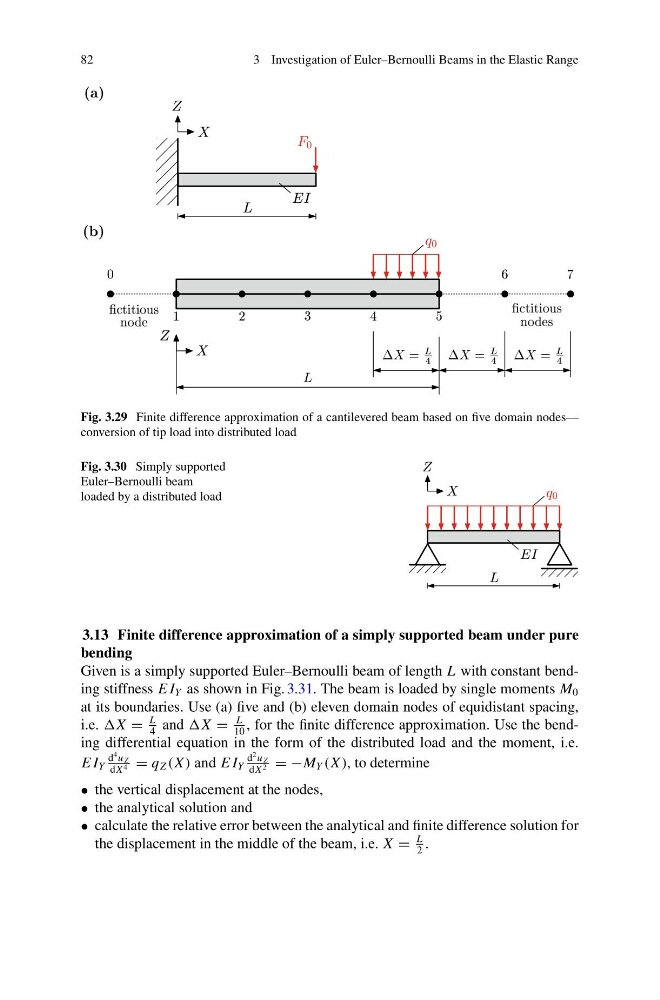
Fig. 3.29 Finite difference approximation of a cantilevered beam based on five domain nodes—
conversion of tip load into distributed load
Fig. 3.30 Simply supported
Euler–Bernoulli beam
loaded by a distributed load
3.13 Finite difference approximation of a simply supported beam under pure
bending
Given is a simply supported Euler–Bernoulli beam of length L with constant bending stiffness E I Y as shown in Fig. 3.31. The beam is loaded by single moments M 0
at its boundaries. Use (a) five and (b) eleven domain nodes of equidistant spacing,
i.e. =
L
4
and =
L
10
, for the finite difference approximation. Use the bending differential equation in the form of the distributed load and the moment, i.e.
E I Y
d
4 u Z
dX 4 = q Z (X ) and E I Y
d
2 u Z
dX 2 = −M Y (X ), to determine
• the vertical displacement at the nodes,
• the analytical solution and
• calculate the relative error between the analytical and finite difference solution for
the displacement in the middle of the beam, i.e. X =
L
2
.
3 Investigation of Euler–Bernoulli Beams in the Elastic Range
Fig. 3.29 Finite difference approximation of a cantilevered beam based on five domain nodes—
conversion of tip load into distributed load
Fig. 3.30 Simply supported
Euler–Bernoulli beam
loaded by a distributed load
3.13 Finite difference approximation of a simply supported beam under pure
bending
Given is a simply supported Euler–Bernoulli beam of length L with constant bending stiffness E I Y as shown in Fig. 3.31. The beam is loaded by single moments M 0
at its boundaries. Use (a) five and (b) eleven domain nodes of equidistant spacing,
i.e. =
L
4
and =
L
10
, for the finite difference approximation. Use the bending differential equation in the form of the distributed load and the moment, i.e.
E I Y
d
4 u Z
dX 4 = q Z (X ) and E I Y
d
2 u Z
dX 2 = −M Y (X ), to determine
• the vertical displacement at the nodes,
• the analytical solution and
• calculate the relative error between the analytical and finite difference solution for
the displacement in the middle of the beam, i.e. X =
L
2
.