

80
3 Investigation of Euler–Bernoulli Beams in the Elastic Range
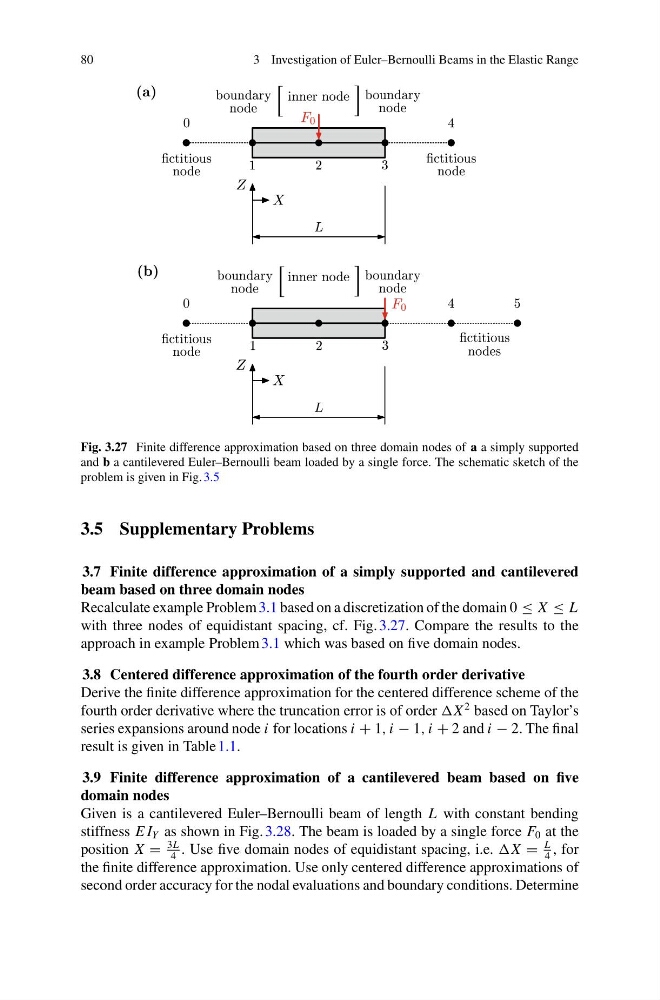
Fig. 3.27 Finite difference approximation based on three domain nodes of a a simply supported
and b a cantilevered Euler–Bernoulli beam loaded by a single force. The schematic sketch of the
problem is given in Fig. 3.5
3.5 Supplementary Problems
3.7 Finite difference approximation of a simply supported and cantilevered
beam based on three domain nodes
Recalculate example Problem 3.1 based on a discretization of the domain 0 ≤ X ≤ L
with three nodes of equidistant spacing, cf. Fig. 3.27. Compare the results to the
approach in example Problem 3.1 which was based on five domain nodes.
3.8 Centered difference approximation of the fourth order derivative
Derive the finite difference approximation for the centered difference scheme of the
fourth order derivative where the truncation error is of order
2 based on Taylor’s
series expansions around node i for locations i + 1, i − 1, i + 2 and i − 2. The final
result is given in Table 1.1.
3.9 Finite difference approximation of a cantilevered beam based on five
domain nodes
Given is a cantilevered Euler–Bernoulli beam of length L with constant bending
stiffness E I Y as shown in Fig. 3.28. The beam is loaded by a single force F 0 at the
position X =
3L
4
. Use five domain nodes of equidistant spacing, i.e. =
L
4
, for
the finite difference approximation. Use only centered difference approximations of
second order accuracy for the nodal evaluations and boundary conditions. Determine
3 Investigation of Euler–Bernoulli Beams in the Elastic Range
Fig. 3.27 Finite difference approximation based on three domain nodes of a a simply supported
and b a cantilevered Euler–Bernoulli beam loaded by a single force. The schematic sketch of the
problem is given in Fig. 3.5
3.5 Supplementary Problems
3.7 Finite difference approximation of a simply supported and cantilevered
beam based on three domain nodes
Recalculate example Problem 3.1 based on a discretization of the domain 0 ≤ X ≤ L
with three nodes of equidistant spacing, cf. Fig. 3.27. Compare the results to the
approach in example Problem 3.1 which was based on five domain nodes.
3.8 Centered difference approximation of the fourth order derivative
Derive the finite difference approximation for the centered difference scheme of the
fourth order derivative where the truncation error is of order
2 based on Taylor’s
series expansions around node i for locations i + 1, i − 1, i + 2 and i − 2. The final
result is given in Table 1.1.
3.9 Finite difference approximation of a cantilevered beam based on five
domain nodes
Given is a cantilevered Euler–Bernoulli beam of length L with constant bending
stiffness E I Y as shown in Fig. 3.28. The beam is loaded by a single force F 0 at the
position X =
3L
4
. Use five domain nodes of equidistant spacing, i.e. =
L
4
, for
the finite difference approximation. Use only centered difference approximations of
second order accuracy for the nodal evaluations and boundary conditions. Determine