

5.1 Basics of the Layered Approach
111
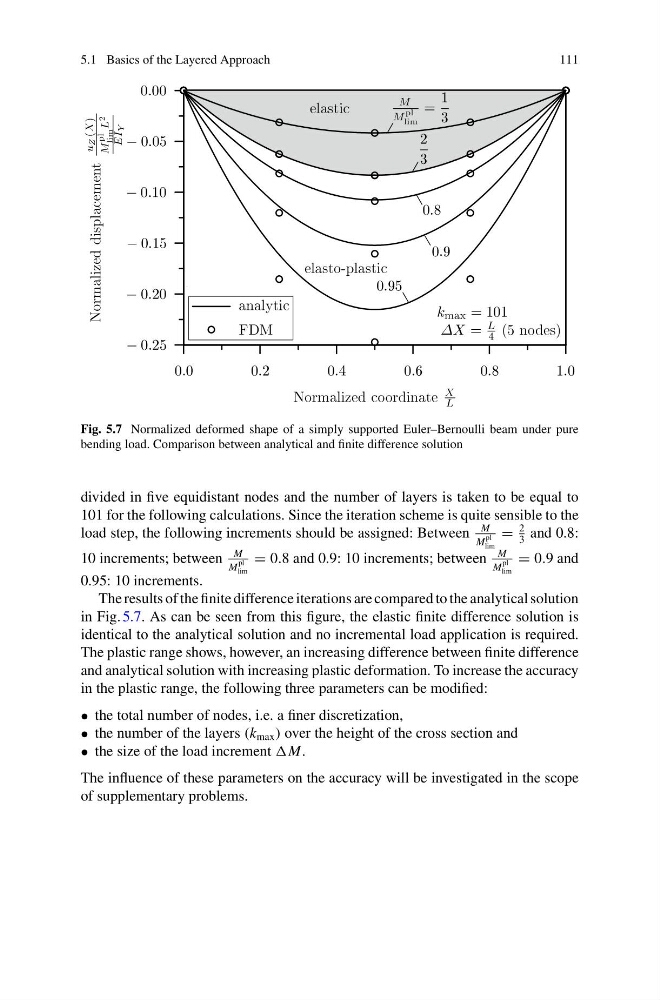
Fig. 5.7 Normalized deformed shape of a simply supported Euler–Bernoulli beam under pure
bending load. Comparison between analytical and finite difference solution
divided in five equidistant nodes and the number of layers is taken to be equal to
101 for the following calculations. Since the iteration scheme is quite sensible to the
load step, the following increments should be assigned: Between
M
M
pl
lim
=
2
3
and 0.8:
10 increments; between
M
M
pl
lim
= 0.8 and 0.9: 10 increments; between
M
M
pl
lim
= 0.9 and
0.95: 10 increments.
The results of the finite difference iterations are compared to the analytical solution
in Fig. 5.7. As can be seen from this figure, the elastic finite difference solution is
identical to the analytical solution and no incremental load application is required.
The plastic range shows, however, an increasing difference between finite difference
and analytical solution with increasing plastic deformation. To increase the accuracy
in the plastic range, the following three parameters can be modified:
• the total number of nodes, i.e. a finer discretization,
• the number of the layers (k max ) over the height of the cross section and
• the size of the load increment
The influence of these parameters on the accuracy will be investigated in the scope
of supplementary problems.
111
Fig. 5.7 Normalized deformed shape of a simply supported Euler–Bernoulli beam under pure
bending load. Comparison between analytical and finite difference solution
divided in five equidistant nodes and the number of layers is taken to be equal to
101 for the following calculations. Since the iteration scheme is quite sensible to the
load step, the following increments should be assigned: Between
M
M
pl
lim
=
2
3
and 0.8:
10 increments; between
M
M
pl
lim
= 0.8 and 0.9: 10 increments; between
M
M
pl
lim
= 0.9 and
0.95: 10 increments.
The results of the finite difference iterations are compared to the analytical solution
in Fig. 5.7. As can be seen from this figure, the elastic finite difference solution is
identical to the analytical solution and no incremental load application is required.
The plastic range shows, however, an increasing difference between finite difference
and analytical solution with increasing plastic deformation. To increase the accuracy
in the plastic range, the following three parameters can be modified:
• the total number of nodes, i.e. a finer discretization,
• the number of the layers (k max ) over the height of the cross section and
• the size of the load increment
The influence of these parameters on the accuracy will be investigated in the scope
of supplementary problems.