

volcanic glasses (Figs. 4.2c, 4.3e, and 4.4c). Many plagioclase crystallites are visible
in the magnified SEM image (Fig. 4.6d).
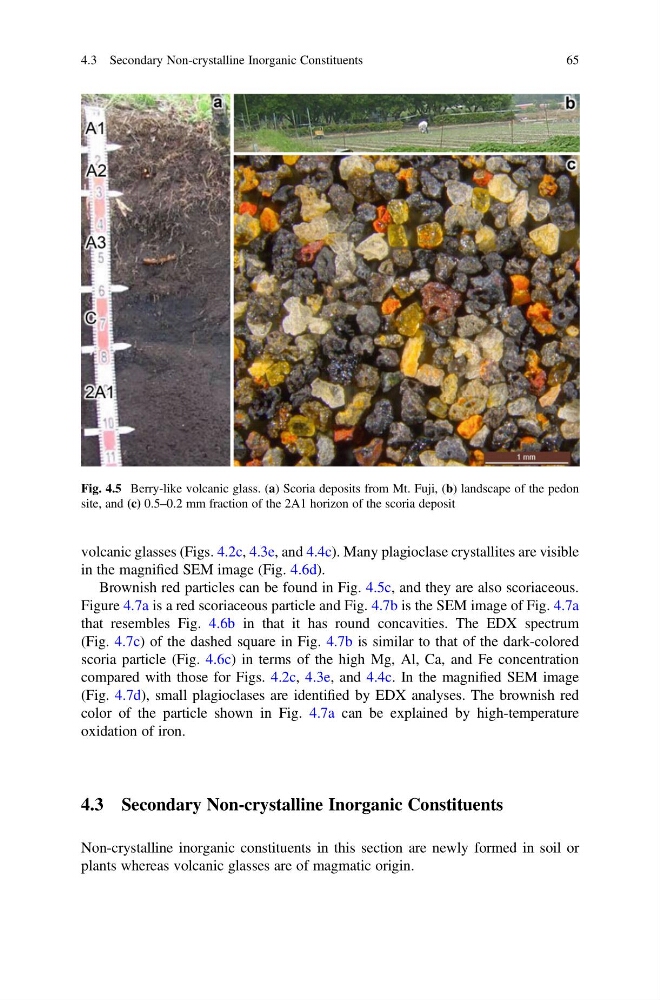
Brownish red particles can be found in Fig. 4.5c, and they are also scoriaceous.
Figure 4.7a is a red scoriaceous particle and Fig. 4.7b is the SEM image of Fig. 4.7a
that resembles Fig. 4.6b in that it has round concavities. The EDX spectrum
(Fig. 4.7c) of the dashed square in Fig. 4.7b is similar to that of the dark-colored
scoria particle (Fig. 4.6c) in terms of the high Mg, Al, Ca, and Fe concentration
compared with those for Figs. 4.2c, 4.3e, and 4.4c. In the magnified SEM image
(Fig. 4.7d), small plagioclases are identified by EDX analyses. The brownish red
color of the particle shown in Fig. 4.7a can be explained by high-temperature
oxidation of iron.
4.3 Secondary Non-crystalline Inorganic Constituents
Non-crystalline inorganic constituents in this section are newly formed in soil or
plants whereas volcanic glasses are of magmatic origin.
Fig. 4.5 Berry-like volcanic glass. (a) Scoria deposits from Mt. Fuji, (b) landscape of the pedon
site, and (c) 0.5–0.2 mm fraction of the 2A1 horizon of the scoria deposit
4.3 Secondary Non-crystalline Inorganic Constituents
65
in the magnified SEM image (Fig. 4.6d).
Brownish red particles can be found in Fig. 4.5c, and they are also scoriaceous.
Figure 4.7a is a red scoriaceous particle and Fig. 4.7b is the SEM image of Fig. 4.7a
that resembles Fig. 4.6b in that it has round concavities. The EDX spectrum
(Fig. 4.7c) of the dashed square in Fig. 4.7b is similar to that of the dark-colored
scoria particle (Fig. 4.6c) in terms of the high Mg, Al, Ca, and Fe concentration
compared with those for Figs. 4.2c, 4.3e, and 4.4c. In the magnified SEM image
(Fig. 4.7d), small plagioclases are identified by EDX analyses. The brownish red
color of the particle shown in Fig. 4.7a can be explained by high-temperature
oxidation of iron.
4.3 Secondary Non-crystalline Inorganic Constituents
Non-crystalline inorganic constituents in this section are newly formed in soil or
plants whereas volcanic glasses are of magmatic origin.
Fig. 4.5 Berry-like volcanic glass. (a) Scoria deposits from Mt. Fuji, (b) landscape of the pedon
site, and (c) 0.5–0.2 mm fraction of the 2A1 horizon of the scoria deposit
4.3 Secondary Non-crystalline Inorganic Constituents
65