

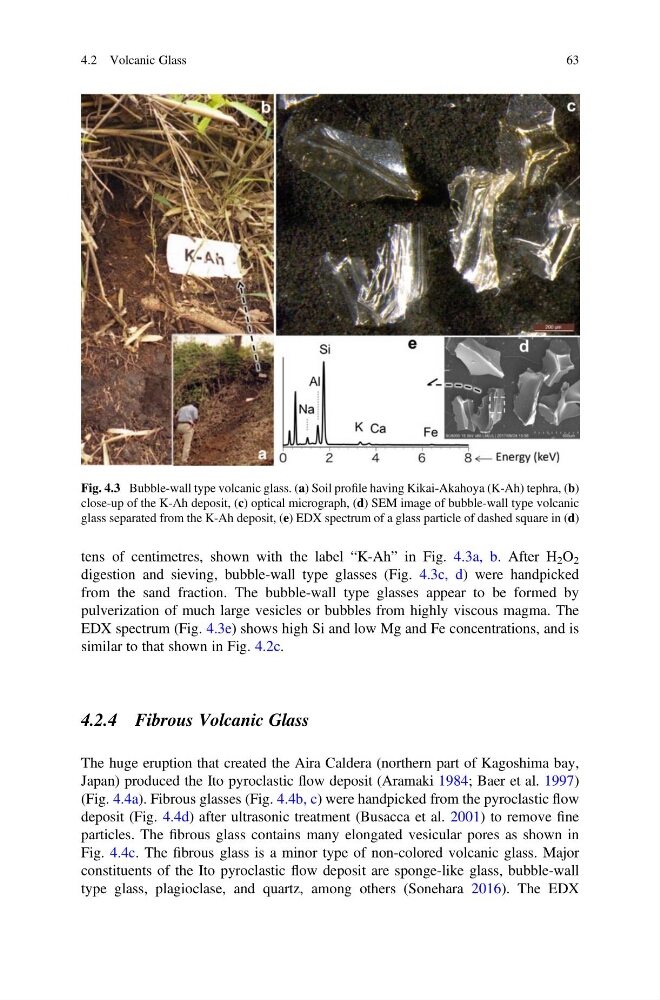
tens of centimetres, shown with the label “K-Ah” in Fig. 4.3a, b. After H 2 O 2
digestion and sieving, bubble-wall type glasses (Fig. 4.3c, d) were handpicked
from the sand fraction. The bubble-wall type glasses appear to be formed by
pulverization of much large vesicles or bubbles from highly viscous magma. The
EDX spectrum (Fig. 4.3e) shows high Si and low Mg and Fe concentrations, and is
similar to that shown in Fig. 4.2c.
4.2.4 Fibrous Volcanic Glass
The huge eruption that created the Aira Caldera (northern part of Kagoshima bay,
Japan) produced the Ito pyroclastic flow deposit (Aramaki 1984; Baer et al. 1997)
(Fig. 4.4a). Fibrous glasses (Fig. 4.4b, c) were handpicked from the pyroclastic flow
deposit (Fig. 4.4d) after ultrasonic treatment (Busacca et al. 2001) to remove fine
particles. The fibrous glass contains many elongated vesicular pores as shown in
Fig. 4.4c. The fibrous glass is a minor type of non-colored volcanic glass. Major
constituents of the Ito pyroclastic flow deposit are sponge-like glass, bubble-wall
type glass, plagioclase, and quartz, among others (Sonehara 2016). The EDX
Fig. 4.3 Bubble-wall type volcanic glass. (a) Soil profile having Kikai-Akahoya (K-Ah) tephra, (b)
close-up of the K-Ah deposit, (c) optical micrograph, (d) SEM image of bubble-wall type volcanic
glass separated from the K-Ah deposit, (e) EDX spectrum of a glass particle of dashed square in (d)
4.2 Volcanic Glass
63
digestion and sieving, bubble-wall type glasses (Fig. 4.3c, d) were handpicked
from the sand fraction. The bubble-wall type glasses appear to be formed by
pulverization of much large vesicles or bubbles from highly viscous magma. The
EDX spectrum (Fig. 4.3e) shows high Si and low Mg and Fe concentrations, and is
similar to that shown in Fig. 4.2c.
4.2.4 Fibrous Volcanic Glass
The huge eruption that created the Aira Caldera (northern part of Kagoshima bay,
Japan) produced the Ito pyroclastic flow deposit (Aramaki 1984; Baer et al. 1997)
(Fig. 4.4a). Fibrous glasses (Fig. 4.4b, c) were handpicked from the pyroclastic flow
deposit (Fig. 4.4d) after ultrasonic treatment (Busacca et al. 2001) to remove fine
particles. The fibrous glass contains many elongated vesicular pores as shown in
Fig. 4.4c. The fibrous glass is a minor type of non-colored volcanic glass. Major
constituents of the Ito pyroclastic flow deposit are sponge-like glass, bubble-wall
type glass, plagioclase, and quartz, among others (Sonehara 2016). The EDX
Fig. 4.3 Bubble-wall type volcanic glass. (a) Soil profile having Kikai-Akahoya (K-Ah) tephra, (b)
close-up of the K-Ah deposit, (c) optical micrograph, (d) SEM image of bubble-wall type volcanic
glass separated from the K-Ah deposit, (e) EDX spectrum of a glass particle of dashed square in (d)
4.2 Volcanic Glass
63