

3.2.3.2 2:1 Type Minerals
Major 2:1 type minerals include smectite, vermiculite, micaceous minerals, chlorite,
etc. (Table 3.1, Fig. 3.3). Among these minerals, smectite and vermiculite show high
CEC, ranging between 90 and 150 cmol c kg
À1 . Soils having these clay minerals and
neutral-range pH are fertile because the minerals can carry a large amount of nutrient
cations due to their high CEC.
Smectite is a group name including three members, montmorillonite, beidellite,
and nontronite. The differences of the members are the major site of isomorphous
substitution and the ions at the sites of substitution. Montmorillonite has major
isomorphous substitution at the octahedral sites, whereas beidellite has it at the
tetrahedral sites. Montmorillonite can be distinguished from other smectites by
using the Greene-Kelly test (Greene-Kelly 1955; Mala and Douglas 1987). If
beidellite has a large amount of iron at the octahedral sites, it is called nontronite
(Table 3.1).
Smectite looks like thin sheets. Figure 3.7a, a TEM image of a reference smectite,
suggests that many thin smectite sheets are randomly overlapped. Figure 3.7b, an
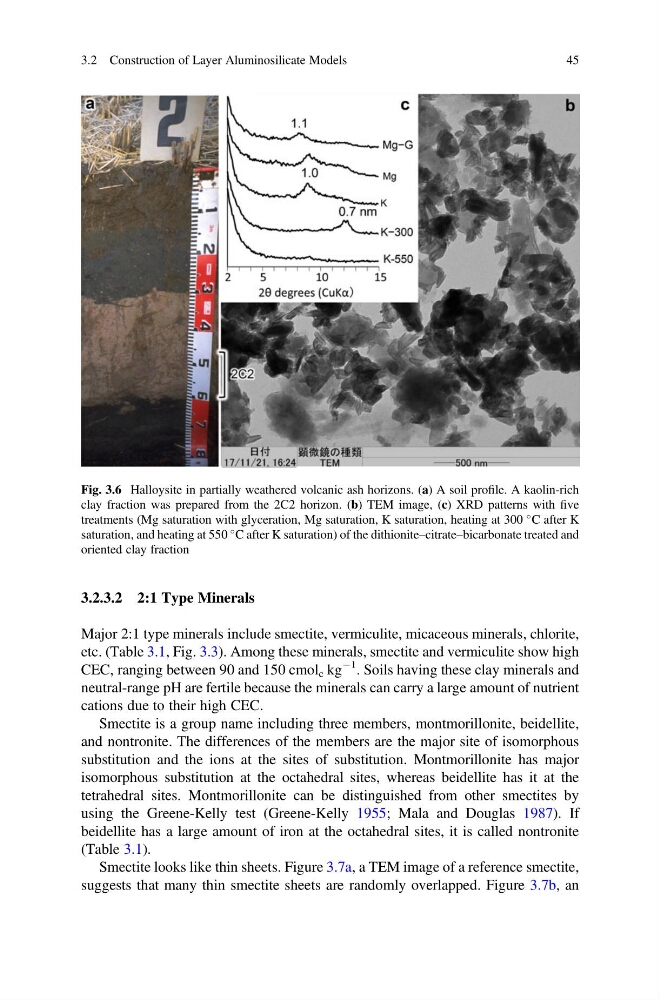
Fig. 3.6 Halloysite in partially weathered volcanic ash horizons. (a) A soil profile. A kaolin-rich
clay fraction was prepared from the 2C2 horizon. (b) TEM image, (c) XRD patterns with five
treatments (Mg saturation with glyceration, Mg saturation, K saturation, heating at 300
C after K
saturation, and heating at 550
C after K saturation) of the dithionite–citrate–bicarbonate treated and
oriented clay fraction
3.2 Construction of Layer Aluminosilicate Models
45
Major 2:1 type minerals include smectite, vermiculite, micaceous minerals, chlorite,
etc. (Table 3.1, Fig. 3.3). Among these minerals, smectite and vermiculite show high
CEC, ranging between 90 and 150 cmol c kg
À1 . Soils having these clay minerals and
neutral-range pH are fertile because the minerals can carry a large amount of nutrient
cations due to their high CEC.
Smectite is a group name including three members, montmorillonite, beidellite,
and nontronite. The differences of the members are the major site of isomorphous
substitution and the ions at the sites of substitution. Montmorillonite has major
isomorphous substitution at the octahedral sites, whereas beidellite has it at the
tetrahedral sites. Montmorillonite can be distinguished from other smectites by
using the Greene-Kelly test (Greene-Kelly 1955; Mala and Douglas 1987). If
beidellite has a large amount of iron at the octahedral sites, it is called nontronite
(Table 3.1).
Smectite looks like thin sheets. Figure 3.7a, a TEM image of a reference smectite,
suggests that many thin smectite sheets are randomly overlapped. Figure 3.7b, an
Fig. 3.6 Halloysite in partially weathered volcanic ash horizons. (a) A soil profile. A kaolin-rich
clay fraction was prepared from the 2C2 horizon. (b) TEM image, (c) XRD patterns with five
treatments (Mg saturation with glyceration, Mg saturation, K saturation, heating at 300
C after K
saturation, and heating at 550
C after K saturation) of the dithionite–citrate–bicarbonate treated and
oriented clay fraction
3.2 Construction of Layer Aluminosilicate Models
45