

size of each ion. The procedure of building the sheet is to place three Mg balls
alternately among six possible sites around the back OH balls, as shown in Fig. 3.1a.
As a result, three Mg sites and three vacant sites are formed around each back OH
ball. The front OH balls are placed on the three vacant sites, and the Mg ion is
located at the center of an octahedron formed by six OH balls, as shown in Fig. 3.1c.
Thus, a brucite sheet is completed (Fig. 3.1b).
3.2.2 Construction of Gibbsite Sheet and 1:1 Layer
Aluminosilicate
In the brucite sheet shown in Fig. 3.1, all of the octahedral sites are filled with a Mg
ion. In the aluminosilicates, Al ions occupy the octahedral sites instead of Mg ions.
Because an Al ion has three positive charges and a Mg ion has two positive charges,
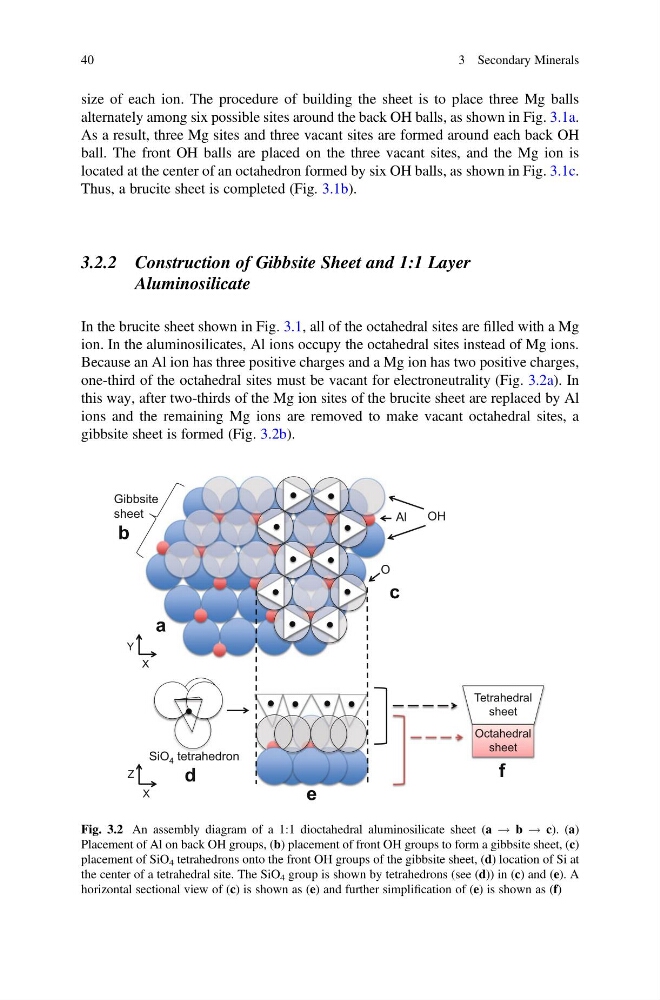
one-third of the octahedral sites must be vacant for electroneutrality (Fig. 3.2a). In
this way, after two-thirds of the Mg ion sites of the brucite sheet are replaced by Al
ions and the remaining Mg ions are removed to make vacant octahedral sites, a
gibbsite sheet is formed (Fig. 3.2b).
SiO 4 tetrahedron
OH
Al
Tetrahedral
sheet
Octahedral
sheet
Y
X
X
Z
Gibbsite
sheet
a
b
c
d
e
f
O
Fig. 3.2 An assembly diagram of a 1:1 dioctahedral aluminosilicate sheet (a ! b ! c). (a)
Placement of Al on back OH groups, (b) placement of front OH groups to form a gibbsite sheet, (c)
placement of SiO 4 tetrahedrons onto the front OH groups of the gibbsite sheet, (d) location of Si at
the center of a tetrahedral site. The SiO 4 group is shown by tetrahedrons (see (d)) in (c) and (e). A
horizontal sectional view of (c) is shown as (e) and further simplification of (e) is shown as (f)
40
3 Secondary Minerals
alternately among six possible sites around the back OH balls, as shown in Fig. 3.1a.
As a result, three Mg sites and three vacant sites are formed around each back OH
ball. The front OH balls are placed on the three vacant sites, and the Mg ion is
located at the center of an octahedron formed by six OH balls, as shown in Fig. 3.1c.
Thus, a brucite sheet is completed (Fig. 3.1b).
3.2.2 Construction of Gibbsite Sheet and 1:1 Layer
Aluminosilicate
In the brucite sheet shown in Fig. 3.1, all of the octahedral sites are filled with a Mg
ion. In the aluminosilicates, Al ions occupy the octahedral sites instead of Mg ions.
Because an Al ion has three positive charges and a Mg ion has two positive charges,
one-third of the octahedral sites must be vacant for electroneutrality (Fig. 3.2a). In
this way, after two-thirds of the Mg ion sites of the brucite sheet are replaced by Al
ions and the remaining Mg ions are removed to make vacant octahedral sites, a
gibbsite sheet is formed (Fig. 3.2b).
SiO 4 tetrahedron
OH
Al
Tetrahedral
sheet
Octahedral
sheet
Y
X
X
Z
Gibbsite
sheet
a
b
c
d
e
f
O
Fig. 3.2 An assembly diagram of a 1:1 dioctahedral aluminosilicate sheet (a ! b ! c). (a)
Placement of Al on back OH groups, (b) placement of front OH groups to form a gibbsite sheet, (c)
placement of SiO 4 tetrahedrons onto the front OH groups of the gibbsite sheet, (d) location of Si at
the center of a tetrahedral site. The SiO 4 group is shown by tetrahedrons (see (d)) in (c) and (e). A
horizontal sectional view of (c) is shown as (e) and further simplification of (e) is shown as (f)
40
3 Secondary Minerals