

White 2008) are shown for several phyllosilicates, with the expectation that these
will be helpful for understanding the properties of the phyllosilicates (Molloy and
Kerr 1961) as well as scanning electron microscope (SEM) and transmission electron microscope (TEM) images (Sudo and Shimoda 1978).
3.2 Construction of Layer Aluminosilicate Models
The major phyllosilicates of the clay fraction in soil are aluminosilicates. The
aluminosilicates are constructed from the phyllosilicate sheet (Fig. 2.3) and the Al
octahedral sheet. The octahedral sites of the phyllosilicates may be wholly or partly
occupied by Mg or Fe. This section begins with the construction of the Mg
octahedral sheet, brucite, followed by the Al octahedral sheet, and the 1:1 type
aluminosilicate. Attention is paid to Al–O–Si bonding and the arrangement between
the Al octahedral sheet and the Si tetrahedrons of the phyllosilicate sheet. The
structure of 1:1 type aluminosilicates to 2:1 types is extended similarly.
3.2.1 Brucite Sheet and Gibbsite Sheet
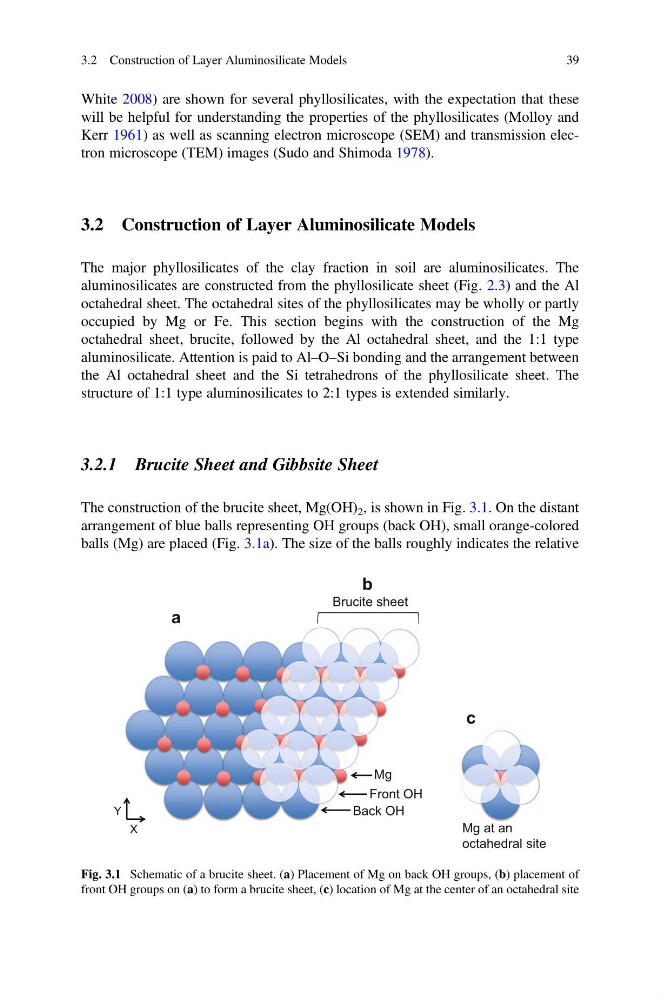
The construction of the brucite sheet, Mg(OH) 2 , is shown in Fig. 3.1. On the distant
arrangement of blue balls representing OH groups (back OH), small orange-colored
balls (Mg) are placed (Fig. 3.1a). The size of the balls roughly indicates the relative
Brucite sheet
Mg
Front OH
Y
X
Mg at an
octahedral site
Back OH
a
b
c
Fig. 3.1 Schematic of a brucite sheet. (a) Placement of Mg on back OH groups, (b) placement of
front OH groups on (a) to form a brucite sheet, (c) location of Mg at the center of an octahedral site
3.2 Construction of Layer Aluminosilicate Models
39
will be helpful for understanding the properties of the phyllosilicates (Molloy and
Kerr 1961) as well as scanning electron microscope (SEM) and transmission electron microscope (TEM) images (Sudo and Shimoda 1978).
3.2 Construction of Layer Aluminosilicate Models
The major phyllosilicates of the clay fraction in soil are aluminosilicates. The
aluminosilicates are constructed from the phyllosilicate sheet (Fig. 2.3) and the Al
octahedral sheet. The octahedral sites of the phyllosilicates may be wholly or partly
occupied by Mg or Fe. This section begins with the construction of the Mg
octahedral sheet, brucite, followed by the Al octahedral sheet, and the 1:1 type
aluminosilicate. Attention is paid to Al–O–Si bonding and the arrangement between
the Al octahedral sheet and the Si tetrahedrons of the phyllosilicate sheet. The
structure of 1:1 type aluminosilicates to 2:1 types is extended similarly.
3.2.1 Brucite Sheet and Gibbsite Sheet
The construction of the brucite sheet, Mg(OH) 2 , is shown in Fig. 3.1. On the distant
arrangement of blue balls representing OH groups (back OH), small orange-colored
balls (Mg) are placed (Fig. 3.1a). The size of the balls roughly indicates the relative
Brucite sheet
Mg
Front OH
Y
X
Mg at an
octahedral site
Back OH
a
b
c
Fig. 3.1 Schematic of a brucite sheet. (a) Placement of Mg on back OH groups, (b) placement of
front OH groups on (a) to form a brucite sheet, (c) location of Mg at the center of an octahedral site
3.2 Construction of Layer Aluminosilicate Models
39