

conversion of high- to low-temperature phases during the cooling process. A single
feldspar particle can be composed of different feldspars, as suggested by Fig. 2.17c.
Biotites tend to weather much more easily than muscovite and many other
minerals. The coarse fraction (2–0.2 mm) exemplified in Fig. 2.9c includes many
weathered biotite particles, as well as muscovite particles that show only weak
weathering. The coarse sand fraction of Fig. 2.16c also contains many weathered
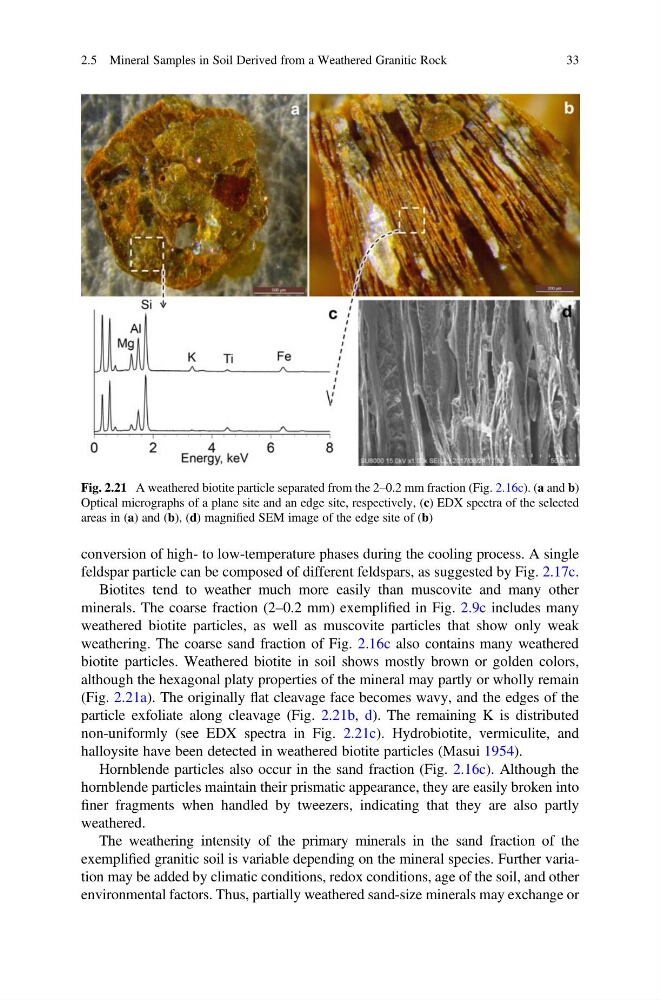
biotite particles. Weathered biotite in soil shows mostly brown or golden colors,
although the hexagonal platy properties of the mineral may partly or wholly remain
(Fig. 2.21a). The originally flat cleavage face becomes wavy, and the edges of the
particle exfoliate along cleavage (Fig. 2.21b, d). The remaining K is distributed
non-uniformly (see EDX spectra in Fig. 2.21c). Hydrobiotite, vermiculite, and
halloysite have been detected in weathered biotite particles (Masui 1954).
Hornblende particles also occur in the sand fraction (Fig. 2.16c). Although the
hornblende particles maintain their prismatic appearance, they are easily broken into
finer fragments when handled by tweezers, indicating that they are also partly
weathered.
The weathering intensity of the primary minerals in the sand fraction of the
exemplified granitic soil is variable depending on the mineral species. Further variation may be added by climatic conditions, redox conditions, age of the soil, and other
environmental factors. Thus, partially weathered sand-size minerals may exchange or
Fig. 2.21 A weathered biotite particle separated from the 2–0.2 mm fraction (Fig. 2.16c). (a and b)
Optical micrographs of a plane site and an edge site, respectively, (c) EDX spectra of the selected
areas in (a) and (b), (d) magnified SEM image of the edge site of (b)
2.5 Mineral Samples in Soil Derived from a Weathered Granitic Rock
33
feldspar particle can be composed of different feldspars, as suggested by Fig. 2.17c.
Biotites tend to weather much more easily than muscovite and many other
minerals. The coarse fraction (2–0.2 mm) exemplified in Fig. 2.9c includes many
weathered biotite particles, as well as muscovite particles that show only weak
weathering. The coarse sand fraction of Fig. 2.16c also contains many weathered
biotite particles. Weathered biotite in soil shows mostly brown or golden colors,
although the hexagonal platy properties of the mineral may partly or wholly remain
(Fig. 2.21a). The originally flat cleavage face becomes wavy, and the edges of the
particle exfoliate along cleavage (Fig. 2.21b, d). The remaining K is distributed
non-uniformly (see EDX spectra in Fig. 2.21c). Hydrobiotite, vermiculite, and
halloysite have been detected in weathered biotite particles (Masui 1954).
Hornblende particles also occur in the sand fraction (Fig. 2.16c). Although the
hornblende particles maintain their prismatic appearance, they are easily broken into
finer fragments when handled by tweezers, indicating that they are also partly
weathered.
The weathering intensity of the primary minerals in the sand fraction of the
exemplified granitic soil is variable depending on the mineral species. Further variation may be added by climatic conditions, redox conditions, age of the soil, and other
environmental factors. Thus, partially weathered sand-size minerals may exchange or
Fig. 2.21 A weathered biotite particle separated from the 2–0.2 mm fraction (Fig. 2.16c). (a and b)
Optical micrographs of a plane site and an edge site, respectively, (c) EDX spectra of the selected
areas in (a) and (b), (d) magnified SEM image of the edge site of (b)
2.5 Mineral Samples in Soil Derived from a Weathered Granitic Rock
33