

Cretaceous granitoids (Kon et al. 2015) is exemplified. The soil is located at the dam
lakeshore of the Utsushi–Gawa River (Figs. 6.17 and 6.24), bottom of a valley slope
in the central Abukuma Plateau, northeastern Japan Arc. Although the age of the
bedrock is old, the soil developed at the bottom of the valley slope can be much
younger than the bedrock due to subsequent continuous erosion. This soil is a
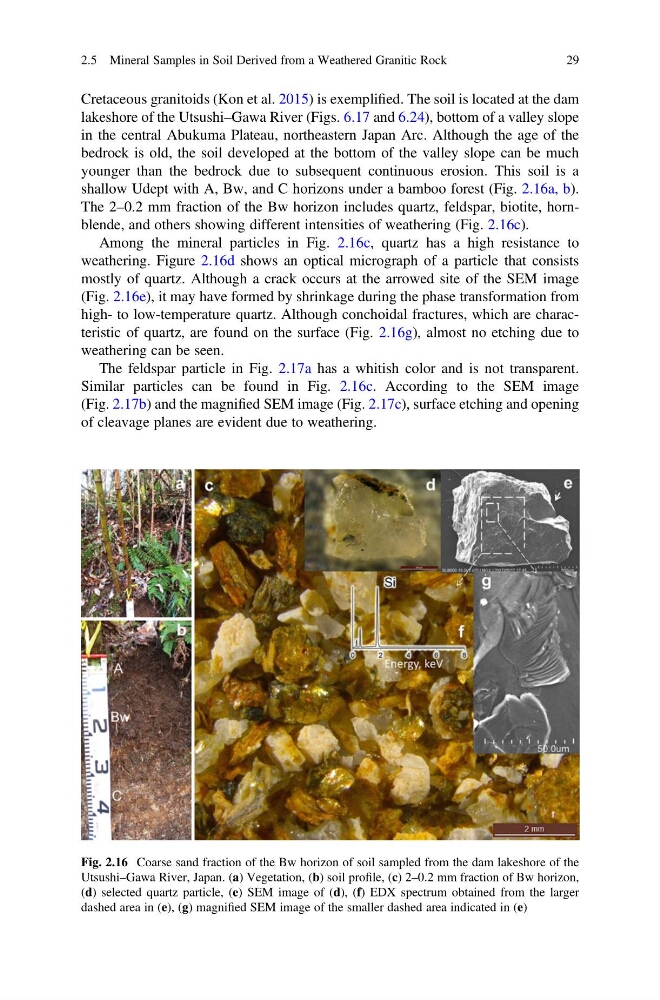
shallow Udept with A, Bw, and C horizons under a bamboo forest (Fig. 2.16a, b).
The 2–0.2 mm fraction of the Bw horizon includes quartz, feldspar, biotite, hornblende, and others showing different intensities of weathering (Fig. 2.16c).
Among the mineral particles in Fig. 2.16c, quartz has a high resistance to
weathering. Figure 2.16d shows an optical micrograph of a particle that consists
mostly of quartz. Although a crack occurs at the arrowed site of the SEM image
(Fig. 2.16e), it may have formed by shrinkage during the phase transformation from
high- to low-temperature quartz. Although conchoidal fractures, which are characteristic of quartz, are found on the surface (Fig. 2.16g), almost no etching due to
weathering can be seen.
The feldspar particle in Fig. 2.17a has a whitish color and is not transparent.
Similar particles can be found in Fig. 2.16c. According to the SEM image
(Fig. 2.17b) and the magnified SEM image (Fig. 2.17c), surface etching and opening
of cleavage planes are evident due to weathering.
Fig. 2.16 Coarse sand fraction of the Bw horizon of soil sampled from the dam lakeshore of the
Utsushi–Gawa River, Japan. (a) Vegetation, (b) soil profile, (c) 2–0.2 mm fraction of Bw horizon,
(d) selected quartz particle, (e) SEM image of (d), (f) EDX spectrum obtained from the larger
dashed area in (e), (g) magnified SEM image of the smaller dashed area indicated in (e)
2.5 Mineral Samples in Soil Derived from a Weathered Granitic Rock
29
lakeshore of the Utsushi–Gawa River (Figs. 6.17 and 6.24), bottom of a valley slope
in the central Abukuma Plateau, northeastern Japan Arc. Although the age of the
bedrock is old, the soil developed at the bottom of the valley slope can be much
younger than the bedrock due to subsequent continuous erosion. This soil is a
shallow Udept with A, Bw, and C horizons under a bamboo forest (Fig. 2.16a, b).
The 2–0.2 mm fraction of the Bw horizon includes quartz, feldspar, biotite, hornblende, and others showing different intensities of weathering (Fig. 2.16c).
Among the mineral particles in Fig. 2.16c, quartz has a high resistance to
weathering. Figure 2.16d shows an optical micrograph of a particle that consists
mostly of quartz. Although a crack occurs at the arrowed site of the SEM image
(Fig. 2.16e), it may have formed by shrinkage during the phase transformation from
high- to low-temperature quartz. Although conchoidal fractures, which are characteristic of quartz, are found on the surface (Fig. 2.16g), almost no etching due to
weathering can be seen.
The feldspar particle in Fig. 2.17a has a whitish color and is not transparent.
Similar particles can be found in Fig. 2.16c. According to the SEM image
(Fig. 2.17b) and the magnified SEM image (Fig. 2.17c), surface etching and opening
of cleavage planes are evident due to weathering.
Fig. 2.16 Coarse sand fraction of the Bw horizon of soil sampled from the dam lakeshore of the
Utsushi–Gawa River, Japan. (a) Vegetation, (b) soil profile, (c) 2–0.2 mm fraction of Bw horizon,
(d) selected quartz particle, (e) SEM image of (d), (f) EDX spectrum obtained from the larger
dashed area in (e), (g) magnified SEM image of the smaller dashed area indicated in (e)
2.5 Mineral Samples in Soil Derived from a Weathered Granitic Rock
29