

X-ray detector. The bulk area of the pelletized compost, the other dashed square e of
Fig. 6.35c, shows an EDX spectrum with very small peaks for Mg, P, K, and Ca. A
power XRD pattern obtained from the ground sample (Fig. 6.35f) includes XRD
peaks identical to those of the reference struvite (Fig. 6.35g).
6.4.4 Phosphorus Management in Farmlands
For sustainable phosphorus management in farmlands, measurement and evaluation
of the plant-available P level in soil and the P recovery by crop plants is needed.
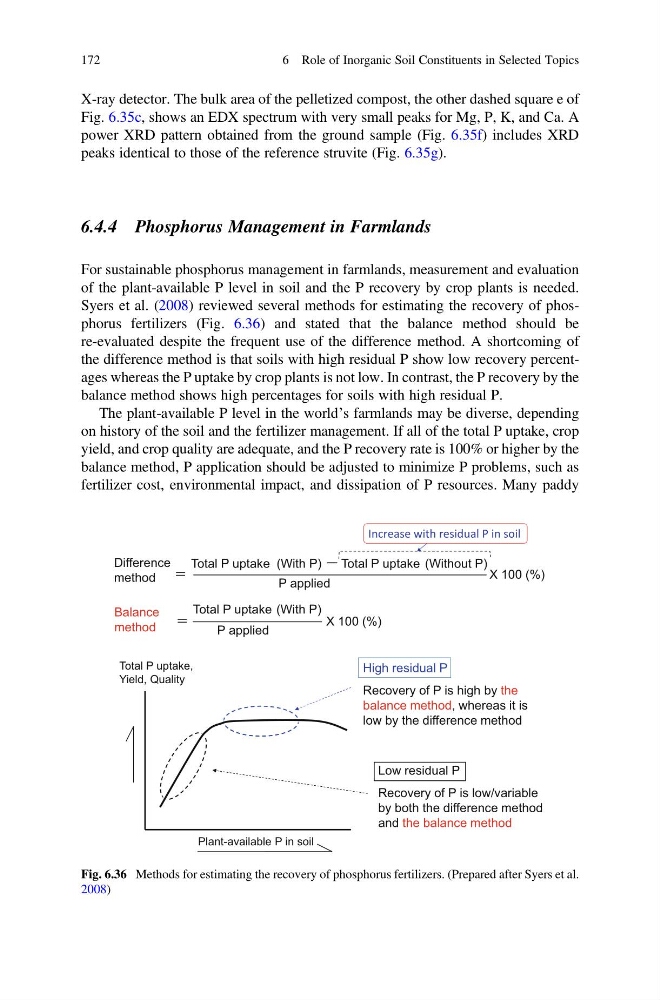
Syers et al. (2008) reviewed several methods for estimating the recovery of phosphorus fertilizers (Fig. 6.36) and stated that the balance method should be
re-evaluated despite the frequent use of the difference method. A shortcoming of
the difference method is that soils with high residual P show low recovery percentages whereas the P uptake by crop plants is not low. In contrast, the P recovery by the
balance method shows high percentages for soils with high residual P.
The plant-available P level in the world’s farmlands may be diverse, depending
on history of the soil and the fertilizer management. If all of the total P uptake, crop
yield, and crop quality are adequate, and the P recovery rate is 100% or higher by the
balance method, P application should be adjusted to minimize P problems, such as
fertilizer cost, environmental impact, and dissipation of P resources. Many paddy
Increase with residual P in soil
X 100 (%)
Total P uptake (With P) Total P uptake (Without P)
P applied
X 100 (%)
Total P uptake (With P)
P applied
Plant-available P in soil
High residual P
Recovery of P is high by the
balance method, whereas it is
low by the difference method
Low residual P
Recovery of P is low/variable
by both the difference method
and the balance method
Difference
method
Balance
method
Total P uptake,
Yield, Quality
Fig. 6.36 Methods for estimating the recovery of phosphorus fertilizers. (Prepared after Syers et al.
2008)
172
6 Role of Inorganic Soil Constituents in Selected Topics
Fig. 6.35c, shows an EDX spectrum with very small peaks for Mg, P, K, and Ca. A
power XRD pattern obtained from the ground sample (Fig. 6.35f) includes XRD
peaks identical to those of the reference struvite (Fig. 6.35g).
6.4.4 Phosphorus Management in Farmlands
For sustainable phosphorus management in farmlands, measurement and evaluation
of the plant-available P level in soil and the P recovery by crop plants is needed.
Syers et al. (2008) reviewed several methods for estimating the recovery of phosphorus fertilizers (Fig. 6.36) and stated that the balance method should be
re-evaluated despite the frequent use of the difference method. A shortcoming of
the difference method is that soils with high residual P show low recovery percentages whereas the P uptake by crop plants is not low. In contrast, the P recovery by the
balance method shows high percentages for soils with high residual P.
The plant-available P level in the world’s farmlands may be diverse, depending
on history of the soil and the fertilizer management. If all of the total P uptake, crop
yield, and crop quality are adequate, and the P recovery rate is 100% or higher by the
balance method, P application should be adjusted to minimize P problems, such as
fertilizer cost, environmental impact, and dissipation of P resources. Many paddy
Increase with residual P in soil
X 100 (%)
Total P uptake (With P) Total P uptake (Without P)
P applied
X 100 (%)
Total P uptake (With P)
P applied
Plant-available P in soil
High residual P
Recovery of P is high by the
balance method, whereas it is
low by the difference method
Low residual P
Recovery of P is low/variable
by both the difference method
and the balance method
Difference
method
Balance
method
Total P uptake,
Yield, Quality
Fig. 6.36 Methods for estimating the recovery of phosphorus fertilizers. (Prepared after Syers et al.
2008)
172
6 Role of Inorganic Soil Constituents in Selected Topics