

sulfate by the Al hydroxide gel have an increased degree of splitting with reduced
pressure and heating. The symmetry of SO 4
2À was reduced with an increase in the
interaction between sulfate and the Al hydroxide gel surface under reduced pressure
and heating. As a result, the IR absorption bands of sulfate split (Figs. 6.33f, g, h).
The contrasting IR spectral changes between P and sulfate when sorbed by Al
hydroxide gel is believed to reflect the difference in their reactions with the Al
hydroxide gel.
Taranakite [Al 5 (NH 4 ) 3 H 6 (PO 4 ) 8 Á18H 2 O] is the crystalline product from reactions
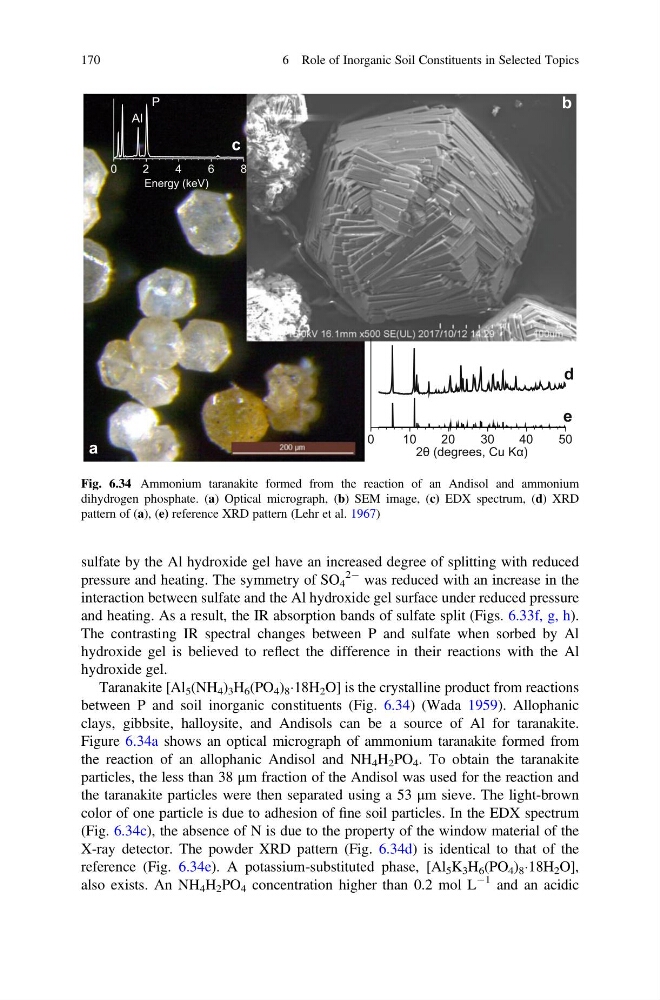
between P and soil inorganic constituents (Fig. 6.34) (Wada 1959). Allophanic
clays, gibbsite, halloysite, and Andisols can be a source of Al for taranakite.
Figure 6.34a shows an optical micrograph of ammonium taranakite formed from
the reaction of an allophanic Andisol and NH 4 H 2 PO 4 . To obtain the taranakite
particles, the less than 38 μm fraction of the Andisol was used for the reaction and
the taranakite particles were then separated using a 53 μm sieve. The light-brown
color of one particle is due to adhesion of fine soil particles. In the EDX spectrum
(Fig. 6.34c), the absence of N is due to the property of the window material of the
X-ray detector. The powder XRD pattern (Fig. 6.34d) is identical to that of the
reference (Fig. 6.34e). A potassium-substituted phase, [Al 5 K 3 H 6 (PO 4 ) 8 Á18H 2 O],
also exists. An NH 4 H 2 PO 4 concentration higher than 0.2 mol L
À1 and an acidic
0
10
20
30
40
50
0
2
4
6
8
Energy (keV)
P
Al
a
b
c
d
e
2θ (degrees, Cu Kα)
Fig. 6.34 Ammonium taranakite formed from the reaction of an Andisol and ammonium
dihydrogen phosphate. (a) Optical micrograph, (b) SEM image, (c) EDX spectrum, (d) XRD
pattern of (a), (e) reference XRD pattern (Lehr et al. 1967)
170
6 Role of Inorganic Soil Constituents in Selected Topics
pressure and heating. The symmetry of SO 4
2À was reduced with an increase in the
interaction between sulfate and the Al hydroxide gel surface under reduced pressure
and heating. As a result, the IR absorption bands of sulfate split (Figs. 6.33f, g, h).
The contrasting IR spectral changes between P and sulfate when sorbed by Al
hydroxide gel is believed to reflect the difference in their reactions with the Al
hydroxide gel.
Taranakite [Al 5 (NH 4 ) 3 H 6 (PO 4 ) 8 Á18H 2 O] is the crystalline product from reactions
between P and soil inorganic constituents (Fig. 6.34) (Wada 1959). Allophanic
clays, gibbsite, halloysite, and Andisols can be a source of Al for taranakite.
Figure 6.34a shows an optical micrograph of ammonium taranakite formed from
the reaction of an allophanic Andisol and NH 4 H 2 PO 4 . To obtain the taranakite
particles, the less than 38 μm fraction of the Andisol was used for the reaction and
the taranakite particles were then separated using a 53 μm sieve. The light-brown
color of one particle is due to adhesion of fine soil particles. In the EDX spectrum
(Fig. 6.34c), the absence of N is due to the property of the window material of the
X-ray detector. The powder XRD pattern (Fig. 6.34d) is identical to that of the
reference (Fig. 6.34e). A potassium-substituted phase, [Al 5 K 3 H 6 (PO 4 ) 8 Á18H 2 O],
also exists. An NH 4 H 2 PO 4 concentration higher than 0.2 mol L
À1 and an acidic
0
10
20
30
40
50
0
2
4
6
8
Energy (keV)
P
Al
a
b
c
d
e
2θ (degrees, Cu Kα)
Fig. 6.34 Ammonium taranakite formed from the reaction of an Andisol and ammonium
dihydrogen phosphate. (a) Optical micrograph, (b) SEM image, (c) EDX spectrum, (d) XRD
pattern of (a), (e) reference XRD pattern (Lehr et al. 1967)
170
6 Role of Inorganic Soil Constituents in Selected Topics