

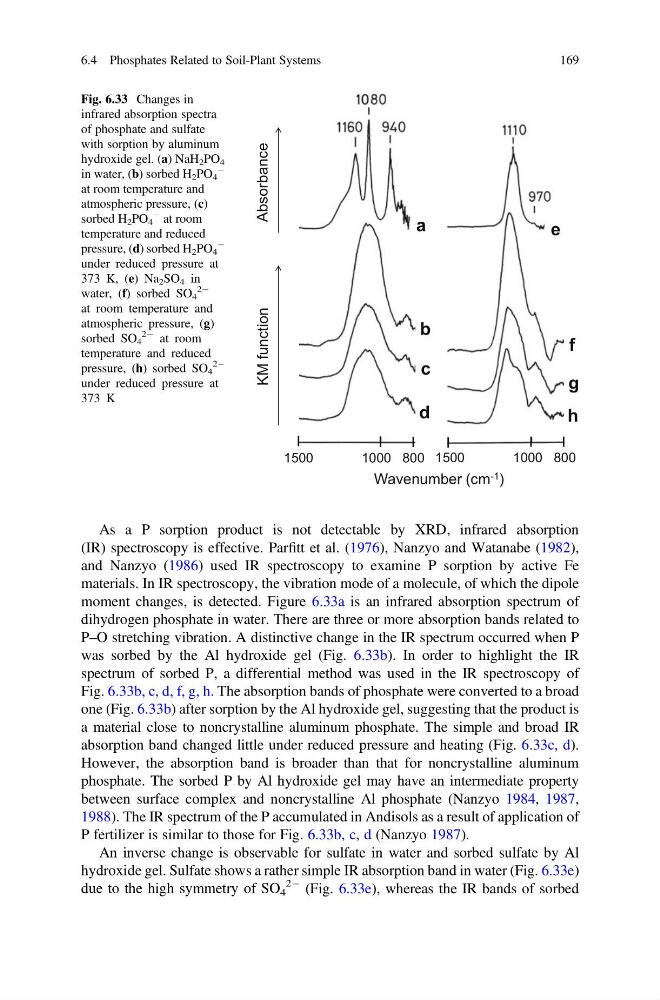
As a P sorption product is not detectable by XRD, infrared absorption
(IR) spectroscopy is effective. Parfitt et al. (1976), Nanzyo and Watanabe (1982),
and Nanzyo (1986) used IR spectroscopy to examine P sorption by active Fe
materials. In IR spectroscopy, the vibration mode of a molecule, of which the dipole
moment changes, is detected. Figure 6.33a is an infrared absorption spectrum of
dihydrogen phosphate in water. There are three or more absorption bands related to
P–O stretching vibration. A distinctive change in the IR spectrum occurred when P
was sorbed by the Al hydroxide gel (Fig. 6.33b). In order to highlight the IR
spectrum of sorbed P, a differential method was used in the IR spectroscopy of
Fig. 6.33b, c, d, f, g, h. The absorption bands of phosphate were converted to a broad
one (Fig. 6.33b) after sorption by the Al hydroxide gel, suggesting that the product is
a material close to noncrystalline aluminum phosphate. The simple and broad IR
absorption band changed little under reduced pressure and heating (Fig. 6.33c, d).
However, the absorption band is broader than that for noncrystalline aluminum
phosphate. The sorbed P by Al hydroxide gel may have an intermediate property
between surface complex and noncrystalline Al phosphate (Nanzyo 1984, 1987,
1988). The IR spectrum of the P accumulated in Andisols as a result of application of
P fertilizer is similar to those for Fig. 6.33b, c, d (Nanzyo 1987).
An inverse change is observable for sulfate in water and sorbed sulfate by Al
hydroxide gel. Sulfate shows a rather simple IR absorption band in water (Fig. 6.33e)
due to the high symmetry of SO 4
2À (Fig. 6.33e), whereas the IR bands of sorbed
1500
1000 800 1500
1000 800
a
b
c
d
e
f
g
h
Wavenumber (cm -1 )
Absorbance
KM function
Fig. 6.33 Changes in
infrared absorption spectra
of phosphate and sulfate
with sorption by aluminum
hydroxide gel. (a) NaH 2 PO 4
in water, (b) sorbed H 2 PO 4
À
at room temperature and
atmospheric pressure, (c)
sorbed H 2 PO 4
À at room
temperature and reduced
pressure, (d) sorbed H 2 PO 4
À
under reduced pressure at
373 K, (e) Na 2 SO 4 in
water, (f) sorbed SO 4
2À
at room temperature and
atmospheric pressure, (g)
sorbed SO 4
2À at room
temperature and reduced
pressure, (h) sorbed SO 4
2À
under reduced pressure at
373 K
6.4 Phosphates Related to Soil-Plant Systems
169
(IR) spectroscopy is effective. Parfitt et al. (1976), Nanzyo and Watanabe (1982),
and Nanzyo (1986) used IR spectroscopy to examine P sorption by active Fe
materials. In IR spectroscopy, the vibration mode of a molecule, of which the dipole
moment changes, is detected. Figure 6.33a is an infrared absorption spectrum of
dihydrogen phosphate in water. There are three or more absorption bands related to
P–O stretching vibration. A distinctive change in the IR spectrum occurred when P
was sorbed by the Al hydroxide gel (Fig. 6.33b). In order to highlight the IR
spectrum of sorbed P, a differential method was used in the IR spectroscopy of
Fig. 6.33b, c, d, f, g, h. The absorption bands of phosphate were converted to a broad
one (Fig. 6.33b) after sorption by the Al hydroxide gel, suggesting that the product is
a material close to noncrystalline aluminum phosphate. The simple and broad IR
absorption band changed little under reduced pressure and heating (Fig. 6.33c, d).
However, the absorption band is broader than that for noncrystalline aluminum
phosphate. The sorbed P by Al hydroxide gel may have an intermediate property
between surface complex and noncrystalline Al phosphate (Nanzyo 1984, 1987,
1988). The IR spectrum of the P accumulated in Andisols as a result of application of
P fertilizer is similar to those for Fig. 6.33b, c, d (Nanzyo 1987).
An inverse change is observable for sulfate in water and sorbed sulfate by Al
hydroxide gel. Sulfate shows a rather simple IR absorption band in water (Fig. 6.33e)
due to the high symmetry of SO 4
2À (Fig. 6.33e), whereas the IR bands of sorbed
1500
1000 800 1500
1000 800
a
b
c
d
e
f
g
h
Wavenumber (cm -1 )
Absorbance
KM function
Fig. 6.33 Changes in
infrared absorption spectra
of phosphate and sulfate
with sorption by aluminum
hydroxide gel. (a) NaH 2 PO 4
in water, (b) sorbed H 2 PO 4
À
at room temperature and
atmospheric pressure, (c)
sorbed H 2 PO 4
À at room
temperature and reduced
pressure, (d) sorbed H 2 PO 4
À
under reduced pressure at
373 K, (e) Na 2 SO 4 in
water, (f) sorbed SO 4
2À
at room temperature and
atmospheric pressure, (g)
sorbed SO 4
2À at room
temperature and reduced
pressure, (h) sorbed SO 4
2À
under reduced pressure at
373 K
6.4 Phosphates Related to Soil-Plant Systems
169