

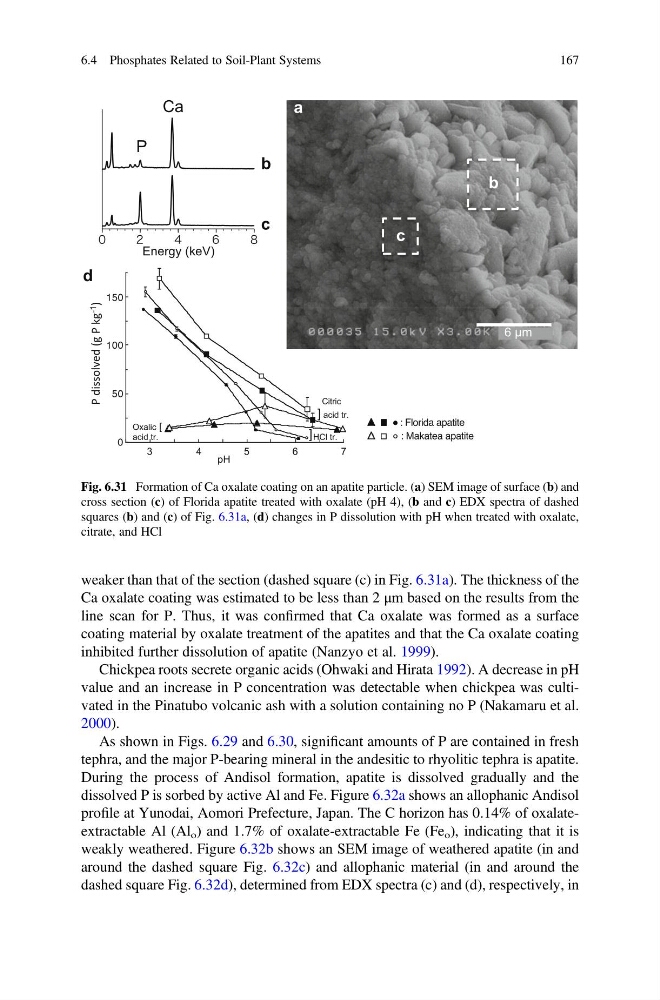
weaker than that of the section (dashed square (c) in Fig. 6.31a). The thickness of the
Ca oxalate coating was estimated to be less than 2 μm based on the results from the
line scan for P. Thus, it was confirmed that Ca oxalate was formed as a surface
coating material by oxalate treatment of the apatites and that the Ca oxalate coating
inhibited further dissolution of apatite (Nanzyo et al. 1999).
Chickpea roots secrete organic acids (Ohwaki and Hirata 1992). A decrease in pH
value and an increase in P concentration was detectable when chickpea was cultivated in the Pinatubo volcanic ash with a solution containing no P (Nakamaru et al.
2000).
As shown in Figs. 6.29 and 6.30, significant amounts of P are contained in fresh
tephra, and the major P-bearing mineral in the andesitic to rhyolitic tephra is apatite.
During the process of Andisol formation, apatite is dissolved gradually and the
dissolved P is sorbed by active Al and Fe. Figure 6.32a shows an allophanic Andisol
profile at Yunodai, Aomori Prefecture, Japan. The C horizon has 0.14% of oxalateextractable Al (Al o ) and 1.7% of oxalate-extractable Fe (Fe o ), indicating that it is
weakly weathered. Figure 6.32b shows an SEM image of weathered apatite (in and
around the dashed square Fig. 6.32c) and allophanic material (in and around the
dashed square Fig. 6.32d), determined from EDX spectra (c) and (d), respectively, in
P dissolved (g P kg -1
)
a
b
c
b
c
d
P
Ca
Energy (keV)
6 μm
Fig. 6.31 Formation of Ca oxalate coating on an apatite particle. (a) SEM image of surface (b) and
cross section (c) of Florida apatite treated with oxalate (pH 4), (b and c) EDX spectra of dashed
squares (b) and (c) of Fig. 6.31a, (d) changes in P dissolution with pH when treated with oxalate,
citrate, and HCl
6.4 Phosphates Related to Soil-Plant Systems
167
Ca oxalate coating was estimated to be less than 2 μm based on the results from the
line scan for P. Thus, it was confirmed that Ca oxalate was formed as a surface
coating material by oxalate treatment of the apatites and that the Ca oxalate coating
inhibited further dissolution of apatite (Nanzyo et al. 1999).
Chickpea roots secrete organic acids (Ohwaki and Hirata 1992). A decrease in pH
value and an increase in P concentration was detectable when chickpea was cultivated in the Pinatubo volcanic ash with a solution containing no P (Nakamaru et al.
2000).
As shown in Figs. 6.29 and 6.30, significant amounts of P are contained in fresh
tephra, and the major P-bearing mineral in the andesitic to rhyolitic tephra is apatite.
During the process of Andisol formation, apatite is dissolved gradually and the
dissolved P is sorbed by active Al and Fe. Figure 6.32a shows an allophanic Andisol
profile at Yunodai, Aomori Prefecture, Japan. The C horizon has 0.14% of oxalateextractable Al (Al o ) and 1.7% of oxalate-extractable Fe (Fe o ), indicating that it is
weakly weathered. Figure 6.32b shows an SEM image of weathered apatite (in and
around the dashed square Fig. 6.32c) and allophanic material (in and around the
dashed square Fig. 6.32d), determined from EDX spectra (c) and (d), respectively, in
P dissolved (g P kg -1
)
a
b
c
b
c
d
P
Ca
Energy (keV)
6 μm
Fig. 6.31 Formation of Ca oxalate coating on an apatite particle. (a) SEM image of surface (b) and
cross section (c) of Florida apatite treated with oxalate (pH 4), (b and c) EDX spectra of dashed
squares (b) and (c) of Fig. 6.31a, (d) changes in P dissolution with pH when treated with oxalate,
citrate, and HCl
6.4 Phosphates Related to Soil-Plant Systems
167