

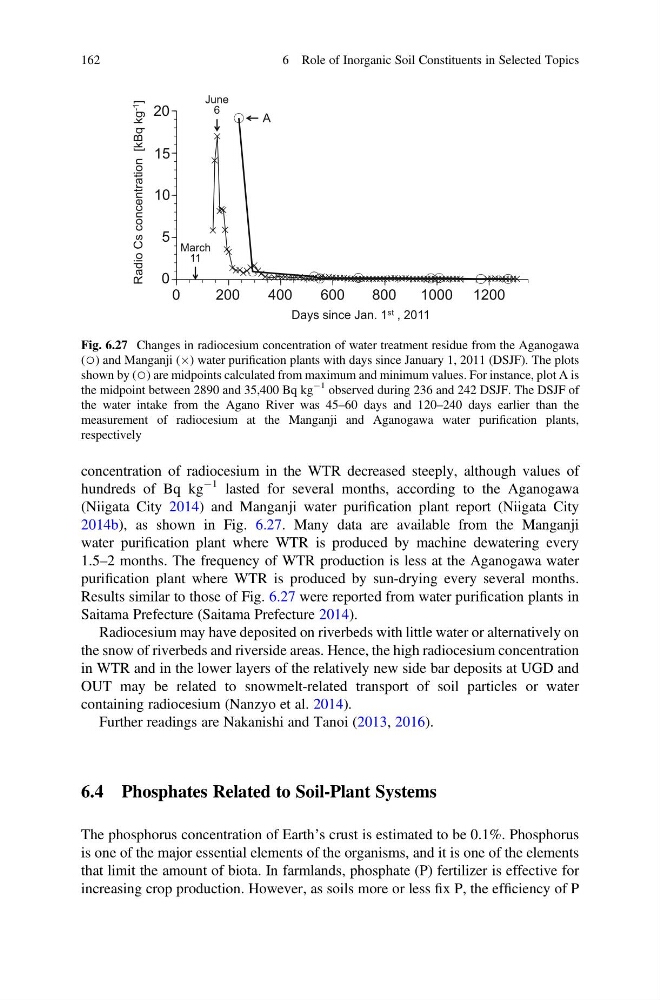
concentration of radiocesium in the WTR decreased steeply, although values of
hundreds of Bq kg
À1 lasted for several months, according to the Aganogawa
(Niigata City 2014) and Manganji water purification plant report (Niigata City
2014b), as shown in Fig. 6.27. Many data are available from the Manganji
water purification plant where WTR is produced by machine dewatering every
1.5–2 months. The frequency of WTR production is less at the Aganogawa water
purification plant where WTR is produced by sun-drying every several months.
Results similar to those of Fig. 6.27 were reported from water purification plants in
Saitama Prefecture (Saitama Prefecture 2014).
Radiocesium may have deposited on riverbeds with little water or alternatively on
the snow of riverbeds and riverside areas. Hence, the high radiocesium concentration
in WTR and in the lower layers of the relatively new side bar deposits at UGD and
OUT may be related to snowmelt-related transport of soil particles or water
containing radiocesium (Nanzyo et al. 2014).
Further readings are Nakanishi and Tanoi (2013, 2016).
6.4 Phosphates Related to Soil-Plant Systems
The phosphorus concentration of Earth’s crust is estimated to be 0.1%. Phosphorus
is one of the major essential elements of the organisms, and it is one of the elements
that limit the amount of biota. In farmlands, phosphate (P) fertilizer is effective for
increasing crop production. However, as soils more or less fix P, the efficiency of P
20
15
10
5
0
Days since Jan. 1 st , 2011
Radio Cs concentration [kBq kg -1
]
June
6
A
March
11
Fig. 6.27 Changes in radiocesium concentration of water treatment residue from the Aganogawa
(○) and Manganji (Â) water purification plants with days since January 1, 2011 (DSJF). The plots
shown by (○) are midpoints calculated from maximum and minimum values. For instance, plot A is
the midpoint between 2890 and 35,400 Bq kg
À1 observed during 236 and 242 DSJF. The DSJF of
the water intake from the Agano River was 45–60 days and 120–240 days earlier than the
measurement of radiocesium at the Manganji and Aganogawa water purification plants,
respectively
162
6 Role of Inorganic Soil Constituents in Selected Topics
hundreds of Bq kg
À1 lasted for several months, according to the Aganogawa
(Niigata City 2014) and Manganji water purification plant report (Niigata City
2014b), as shown in Fig. 6.27. Many data are available from the Manganji
water purification plant where WTR is produced by machine dewatering every
1.5–2 months. The frequency of WTR production is less at the Aganogawa water
purification plant where WTR is produced by sun-drying every several months.
Results similar to those of Fig. 6.27 were reported from water purification plants in
Saitama Prefecture (Saitama Prefecture 2014).
Radiocesium may have deposited on riverbeds with little water or alternatively on
the snow of riverbeds and riverside areas. Hence, the high radiocesium concentration
in WTR and in the lower layers of the relatively new side bar deposits at UGD and
OUT may be related to snowmelt-related transport of soil particles or water
containing radiocesium (Nanzyo et al. 2014).
Further readings are Nakanishi and Tanoi (2013, 2016).
6.4 Phosphates Related to Soil-Plant Systems
The phosphorus concentration of Earth’s crust is estimated to be 0.1%. Phosphorus
is one of the major essential elements of the organisms, and it is one of the elements
that limit the amount of biota. In farmlands, phosphate (P) fertilizer is effective for
increasing crop production. However, as soils more or less fix P, the efficiency of P
20
15
10
5
0
Days since Jan. 1 st , 2011
Radio Cs concentration [kBq kg -1
]
June
6
A
March
11
Fig. 6.27 Changes in radiocesium concentration of water treatment residue from the Aganogawa
(○) and Manganji (Â) water purification plants with days since January 1, 2011 (DSJF). The plots
shown by (○) are midpoints calculated from maximum and minimum values. For instance, plot A is
the midpoint between 2890 and 35,400 Bq kg
À1 observed during 236 and 242 DSJF. The DSJF of
the water intake from the Agano River was 45–60 days and 120–240 days earlier than the
measurement of radiocesium at the Manganji and Aganogawa water purification plants,
respectively
162
6 Role of Inorganic Soil Constituents in Selected Topics