

sank by several tens of centimeters due to the earthquake. In these areas, dikes,
drainage, and the pumping system should be restored.
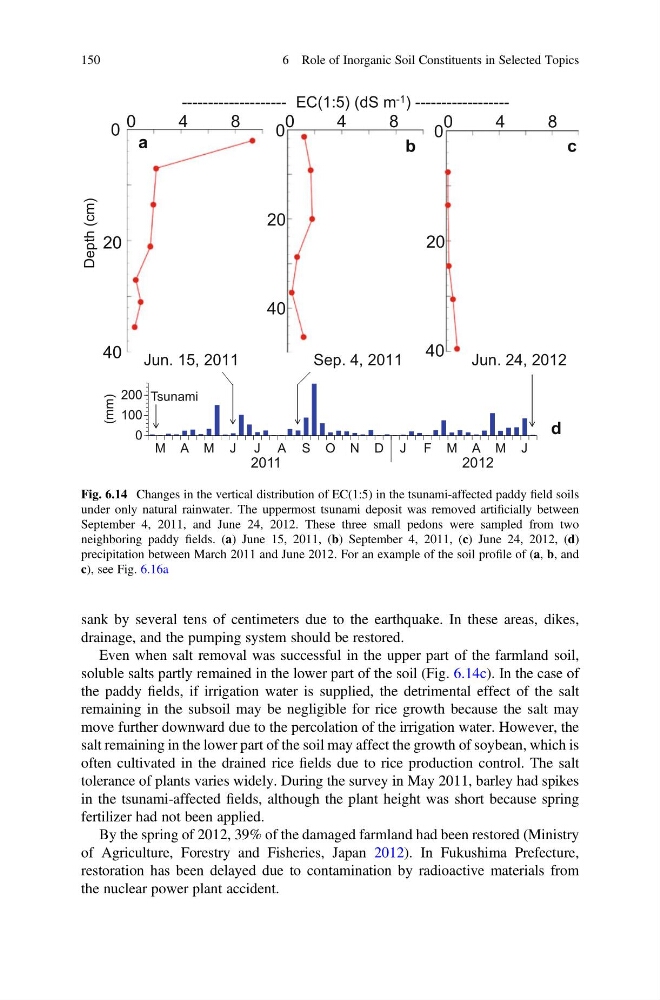
Even when salt removal was successful in the upper part of the farmland soil,
soluble salts partly remained in the lower part of the soil (Fig. 6.14c). In the case of
the paddy fields, if irrigation water is supplied, the detrimental effect of the salt
remaining in the subsoil may be negligible for rice growth because the salt may
move further downward due to the percolation of the irrigation water. However, the
salt remaining in the lower part of the soil may affect the growth of soybean, which is
often cultivated in the drained rice fields due to rice production control. The salt
tolerance of plants varies widely. During the survey in May 2011, barley had spikes
in the tsunami-affected fields, although the plant height was short because spring
fertilizer had not been applied.
By the spring of 2012, 39% of the damaged farmland had been restored (Ministry
of Agriculture, Forestry and Fisheries, Japan 2012). In Fukushima Prefecture,
restoration has been delayed due to contamination by radioactive materials from
the nuclear power plant accident.
0
4
8
0
4
8
0
4
8
-------------------- EC(1:5) (dS m -1 ) -----------------)
m
c
(
h
t
p
e
D
0
20
40
0
20
40
0
20
40
Jun. 15, 2011
Sep. 4, 2011
Jun. 24, 2012
M A M J J A S O N D J F M A M J
0
100
200 Tsunami
d
2011
2012
(mm)
c
b
a
Fig. 6.14 Changes in the vertical distribution of EC(1:5) in the tsunami-affected paddy field soils
under only natural rainwater. The uppermost tsunami deposit was removed artificially between
September 4, 2011, and June 24, 2012. These three small pedons were sampled from two
neighboring paddy fields. (a) June 15, 2011, (b) September 4, 2011, (c) June 24, 2012, (d)
precipitation between March 2011 and June 2012. For an example of the soil profile of (a, b, and
c), see Fig. 6.16a
150
6 Role of Inorganic Soil Constituents in Selected Topics
drainage, and the pumping system should be restored.
Even when salt removal was successful in the upper part of the farmland soil,
soluble salts partly remained in the lower part of the soil (Fig. 6.14c). In the case of
the paddy fields, if irrigation water is supplied, the detrimental effect of the salt
remaining in the subsoil may be negligible for rice growth because the salt may
move further downward due to the percolation of the irrigation water. However, the
salt remaining in the lower part of the soil may affect the growth of soybean, which is
often cultivated in the drained rice fields due to rice production control. The salt
tolerance of plants varies widely. During the survey in May 2011, barley had spikes
in the tsunami-affected fields, although the plant height was short because spring
fertilizer had not been applied.
By the spring of 2012, 39% of the damaged farmland had been restored (Ministry
of Agriculture, Forestry and Fisheries, Japan 2012). In Fukushima Prefecture,
restoration has been delayed due to contamination by radioactive materials from
the nuclear power plant accident.
0
4
8
0
4
8
0
4
8
-------------------- EC(1:5) (dS m -1 ) -----------------)
m
c
(
h
t
p
e
D
0
20
40
0
20
40
0
20
40
Jun. 15, 2011
Sep. 4, 2011
Jun. 24, 2012
M A M J J A S O N D J F M A M J
0
100
200 Tsunami
d
2011
2012
(mm)
c
b
a
Fig. 6.14 Changes in the vertical distribution of EC(1:5) in the tsunami-affected paddy field soils
under only natural rainwater. The uppermost tsunami deposit was removed artificially between
September 4, 2011, and June 24, 2012. These three small pedons were sampled from two
neighboring paddy fields. (a) June 15, 2011, (b) September 4, 2011, (c) June 24, 2012, (d)
precipitation between March 2011 and June 2012. For an example of the soil profile of (a, b, and
c), see Fig. 6.16a
150
6 Role of Inorganic Soil Constituents in Selected Topics