

other words, the pH(H 2 O) value can be close to the pH(KCl) value for samples if the
samples were under restricted drainage.
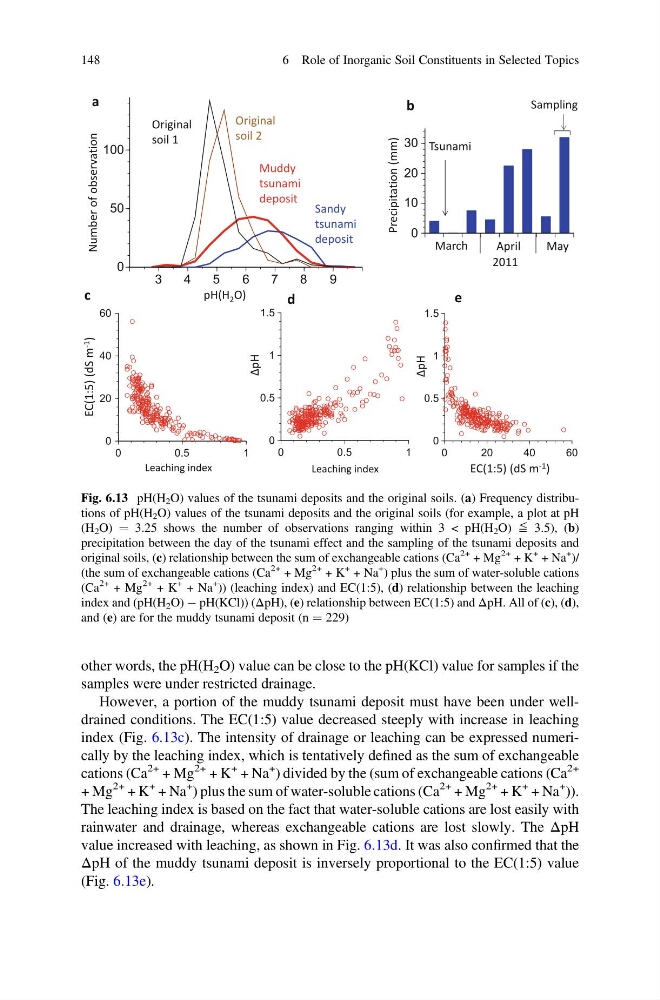
However, a portion of the muddy tsunami deposit must have been under welldrained conditions. The EC(1:5) value decreased steeply with increase in leaching
index (Fig. 6.13c). The intensity of drainage or leaching can be expressed numerically by the leaching index, which is tentatively defined as the sum of exchangeable
cations (Ca
2+ + Mg
2+ + K
+ + Na
+
) divided by the (sum of exchangeable cations (Ca
2+
+ Mg
2+ + K
+ + Na
+
) plus the sum of water-soluble cations (Ca
2+ + Mg
2+ + K
+ + Na
+
)).
The leaching index is based on the fact that water-soluble cations are lost easily with
rainwater and drainage, whereas exchangeable cations are lost slowly. The ΔpH
value increased with leaching, as shown in Fig. 6.13d. It was also confirmed that the
ΔpH of the muddy tsunami deposit is inversely proportional to the EC(1:5) value
(Fig. 6.13e).
0
50
100
3
4
5
6
7
8
9
EC(1:5) (dS m -1 )
ΔpH
EC(1:5) (dS m -1
)
Leaching index
Number of observation
pH(H 2 O)
Muddy
tsunami
deposit
Sandy
tsunami
deposit
Original
soil 1
Original
soil 2
May
April
March
0
10
20
30 Tsunami
Sampling
2011
Precipitation (mm)
a
b
c
d
e
ΔpH
Leaching index
Fig. 6.13 pH(H 2 O) values of the tsunami deposits and the original soils. (a) Frequency distributions of pH(H 2 O) values of the tsunami deposits and the original soils (for example, a plot at pH
(H 2 O) ¼ 3.25 shows the number of observations ranging within 3 < pH(H 2 O) ≦ 3.5), (b)
precipitation between the day of the tsunami effect and the sampling of the tsunami deposits and
original soils, (c) relationship between the sum of exchangeable cations (Ca
2+ + Mg
2+ + K
+ + Na
+ )/
(the sum of exchangeable cations (Ca
2+ + Mg
2+ + K
+ + Na
+ ) plus the sum of water-soluble cations
(Ca
2+ + Mg
2+ + K
+ + Na
+ )) (leaching index) and EC(1:5), (d) relationship between the leaching
index and (pH(H 2 O) À pH(KCl)) (ΔpH), (e) relationship between EC(1:5) and ΔpH. All of (c), (d),
and (e) are for the muddy tsunami deposit (n ¼ 229)
148
6 Role of Inorganic Soil Constituents in Selected Topics
samples were under restricted drainage.
However, a portion of the muddy tsunami deposit must have been under welldrained conditions. The EC(1:5) value decreased steeply with increase in leaching
index (Fig. 6.13c). The intensity of drainage or leaching can be expressed numerically by the leaching index, which is tentatively defined as the sum of exchangeable
cations (Ca
2+ + Mg
2+ + K
+ + Na
+
) divided by the (sum of exchangeable cations (Ca
2+
+ Mg
2+ + K
+ + Na
+
) plus the sum of water-soluble cations (Ca
2+ + Mg
2+ + K
+ + Na
+
)).
The leaching index is based on the fact that water-soluble cations are lost easily with
rainwater and drainage, whereas exchangeable cations are lost slowly. The ΔpH
value increased with leaching, as shown in Fig. 6.13d. It was also confirmed that the
ΔpH of the muddy tsunami deposit is inversely proportional to the EC(1:5) value
(Fig. 6.13e).
0
50
100
3
4
5
6
7
8
9
EC(1:5) (dS m -1 )
ΔpH
EC(1:5) (dS m -1
)
Leaching index
Number of observation
pH(H 2 O)
Muddy
tsunami
deposit
Sandy
tsunami
deposit
Original
soil 1
Original
soil 2
May
April
March
0
10
20
30 Tsunami
Sampling
2011
Precipitation (mm)
a
b
c
d
e
ΔpH
Leaching index
Fig. 6.13 pH(H 2 O) values of the tsunami deposits and the original soils. (a) Frequency distributions of pH(H 2 O) values of the tsunami deposits and the original soils (for example, a plot at pH
(H 2 O) ¼ 3.25 shows the number of observations ranging within 3 < pH(H 2 O) ≦ 3.5), (b)
precipitation between the day of the tsunami effect and the sampling of the tsunami deposits and
original soils, (c) relationship between the sum of exchangeable cations (Ca
2+ + Mg
2+ + K
+ + Na
+ )/
(the sum of exchangeable cations (Ca
2+ + Mg
2+ + K
+ + Na
+ ) plus the sum of water-soluble cations
(Ca
2+ + Mg
2+ + K
+ + Na
+ )) (leaching index) and EC(1:5), (d) relationship between the leaching
index and (pH(H 2 O) À pH(KCl)) (ΔpH), (e) relationship between EC(1:5) and ΔpH. All of (c), (d),
and (e) are for the muddy tsunami deposit (n ¼ 229)
148
6 Role of Inorganic Soil Constituents in Selected Topics