

Analytical results of the tsunami deposits and the underlying original soils are
summarized in Table 6.2. The EC(1:5) values rose with inundation by seawater.
Although the highest EC(1:5) values were observed in the muddy tsunami deposit,
the original soils showed higher EC(1:5) values than the ordinary soils, indicating
that the effects of seawater reached most of the original soil 2. The total C, N, and S
content of the muddy tsunami sediment was higher than the content in the sandy
tsunami deposits and original soils. Water-soluble and exchangeable Ca
2+
, Mg
2+
, K
+
,
and Na
+ content was also high in the muddy tsunami deposit due to the effect of
seawater. The EC(1:5) values were highly correlated with the sum of water-soluble
Ca
2+ + Mg
2+ + K
+ + Na
+ on a positive charge basis. Among the four exchangeable
cations, the exchangeable sodium percentage (ESP) is used as an index of
sodification. In this monograph, the value of 100 times the exchangeable Na divided
by the sum of exchangeable Ca
2+ + Mg
2+ + K
+ + Na
+ on a positive charge basis is
used as ESP. The seawater also affected the pH(H 2 O) values. The mean pH(H 2 O)
values were higher in the muddy and sandy tsunami deposits than in the original soils.
Truog P values were higher in the muddy tsunami deposit than in the other deposits. A
considerable sulfide concentration in some of the muddy tsunami deposits was
suggested from their pH(H 2 O 2 ) value of 3 or less (Shima et al. 2012). These results
are discussed further below.
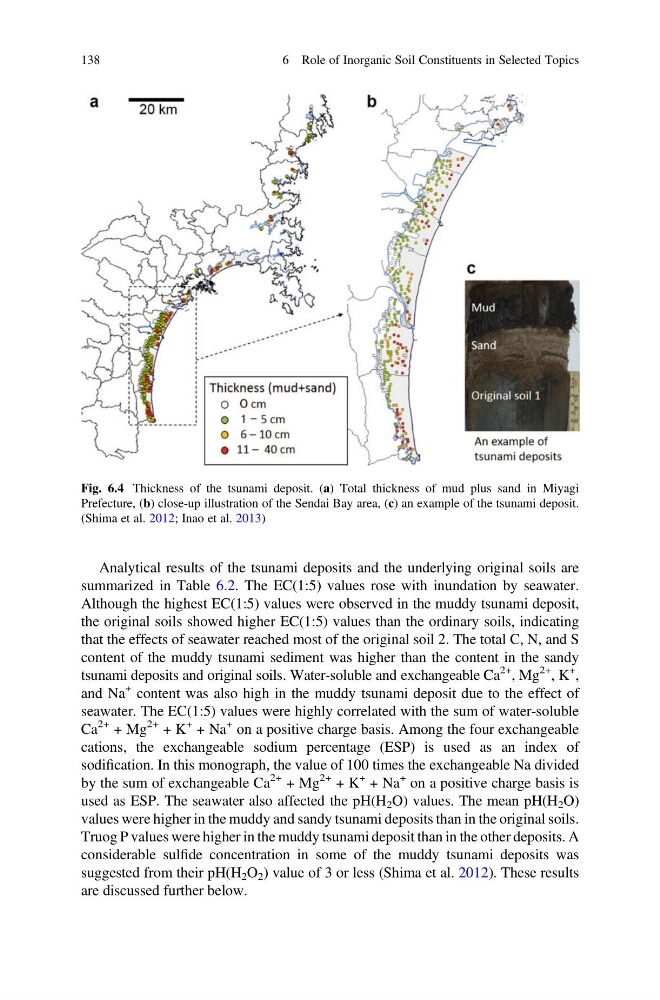
Fig. 6.4 Thickness of the tsunami deposit. (a) Total thickness of mud plus sand in Miyagi
Prefecture, (b) close-up illustration of the Sendai Bay area, (c) an example of the tsunami deposit.
(Shima et al. 2012; Inao et al. 2013)
138
6 Role of Inorganic Soil Constituents in Selected Topics
summarized in Table 6.2. The EC(1:5) values rose with inundation by seawater.
Although the highest EC(1:5) values were observed in the muddy tsunami deposit,
the original soils showed higher EC(1:5) values than the ordinary soils, indicating
that the effects of seawater reached most of the original soil 2. The total C, N, and S
content of the muddy tsunami sediment was higher than the content in the sandy
tsunami deposits and original soils. Water-soluble and exchangeable Ca
2+
, Mg
2+
, K
+
,
and Na
+ content was also high in the muddy tsunami deposit due to the effect of
seawater. The EC(1:5) values were highly correlated with the sum of water-soluble
Ca
2+ + Mg
2+ + K
+ + Na
+ on a positive charge basis. Among the four exchangeable
cations, the exchangeable sodium percentage (ESP) is used as an index of
sodification. In this monograph, the value of 100 times the exchangeable Na divided
by the sum of exchangeable Ca
2+ + Mg
2+ + K
+ + Na
+ on a positive charge basis is
used as ESP. The seawater also affected the pH(H 2 O) values. The mean pH(H 2 O)
values were higher in the muddy and sandy tsunami deposits than in the original soils.
Truog P values were higher in the muddy tsunami deposit than in the other deposits. A
considerable sulfide concentration in some of the muddy tsunami deposits was
suggested from their pH(H 2 O 2 ) value of 3 or less (Shima et al. 2012). These results
are discussed further below.
Fig. 6.4 Thickness of the tsunami deposit. (a) Total thickness of mud plus sand in Miyagi
Prefecture, (b) close-up illustration of the Sendai Bay area, (c) an example of the tsunami deposit.
(Shima et al. 2012; Inao et al. 2013)
138
6 Role of Inorganic Soil Constituents in Selected Topics